Kirjojen hintavertailu. Mukana 12 595 353 kirjaa ja 12 kauppaa.

Kirjailija

Alexander Arnfinn Olsen

Kirjat ja teokset yhdessä paikassa: 57 kirjaa, julkaisuja vuosilta 2022-2026, suosituimpien joukossa Introduction to Ship Engine Room Systems. Vertaile teosten hintoja ja tarkista saatavuus suomalaisista kirjakaupoista.

57 kirjaa

Kirjojen julkaisuhaarukka 2022-2026.

Introduction to Oil Tanker and Gas Carrier Operations

Introduction to Oil Tanker and Gas Carrier Operations

Alexander Arnfinn Olsen

TAYLOR FRANCIS LTD
2024
sidottu
Introduction to Oil Tanker and Gas Carrier Operations introduces the mandatory minimum requirements for training and qualifications for masters, officers and ratings serving on-board liquefied gas tankers. It covers basic safety and pollution-prevention precautions and procedures, layouts of several types of liquefied gas tankers, types of cargo, their hazards and their handling equipment, as well as general operational sequence and liquefied gas tanker terminology.The book is intended for officers and key ratings who have not previously served on board crude oil or liquefied gas tankers as part of the regular ship’s company. It covers the Level 1 training requirements prescribed by Regulation V/1, paragraph 1.2 of the International Convention on Standards of Training, Certification and Watchkeeping for Seafarers, STCW-95.
Maritime Accident and Incident Investigation

Maritime Accident and Incident Investigation

Alexander Arnfinn Olsen

TAYLOR FRANCIS LTD
2023
nidottu
Maritime Accident and Incident Investigation covers a wide range of topics relating to maritime-orientated organisational hazards and risks, as well as root cause analyses and techniques for analysing evidence. Its approach to maritime casualty and incident investigation caters to the unique needs of the maritime industry and covers the human element, machinery and engineering, and structural and security concerns.The book is divided into four parts, which respectively introduce the concepts and theories of organisational risks and hazards; provide a framework structure for planning, initiating, performing, and closing out maritime casualty and incident investigations; provide an overview of the main forms of analyses; and offer a toolkit of forms and documents for preparing and carrying out incident investigations.Features:Focuses on basic principles independent of particular software or protocols, allowing customisation to the reader’s own management system, Health, Safety and Environment (HSE) programmes, or related initiativesSupports the reader in applying class-related activities such as the provisions of the ISM Code and the International Ship and Port Facility Security (ISPS) CodeThe book is ideal for trainees, advanced students, and junior maritime professionals involved in the investigation of maritime accidents and incidents. Also available as online Support Material is a full MaRCIIF Toolkit, containing several resources, such as checklists, forms, and guidelines, useful in the execution of maritime incident investigations. Access the Support Material: www.routledge.com/9781032530239Alexander Arnfinn Olsen is a Senior Consultant at RINA Consulting Defence UK. He is STCW II 1995 qualified and has also worked as a marine training designer, marine auditor, and fisheries observer. He is the author of Introduction to Ship Operations and Onboard Safety, Core Concepts of Maritime Navigation, Introduction to Ship Engine Room Systems, Maritime Cargo Operations, Merchant Ship Types, and Firefighting and Fire Safety Systems on Ships (with Routledge).
Maritime Cargo Operations

Maritime Cargo Operations

Alexander Arnfinn Olsen

TAYLOR FRANCIS LTD
2023
nidottu
Maritime Cargo Operations presents the core concepts of cargo work for marine engineering students and cadets. It is built around the essential principles of the maritime profession and is a valuable guide to a broad range of key subject areas in the safe carriage, handling, stowage and securing of cargo, and cargo watches in port. It contributes to a sound understanding of cargo operations for a future career in the profession, as well as offering a general overview for deck officers. Gives an overview of the key areas in cargo operations work. Includes structured Learning Outcomes and self-test questions for each subject area to assist readers in evaluating their understanding.The book suits merchant navy cadets at Higher National Certificate (HNC), and Higher National Diploma (HND), and foundation degree level in both the deck and engineering branches, and also serves as a general reference for maritime professionals.
Introduction to Ship Engine Room Systems

Introduction to Ship Engine Room Systems

Alexander Arnfinn Olsen

TAYLOR FRANCIS LTD
2023
nidottu
Introduction to Ship Engine Room Systems outlines the key systems, machinery and equipment found in a ship’s engine room. It explores the basics of their function with overall practical guidance for engine room operation and maintenance, recognising emerging environmental challenges. It covers the following topics: The role and function of the steering and propulsion systems Power generation The heating, ventilation, and air conditioning systems The water management system Engine room fires and emergency response systems Engine room watch procedures and checklistsThe book serves as an accessible introductory text for engineering students at HNC, HND, and foundation degree level, marine engineering cadets, and non-engineering marine professionals such as deck officers and cadets who want a general guide to how the engine room functions.
Introduction to Oil Tanker and Gas Carrier Operations

Introduction to Oil Tanker and Gas Carrier Operations

Alexander Arnfinn Olsen

TAYLOR FRANCIS LTD
2026
nidottu
Introduction to Oil Tanker and Gas Carrier Operations introduces the mandatory minimum requirements for training and qualifications for masters, officers and ratings serving on-board liquefied gas tankers. It covers basic safety and pollution-prevention precautions and procedures, layouts of several types of liquefied gas tankers, types of cargo, their hazards and their handling equipment, as well as general operational sequence and liquefied gas tanker terminology. The book is intended for officers and key ratings who have not previously served on board crude oil or liquefied gas tankers as part of the regular ship’s company. It covers the Level 1 training requirements prescribed by Regulation V/1, paragraph 1.2 of the International Convention on Standards of Training, Certification and Watchkeeping for Seafarers, STCW-95.
Dropped Object Prevention on Offshore Facilities and Installations

Dropped Object Prevention on Offshore Facilities and Installations

Alexander Arnfinn Olsen

Springer International Publishing AG
2025
nidottu
The prevention of dropped objects is an important component of safeguarding personnel, property and the maritime environment. This concise book has been developed to provide safety professionals and practitioners with specific guidance and criteria on the development, implementation and management of dropped object prevention programs which corresponds to a growing industry-wide development to mitigate and eliminate the hazards imposed by dropped objects. This book relates to the Class requirements for an onboard dropped object prevention program to be implemented on offshore assets, and provides the design requirements for equipment primary securing, secondary retention methods and securing for specific equipment, etc. This book is intended for use by offshore installation Owners, Operators, and Companies whose intention is to prepare for, and ultimately apply for optional Class notations highlighting the installation's compliance with dropped object safety management. For the benefit of context, the book uses the provisions which relate specifically to the DOPP and DOPP+ notations.
Applying Physical Ergonomics to Modern Ship Design

Applying Physical Ergonomics to Modern Ship Design

Alexander Arnfinn Olsen

Springer International Publishing AG
2025
nidottu
This book combines and summarizes the myriad rules, regulations, guidance, and guidelines that pertain to the human factor element of vessel design and marine operations. With a focus on physical ergonomics, the book is thoroughly researched and draws on the most current Class rules and industry regulations promulgated by the IMO and other organizations. As such, this book serves as a single point of reference for professionals and students involved in human factors and ergonomics at sea.
Means of Access for Enclosed Spaces

Means of Access for Enclosed Spaces

Alexander Arnfinn Olsen

Springer International Publishing AG
2025
sidottu
This book provides critical information relating to the design and construction of means of access onboard marine vessels and platforms, including ladders, walkways and ramps, hatches, and alternative access points. Uniquely, this book highlights the importance of considering human factors and ergonomics in engineering design. In support of the Statutory and IACS guidance, this book has been written to provide graphical illustrations and additional textual clarification of the means of access requirements. The goal is to improve the comprehension and application of the Statutory and IACS guidance. Conceptually, this text presents two levels of means of access guidance. The first provides the base criteria to meet the IMO requirements. The second, and preferred, level of guidance incorporates the application of current ergonomics practices to the means of access requirements. The application of ergonomics to the means of access requirements will enhance levels of safety as well as quality of work by providing appropriate access for survey, inspection and maintenance activities for tanks and holds.
Equipment Conditioning Monitoring and Techniques

Equipment Conditioning Monitoring and Techniques

Alexander Arnfinn Olsen

Springer International Publishing AG
2025
nidottu
This book is a single source of guidance and information relating to condition monitoring techniques when designing, implementing and managing a reliability-centred maintenance programme. The topics addressed in this book include a summary of the types of condition-monitoring techniques used by the marine industry, in addition to guidance on the selection of appropriate technique(s), measurement frequency, personnel skills, company resources, and risk assessment. Through the application of condition-monitoring techniques, vessel owners, onshore managers, and marine asset operators should be able to see improved equipment and system reliability onboard their vessels or other marine installations. Moreover, consideration should be given to enrolling vessels and assets in either a reliability-centred maintenance programme or a preventative maintenance programme to take advantage of the additional cost saving benefits for equipment maintenance together with receiving credit towards Class mandated continuous survey for machinery.
Introduction to Celestial Navigation

Introduction to Celestial Navigation

Alexander Arnfinn Olsen

Springer International Publishing AG
2025
nidottu
This book focuses on Coastal and Ocean Navigation with an emphasis on celestial navigation techniques as a ‘back up’ in the event digital technologies fail.It deals with the main themes and principles of celestial navigation (including time). It covers the syllabus for deck officers working towards the Officer of the Watch (OOW) certificate of competence (COC) awarded by the Maritime and Coastguard Agency (MCA), and for Royal Navy navigation officers working towards achieving the equivalent Navigational Watch Certificate (NWC). The NWC is equivalent to the certificate awarded by the MCA to OOWs in the Merchant Service under the international Standardisation of Training, Certification and Watchkeeping (STCW) agreements. The detailed theory of celestial navigation is provided.
Introduction to Digital Navigation

Introduction to Digital Navigation

Alexander Arnfinn Olsen

Springer International Publishing AG
2025
nidottu
This book focuses on Coastal and Ocean Navigation with an emphasis on digital navigation (using ECDIS) and would be useful to both experienced seafarers as an aide memoire, and also to cadets and trainees embarking on their maritime careers.The text has been developed for modern day ship’s navigator in the ‘digital era’. It is written from the perspective that the reader’s vessel will be navigated using an IMO type-approved electronic chart and display information system (ECDIS) as opposed to traditional chart-based passage planning. As such, the book focuses on the main principles associated with position and direction of the earth's surface, geodesy projects and grids, digital navigation, electronic chart and data information systems, fixing, internal aids to navigation and systems, external aids to navigation, tides and currents, ocean navigation, coastal navigation, pilotage and blind pilotage, anchoring, navigational errors, relative velocity, and bridge organisation and management.
Zustandsüberwachung und Instandhaltungstechniken maritimer Ausrüstung

Zustandsüberwachung und Instandhaltungstechniken maritimer Ausrüstung

Alexander Arnfinn Olsen

Springer Fachmedien Wiesbaden
2025
sidottu
Dieses Buch ist eine umfassende Informationsquelle zu Zustandsüberwachungstechniken bei der Auslegung, Umsetzung und Verwaltung eines auf Zuverlässigkeit ausgerichteten Instandhaltungsprogramms. Die behandelten Themen beinhalten eine Zusammenfassung der in der maritimen Industrie verwendeten Zustandsüberwachungstechniken sowie Hinweise zur Auswahl geeigneter Technik(en), Messhäufigkeit, erforderlicher Fachkenntnisse, Unternehmensressourcen und Risikobewertung. Durch den Einsatz von Zustandsüberwachungstechniken sollen Schiffsbesitzer, On-shore-Manager und Betreiber maritimer Anlagen eine verbesserte Zuverlässigkeit der Ausrüstung und Systeme an Bord ihrer Schiffe oder anderer maritimer Anlagen erreichen. Betreiber sollen ermutigt werden, ihre Schiffe und Anlagen einer zuverlässigkeitsorientierten oder präventiven Instandhaltung zu unterziehen, um von den zusätzlichen Kosteneinsparungen bei der Wartung zu profitieren und gleichzeitig den regelmäßigen Überprüfungen von Klassifikationsgesellschaften zu entsprechen.
Inventory of Hazardous Materials

Inventory of Hazardous Materials

Fidaa Karkori; Alexander Arnfinn Olsen

Springer International Publishing AG
2025
sidottu
This book provides a comprehensive guide to the Inventory of Hazardous Materials (IHM), a critical document for ensuring the safe and environmentally sound recycling of ships. At the heart of this book is the matter of compliance with the Hong Kong International Convention for the Safe and Environmentally Sound Recycling of Ships, which mandates the development and maintenance of an IHM throughout a vessel's lifecycle.The chapters cover topics such as the development, review, and verification of the initial Inventory for new construction vessels, as well as the maintenance and verification processes for vessels in service. Readers will find contributions by renowned experts in marine quality welding, non-destructive testing, radiographic inspection, ultrasonic inspection, and phased array inspection. The authors provide an expert analysis of these techniques through practical case studies and theoretical perspectives.This book is an essential resource for offshore installation managers, senior safety management professionals, academics, and students in industrial design and engineering. It offers invaluable insights into regulatory compliance and best practices in ship recycling. Whether you are a seasoned professional or a student entering the field, this guide will equip you with the knowledge needed to navigate the complexities of hazardous materials management in maritime contexts.
Design and Installation of Drag Anchors and Plate Anchors

Design and Installation of Drag Anchors and Plate Anchors

Alexander Arnfinn Olsen

Springer International Publishing AG
2025
nidottu
This book sheds new light on the design and installation of drag anchors and plate anchors for offshore service. It provides readers with detailed methodologies for geotechnical design, structural assessment, and installation techniques that are crucial for ensuring the safety and reliability of offshore anchorage systems. The chapters cover topics such as site investigation methods, geotechnical design principles, structural assessment methodologies, and installation and testing recommendations. Expert contributors offer insights into taut, semi-taut, and catenary mooring systems. The author presents an expert analysis of classification protocols while recognizing alternative approaches that meet safety standards. This book invites readers to think through critical questions such as: How can we ensure the reliability of offshore anchorage systems? What are the best practices for site investigation? How do we perform accurate structural assessments? Readers will discover diverse perspectives from practitioners in marine engineering. The empirical research presented here addresses both theoretical perspectives and practical case studies. Particular attention is given to methodologies that support or augment Class Rules without replacing them. This makes the book highly readable while maintaining its scientific rigor. Naval architects, marine engineering students, marine surveyors, and offshore industry professionals will find this book invaluable. It serves as an essential reference for academics in industrial design and engineering courses. Offshore installation managers and senior safety management professionals will benefit from its practical guidance on classification protocols for drag and plate type anchors used in the offshore industry. Whether you are a seasoned expert or new to the field, this book offers indispensable knowledge that will enhance your understanding and application of offshore anchorage systems. This volume is part of a series dedicated to advancing knowledge in marine engineering practices. Researchers in the field of offshore industry will find it particularly beneficial for its comprehensive coverage of current methodologies and best practices.
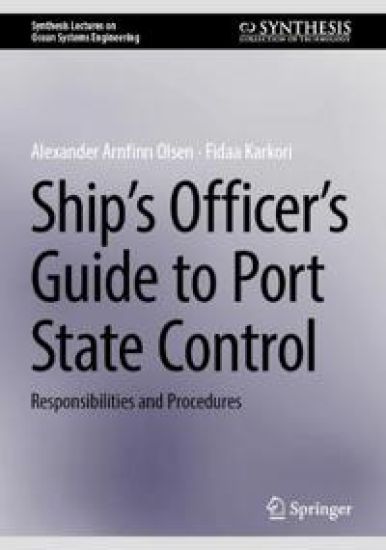
Ship’s Officer’s Guide to Port State Control

Ship’s Officer’s Guide to Port State Control

Alexander Arnfinn Olsen; Fidaa Karkori

Springer International Publishing AG
2025
sidottu
This book is a comprehensive guide to Port State Control (PSC) responsibilities and procedures, offering invaluable insights for maritime professionals. Through this book, readers will learn the intricacies of PSC inspections, contraventions, and detentions, as well as discharge requirements under MARPOL.The chapters cover topics such as the Port State Control regime, conduct of PSC officers, detention of vessels, and detailed inspections for vessel structural and equipment requirements. The authors provide an expert analysis of investigations and inspections under MARPOL Annexes I and II, control of operational requirements, and certification of seafarers. Particular attention is given to the ISM Code and PSC procedures related to LRIT.This essential resource is designed for engineers, maritime professionals, and students in merchant ship operations, maritime law, and port procedures. It offers a clear and unambiguous structure central to safety in safety-critical industries. Whether you are an academic or a practitioner in the field, this book will enhance your understanding of PSC responsibilities and procedures.
Finite Element Method Analysis for Ice Class Vessels

Finite Element Method Analysis for Ice Class Vessels

Alexander Arnfinn Olsen

Springer International Publishing AG
2025
sidottu
This book provides ship designers with clear guidance on alternative design procedures for hull side structures, power requirements, and propeller strength assessment based on the Finite Element Method for Baltic Ice Class Vessels. Through this comprehensive guide, readers will learn the intricacies of designing vessels capable of navigating the harsh ice conditions of the Baltic Sea. The chapters cover topics such as ice strengthening designs using direct calculation approaches, power requirement calculations for ice class vessels, and strength analysis of propellers. The authors present an expert analysis of these critical aspects, offering practical solutions and methodologies that are essential for marine engineers and naval architects. This book is a must-read for anyone involved in the design and construction of ice-class vessels, providing invaluable insights into the latest research and best practices in the field. This guide is indispensable for naval architects, marine engineering students, marine surveyors, and professionals working in maritime defense and shipping registries. It serves as a reference for academics and students in marine design and engineering, as well as a textbook for marine engineering courses. With contributions from experienced practitioners in the field, this book offers both theoretical perspectives and practical case studies that will benefit anyone involved in the design and operation of ice-class vessels.