Kirjojen hintavertailu. Mukana 12 595 353 kirjaa ja 12 kauppaa.

Kirjailija

Alexander E Davis

Kirjat ja teokset yhdessä paikassa: 4 kirjaa, julkaisuja vuosilta 2020-2024, suosituimpien joukossa The Geopolitics of Melting Mountains. Vertaile teosten hintoja ja tarkista saatavuus suomalaisista kirjakaupoista.

Mukana myös kirjoitusasut: Alexander E. Davis

4 kirjaa

Kirjojen julkaisuhaarukka 2020-2024.

The Geopolitics of Melting Mountains

The Geopolitics of Melting Mountains

Alexander E. Davis

SPRINGER VERLAG, SINGAPORE
2024
nidottu
The book addresses the urgent need for rethinking the geopolitics and ecology in the Himalaya, by emphasising the entanglements between these two factors. Most international relations analyses of the Himalaya emphasize the central role of the region’s states and their great power struggles. By reducing the region to its state actors, however, we miss the intense more-than-human diversity of the region, and the crucial role that the mountains play in the global environment. In doing so, the book makes a major contribution to international relations theory by drawing on insights from international political ecology. It first theorises international political ecology and examines the Himalaya as a global region, before moving looking at the international aspects of political ecology in the Himalaya through key areas of the mountains where international politics and ecology are deeply, inextricably linked. It presents three detailed case studies of different environmentaland political issues in the Himalaya: icecaps (the India-China-Pakistan boundary dispute in the western Himalaya), foothills and forests (the Nepal-Bhutan-Sikkim borderlands), and rivers (the India-China Bangladesh dispute over the Brahmaputra River basin). Each case study draws on a mix of source materials including fieldwork, government sources, foreign policy discourse, Himalayan ethnographies, and environmental and ecological sciences scholarship.
The Geopolitics of Melting Mountains

The Geopolitics of Melting Mountains

Alexander E. Davis

SPRINGER VERLAG, SINGAPORE
2023
sidottu
The book addresses the urgent need for rethinking the geopolitics and ecology in the Himalaya, by emphasising the entanglements between these two factors. Most international relations analyses of the Himalaya emphasize the central role of the region’s states and their great power struggles. By reducing the region to its state actors, however, we miss the intense more-than-human diversity of the region, and the crucial role that the mountains play in the global environment. In doing so, the book makes a major contribution to international relations theory by drawing on insights from international political ecology. It first theorises international political ecology and examines the Himalaya as a global region, before moving looking at the international aspects of political ecology in the Himalaya through key areas of the mountains where international politics and ecology are deeply, inextricably linked. It presents three detailed case studies of different environmentaland political issues in the Himalaya: icecaps (the India-China-Pakistan boundary dispute in the western Himalaya), foothills and forests (the Nepal-Bhutan-Sikkim borderlands), and rivers (the India-China Bangladesh dispute over the Brahmaputra River basin). Each case study draws on a mix of source materials including fieldwork, government sources, foreign policy discourse, Himalayan ethnographies, and environmental and ecological sciences scholarship.
The Imperial Discipline

The Imperial Discipline

Alexander E Davis; Vineet Thakur; Peter Vale

Pluto Press
2020
pokkari
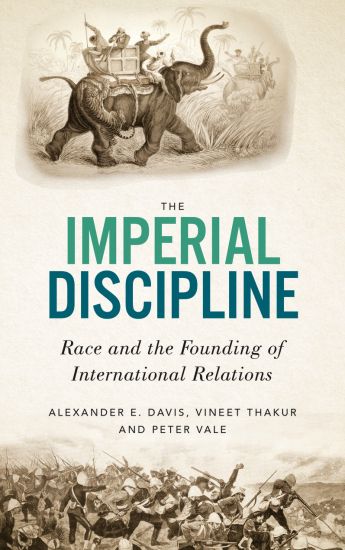
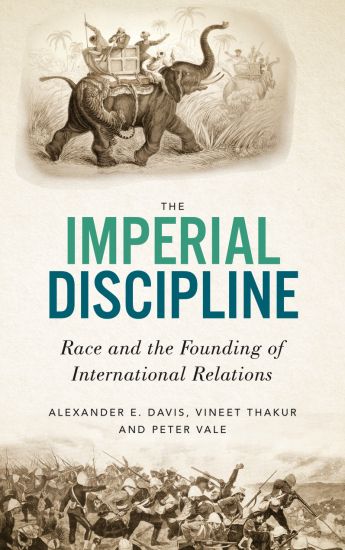
This book questions the accepted origins of the field of International Relations (IR). Commonly understood to have emerged from the horrors of WW1 with the goal of bringing about world peace, the authors argue that on the contrary, IR came from a somewhat less noble tradition – that of the Round Table. The Round Table were a network of imperialists emerging in the late 1800s across five key British imperial societies: Australia, Canada, New Zealand, South Africa and India. Their aim was to improve imperial governance, placing the empire into a position to control world affairs. Although they ultimately failed to rearrange world order according to their vision, they did help to build what we now call the discipline of IR. The Round Table's 'scientific method' for the study of world affairs was rapidly subsumed into each geopolitical context. Through telling this story, the authors recover it, and interrogate its meanings for the discipline of IR today. They show the importance of the Global South to IR's foundations, and argue that IR scholarship in this period was intertwined with imperial racial thought in ways that it should not and cannot forget.
The Imperial Discipline

The Imperial Discipline

Alexander E Davis; Vineet Thakur; Peter Vale

Pluto Press
2020
sidottu
This book questions the accepted origins of the field of International Relations (IR). Commonly understood to have emerged from the horrors of WW1 with the goal of bringing about world peace, the authors argue that on the contrary, IR came from a somewhat less noble tradition – that of the Round Table. The Round Table were a network of imperialists emerging in the late 1800s across five key British imperial societies: Australia, Canada, New Zealand, South Africa and India. Their aim was to improve imperial governance, placing the empire into a position to control world affairs. Although they ultimately failed to rearrange world order according to their vision, they did help to build what we now call the discipline of IR. The Round Table's 'scientific method' for the study of world affairs was rapidly subsumed into each geopolitical context. Through telling this story, the authors recover it, and interrogate its meanings for the discipline of IR today. They show the importance of the Global South to IR's foundations, and argue that IR scholarship in this period was intertwined with imperial racial thought in ways that it should not and cannot forget.