Kirjojen hintavertailu. Mukana 12 595 353 kirjaa ja 12 kauppaa.

Kirjailija

Alexandra Maryanski

Kirjat ja teokset yhdessä paikassa: 13 kirjaa, julkaisuja vuosilta 1993-2024, suosituimpien joukossa Handbook on Evolution and Society. Vertaile teosten hintoja ja tarkista saatavuus suomalaisista kirjakaupoista.

13 kirjaa

Kirjojen julkaisuhaarukka 1993-2024.

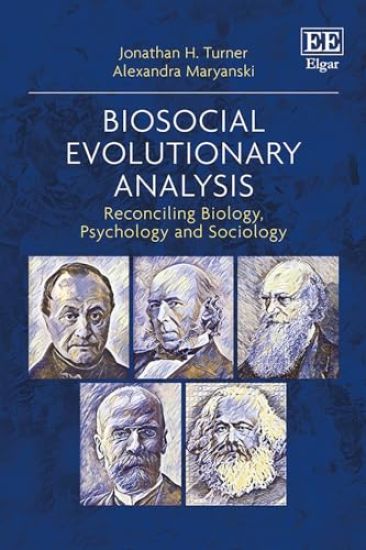
Biosocial Evolutionary Analysis

Biosocial Evolutionary Analysis

Jonathan H. Turner; Alexandra Maryanski

EDWARD ELGAR PUBLISHING LTD
2024
sidottu
This authoritative book proposes a methodological and theoretical strategy for developing sociological explanations of the socio-cultural universe. Jonathan H. Turner and Alexandra Maryanski discuss the problems that persist in explaining the socio-cultural universe using only biological and psychological approaches and outline new strategies for understanding the evolution of human beings and their biological nature.Through exploring human evolution, human nature, human behaviours and patterns of social organisation, Turner and Maryanski demonstrate that evolutionary explanations of behaviours and patterns can be drawn from modern synthesis in biology. They also explain why certain dimensions of the socio-cultural universe can only be understood using purely sociological approaches to evolutionary analysis. They expertly analyse alternative biologically-based strategies for explaining the evolution of human beings and a purely sociological strategy for understanding the emergent properties of human socio-cultural formations.Innovative in its approach, this timely book will be of great interest to scholars interested in the fields of science and technology studies, sociology and sociological theory, cultural sociology, social psychology, and social policy. It will also be highly beneficial to those looking to better understand the optimum methodological strategies for understanding the biology of human nature.
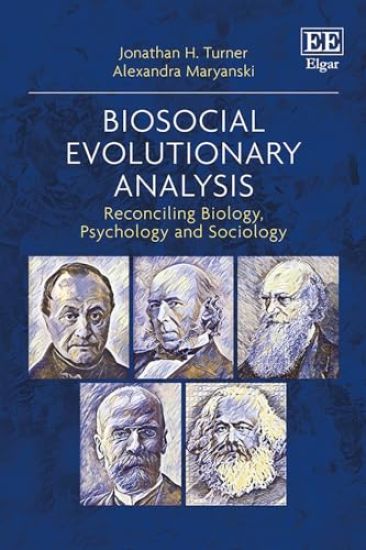
Biosocial Evolutionary Analysis

Biosocial Evolutionary Analysis

Jonathan H. Turner; Alexandra Maryanski

EDWARD ELGAR PUBLISHING LTD
2024
nidottu
This authoritative book proposes a methodological and theoretical strategy for developing sociological explanations of the socio-cultural universe. Jonathan H. Turner and Alexandra Maryanski discuss the problems that persist in explaining the socio-cultural universe using only biological and psychological approaches and outline new strategies for understanding the evolution of human beings and their biological nature.Through exploring human evolution, human nature, human behaviours and patterns of social organisation, Turner and Maryanski demonstrate that evolutionary explanations of behaviours and patterns can be drawn from modern synthesis in biology. They also explain why certain dimensions of the socio-cultural universe can only be understood using purely sociological approaches to evolutionary analysis. They expertly analyse alternative biologically-based strategies for explaining the evolution of human beings and a purely sociological strategy for understanding the emergent properties of human socio-cultural formations.Innovative in its approach, this timely book will be of great interest to scholars interested in the fields of science and technology studies, sociology and sociological theory, cultural sociology, social psychology, and social policy. It will also be highly beneficial to those looking to better understand the optimum methodological strategies for understanding the biology of human nature.
Handbook on Evolution and Society

Handbook on Evolution and Society

Alexandra Maryanski; Richard Machalek; Jonathan H. Turner

TAYLOR FRANCIS INC
2023
nidottu
"Handbook on Evolution and Society" brings together original chapters by prominent scholars who have been instrumental in the revival of evolutionary theorizing and research in the social sciences over the last twenty-five years. Previously unpublished essays provide up-to-date, critical surveys of recent research and key debates. The contributors discuss early challenges posed by sociobiology, the rise of evolutionary psychology, the more conflicted response of evolutionary sociology to sociobiology, and evolutionary psychology. Chapters address the application and limitations of Darwinian ideas in the social sciences. Prominent authors come from a variety of disciplines in ecology, biology, primatology, psychology, sociology, and the humanities. The most comprehensive resource available, this vital collection demonstrates to scholars and students the new ways in which evolutionary approaches, ultimately derived from biology, are influencing the diverse social sciences and humanities.
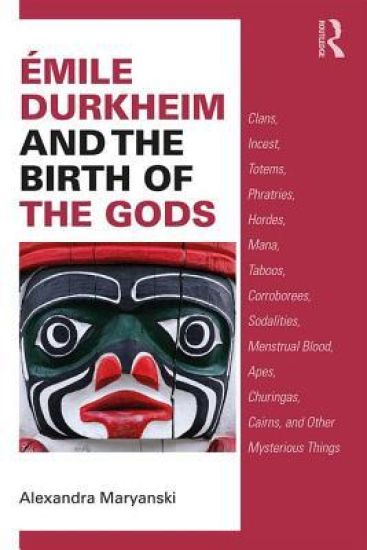
Émile Durkheim and the Birth of the Gods

Émile Durkheim and the Birth of the Gods

Alexandra Maryanski

Routledge
2018
nidottu
The Birth of the Gods is dedicated to Durkheim's effort to understand the basis of social integration. Unlike most social scientists, then and now, Durkheim concluded that humans are naturally more individualistic than collectivistic, that the primal social unit for humans is the macro-level unit ('the horde'), rather than the family, and that social cohesion is easily disrupted by human self-interest. Hence, for Durkheim, one of the "gravest" problems facing sociology is how to mold these human proclivities to serve the collective good. The analysis of elementary religions, Durkheim believed, would allow social scientists to see the fundamental basis of solidarity in human societies, built around collective representations, totems marking sacred forces, and emotion-arousing rituals directed at these totems. The first half of the book traces the key influences and events that led Durkheim to embrace such novel generalizations. The second part makes a significant contribution to sociological theory with an analysis that essentially "tests" Durkheim's core assumptions using cladistic analysis, social network tools and theory, and data on humans closest living relatives—the great apes. Maryanski marshals hard data from primatology, paleontology, archaeology, genetics, and neuroscience that enlightens and, surprisingly, confirms many of Durkheim’s speculations. These data show that integration among both humans and great apes is not so much group or kin oriented, per se, but orientation to a community standing outside each individual that includes a sense of self, but also encompassing a cognitive awareness of a "sense of community" or a connectedness that transcends sensory reality and concrete social relations. This "community complex," as Maryanski terms it, is what Durkheim was beginning to see, although he did not have the data to buttress his arguments as Maryanski is able to do.
Émile Durkheim and the Birth of the Gods

Émile Durkheim and the Birth of the Gods

Alexandra Maryanski

Routledge
2018
sidottu
The Birth of the Gods is dedicated to Durkheim's effort to understand the basis of social integration. Unlike most social scientists, then and now, Durkheim concluded that humans are naturally more individualistic than collectivistic, that the primal social unit for humans is the macro-level unit ('the horde'), rather than the family, and that social cohesion is easily disrupted by human self-interest. Hence, for Durkheim, one of the "gravest" problems facing sociology is how to mold these human proclivities to serve the collective good. The analysis of elementary religions, Durkheim believed, would allow social scientists to see the fundamental basis of solidarity in human societies, built around collective representations, totems marking sacred forces, and emotion-arousing rituals directed at these totems. The first half of the book traces the key influences and events that led Durkheim to embrace such novel generalizations. The second part makes a significant contribution to sociological theory with an analysis that essentially "tests" Durkheim's core assumptions using cladistic analysis, social network tools and theory, and data on humans closest living relatives—the great apes. Maryanski marshals hard data from primatology, paleontology, archaeology, genetics, and neuroscience that enlightens and, surprisingly, confirms many of Durkheim’s speculations. These data show that integration among both humans and great apes is not so much group or kin oriented, per se, but orientation to a community standing outside each individual that includes a sense of self, but also encompassing a cognitive awareness of a "sense of community" or a connectedness that transcends sensory reality and concrete social relations. This "community complex," as Maryanski terms it, is what Durkheim was beginning to see, although he did not have the data to buttress his arguments as Maryanski is able to do.
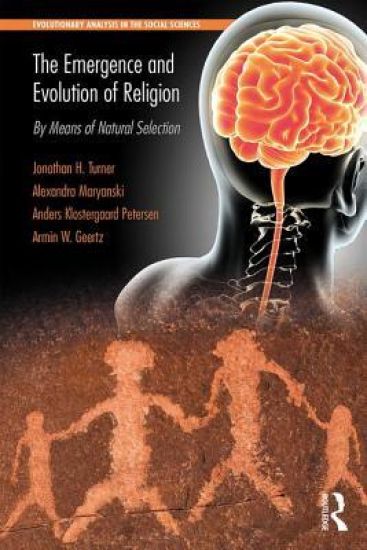
The Emergence and Evolution of Religion

The Emergence and Evolution of Religion

Jonathan Turner; Alexandra Maryanski; Anders Klostergaard Petersen; Armin W. Geertz

Routledge
2017
sidottu
Written by leading theorists and empirical researchers, this book presents new ways of addressing the old question: Why did religion first emerge and then continue to evolve in all human societies? The authors of the book—each with a different background across the social sciences and humanities—assimilate conceptual leads and empirical findings from anthropology, evolutionary biology, evolutionary sociology, neurology, primate behavioral studies, explanations of human interaction and group dynamics, and a wide range of religious scholarship to construct a deeper and more powerful explanation of the origins and subsequent evolutionary development of religions than can currently be found in what is now vast literature. While explaining religion has been a central question in many disciplines for a long time, this book draws upon a much wider array of literature to develop a robust and cross-disciplinary analysis of religion. The book remains true to its subtitle by emphasizing an array of both biological and sociocultural forms of selection dynamics that are fundamental to explaining religion as a universal institution in human societies. In addition to Darwinian selection, which can explain the biology and neurology of religion, the book outlines a set of four additional types of sociocultural natural selection that can fill out the explanation of why religion first emerged as an institutional system in human societies, and why it has continued to evolve over the last 300,000 years of societal evolution. These sociocultural forms of natural selection are labeled by the names of the early sociologists who first emphasized them, and they can be seen as a necessary supplement to the type of natural selection theorized by Charles Darwin. Explanations of religion that remain in the shadow cast by Darwin’s great insights will, it is argued, remain narrow and incomplete when explaining a robust sociocultural phenomenon like religion.
The Emergence and Evolution of Religion

The Emergence and Evolution of Religion

Jonathan Turner; Alexandra Maryanski; Anders Klostergaard Petersen; Armin W. Geertz

Routledge
2017
nidottu
Written by leading theorists and empirical researchers, this book presents new ways of addressing the old question: Why did religion first emerge and then continue to evolve in all human societies? The authors of the book—each with a different background across the social sciences and humanities—assimilate conceptual leads and empirical findings from anthropology, evolutionary biology, evolutionary sociology, neurology, primate behavioral studies, explanations of human interaction and group dynamics, and a wide range of religious scholarship to construct a deeper and more powerful explanation of the origins and subsequent evolutionary development of religions than can currently be found in what is now vast literature. While explaining religion has been a central question in many disciplines for a long time, this book draws upon a much wider array of literature to develop a robust and cross-disciplinary analysis of religion. The book remains true to its subtitle by emphasizing an array of both biological and sociocultural forms of selection dynamics that are fundamental to explaining religion as a universal institution in human societies. In addition to Darwinian selection, which can explain the biology and neurology of religion, the book outlines a set of four additional types of sociocultural natural selection that can fill out the explanation of why religion first emerged as an institutional system in human societies, and why it has continued to evolve over the last 300,000 years of societal evolution. These sociocultural forms of natural selection are labeled by the names of the early sociologists who first emphasized them, and they can be seen as a necessary supplement to the type of natural selection theorized by Charles Darwin. Explanations of religion that remain in the shadow cast by Darwin’s great insights will, it is argued, remain narrow and incomplete when explaining a robust sociocultural phenomenon like religion.
Handbook on Evolution and Society

Handbook on Evolution and Society

Alexandra Maryanski; Richard Machalek; Jonathan H. Turner

Paradigm
2015
sidottu
Handbook on Evolution and Society brings together original chapters by prominent scholars who have been instrumental in the revival of evolutionary theorizing and research in the social sciences over the last twenty-five years. Previously unpublished essays provide up-to-date, critical surveys of recent research and key debates. The contributors discuss early challenges posed by sociobiology, the rise of evolutionary psychology, the more conflicted response of evolutionary sociology to sociobiology, and evolutionary psychology. Chapters address the application and limitations of Darwinian ideas in the social sciences. Prominent authors come from a variety of disciplines in ecology, biology, primatology, psychology, sociology, and the humanities. The most comprehensive resource available, this vital collection demonstrates to scholars and students the new ways in which evolutionary approaches, ultimately derived from biology, are influencing the diverse social sciences and humanities.
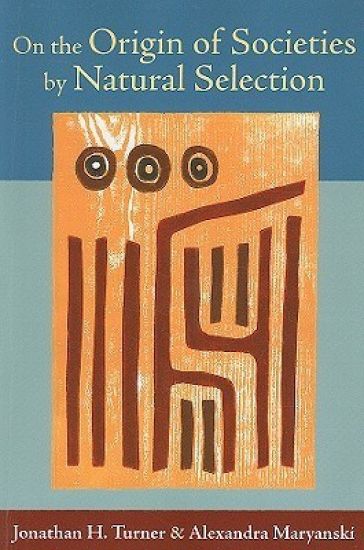
On the Origin of Societies by Natural Selection

On the Origin of Societies by Natural Selection

Jonathan H. Turner; Alexandra Maryanski

Paradigm
2009
nidottu
Kinship, religion, and economy were not "natural" to humans, nor to species of apes that had to survive on the African savanna. Society from its very beginnings involved an uneasy necessity that often stood in conflict with humans' ape ancestry; these tensions only grew along with later, more complex-eventually colossal-sociocultural systems. The ape in us was not extinguished, nor obviated, by culture; indeed, our ancestry continues to place pressures on individuals and their sociocultural creations. Not just an exercise in history, this pathbreaking book dispels many myths about the beginning of society to gain new understandings of the many pressures on societies today.
On the Origin of Societies by Natural Selection

On the Origin of Societies by Natural Selection

Jonathan H. Turner; Alexandra Maryanski

Paradigm
2008
sidottu
Kinship, religion, and economy were not "natural" to humans, nor to species of apes that had to survive on the African savanna. Society from its very beginnings involved an uneasy necessity that often stood in conflict with humans' ape ancestry; these tensions only grew along with later, more complex-eventually colossal-sociocultural systems. The ape in us was not extinguished, nor obviated, by culture; indeed, our ancestry continues to place pressures on individuals and their sociocultural creations. Not just an exercise in history, this pathbreaking book dispels many myths about the beginning of society to gain new understandings of the many pressures on societies today.
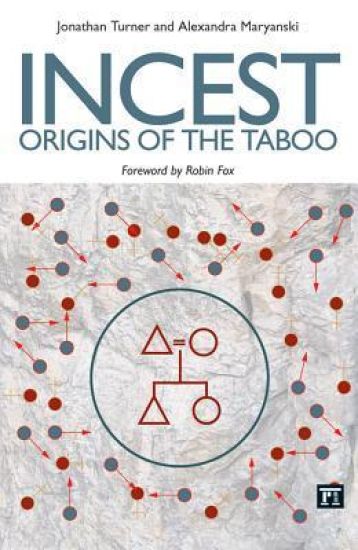
Incest

Incest

Jonathan H. Turner; Alexandra Maryanski

Paradigm
2005
sidottu
Throughout history humans have been fascinated with incest. Stories, fables, literature, philosophers, church officials, and scientists have explored this mysterious topic. The taboo is critical to human survival, as incest threatens the species and patterns of human social organization. Drawing upon the rich legacy of theory, empirical data, and speculation about the origins of the incest taboo, this book develops a new explanation for, not only the emergence of the taboo in hominid and human evolutionary history, but also for the varying strength of the taboo for the incestuous dyads of the nuclear family, the different rates of incest of these dyads, and the dramatic differences the psychological pathology incest has on its younger victims. Synthesizing findings from biology, sociobiology, neurology, primatology, clinical psychology, anthropology, and sociology, the authors weave together a scenario of how natural selection initially generated mechanisms of sexual avoidance; and then, as the nuclear family emerged in hominid and human evolution, how sociocultural selection led to the development of the incest taboo.
Incest

Incest

Jonathan H. Turner; Alexandra Maryanski

Paradigm
2005
nidottu
Throughout history humans have been fascinated with incest. Stories, fables, literature, philosophers, church officials, and scientists have explored this mysterious topic. The taboo is critical to human survival, as incest threatens the species and patterns of human social organization. Drawing upon the rich legacy of theory, empirical data, and speculation about the origins of the incest taboo, this book develops a new explanation for, not only the emergence of the taboo in hominid and human evolutionary history, but also for the varying strength of the taboo for the incestuous dyads of the nuclear family, the different rates of incest of these dyads, and the dramatic differences the psychological pathology incest has on its younger victims. Synthesizing findings from biology, sociobiology, neurology, primatology, clinical psychology, anthropology, and sociology, the authors weave together a scenario of how natural selection initially generated mechanisms of sexual avoidance; and then, as the nuclear family emerged in hominid and human evolution, how sociocultural selection led to the development of the incest taboo.