Kirjojen hintavertailu. Mukana 12 276 916 kirjaa ja 12 kauppaa.

Kirjailija

Alexandra T Evans

Kirjat ja teokset yhdessä paikassa: 10 kirjaa, julkaisuja vuosilta 2021-2024, suosituimpien joukossa A History of the Third Offset, 2014-2018. Vertaile teosten hintoja ja tarkista saatavuus suomalaisista kirjakaupoista.

Mukana myös kirjoitusasut: Alexandra T. Evans

10 kirjaa

Kirjojen julkaisuhaarukka 2021-2024.

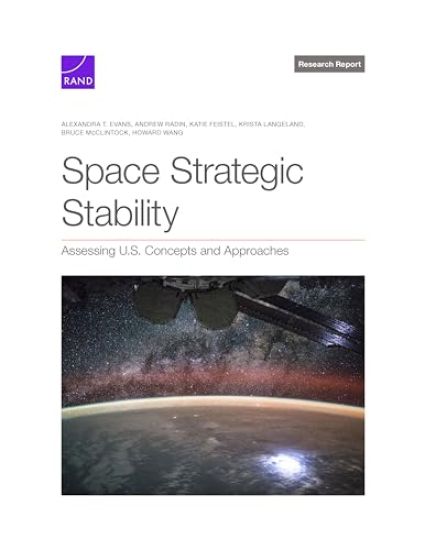
Space Strategic Stability

Space Strategic Stability

Alexandra T Evans; Andrew Radin; Katie Feistel

RAND Corporation
2024
pokkari
Improvements in Russian and Chinese counterspace capabilities could endanger the space-based capabilities that the United States relies on for a broad array of military and economic functions. In this report, the authors examine the conventional wisdom on escalation in the space domain to offer recommendations for how the U.S. Space Force and other stakeholders can better prepare to deter and manage escalation.
Managing Escalation

Managing Escalation

Alexandra T Evans; Emily Ellinger; Jacob L Heim; Nathan Beauchamp-Mustafaga; Zachary Burdette; Lydia Grek

RAND Corporation
2024
pokkari
The return of great-power competition has highlighted the risks of conflict with nuclear-armed great powers. Such a conflict would entail escalation risks that the United States has not seriously considered since the Cold War. Using three historical case studies, the authors examine decisionmakers' ability to identify adversary thresholds and to apply this information to control escalation during militarized crises between nuclear-armed states.
Development as a Tool of Economic Statecraft: A Net Assessment of U.S. and Chinese Approaches

Development as a Tool of Economic Statecraft: A Net Assessment of U.S. and Chinese Approaches

Eric Robinson; Alexandra T. Evans; Raymond Kuo

RAND Corporation
2023
nidottu
In this report, the authors conduct a net assessment of U.S. and Chinese development assistance and cooperation. The authors describe each country's differing approaches to economic engagement with developing countries and conduct a data-driven comparison to identify strategic asymmetries that might present opportunities for the United States to better compete with China for relationships and influence in the developing world.
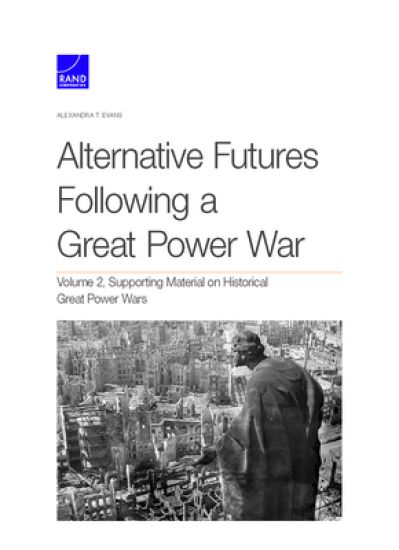
Alternative Futures Following a Great Power War

Alternative Futures Following a Great Power War

Alexandra T Evans

RAND Corporation
2023
pokkari
The Department of Defense is increasingly focused on the possibility of great power war. To inform an analysis of the consequences of such a war, RAND researchers examined ten cases of great power conflict since 1853. This volume describes their findings that prewar predictions about conflict duration, intensity, parties to the conflict, and the post-war world have often been incorrect.
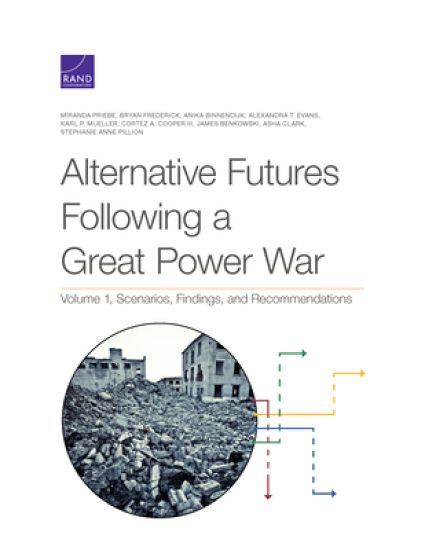
Alternative Futures Following a Great Power War

Alternative Futures Following a Great Power War

Miranda Priebe; Bryan Frederick; Anika Binnendijk; Alexandra T Evans; Karl P Mueller; Cortez A Cooper; James Benkowski; Asha Clark; Stephanie Anne Pillion

RAND Corporation
2023
pokkari
The Department of Defense has become increasingly focused on competition with China and Russia and the possibility of great power war. RAND researchers generated four plausible near-term war scenarios and assessed how they could shape the postwar strategic environment. These scenarios show the complex relationship between wartime and postwar goals, highlighting the importance of considering postwar outcomes in prewar planning.
Future U.S. Peacetime Policy Toward Russia

Future U.S. Peacetime Policy Toward Russia

Miranda Priebe; Bryan Frederick; Alexandra T Evans; Samuel Charap; Gabrielle Tarini; Bryan Rooney

RAND Corporation
2023
pokkari
After the Ukraine war ends, U.S.-Russian relations will remain hostile. But future U.S. policymakers will also need to balance competing demands and might therefore consider a peacetime limited less-hardline approach toward Russia. Using four historical case studies, the authors found that such approaches can lead to durable but narrow gains without emboldening the rival. But such policies may not prevent later deterioration of the relationship.
Staying the Unfavorable Course

Staying the Unfavorable Course

Matthew Sargent; Jason H Campbell; Alexandra T Evans; Caitlin McCulloch; Jordan R Reimer; Richard S Girven

RAND Corporation
2023
pokkari
From 2001 to 2021, despite deteriorating conditions and no apparent hope of military victory, the United States pursued an unchanging policy objective in Afghanistan: to prevent a terrorist group from using the country as a haven in which to plan or launch an attack on the United States. The authors examined the reasons behind this policy inertia through interviews with the senior leaders involved in policy deliberations between 2001 and 2016.
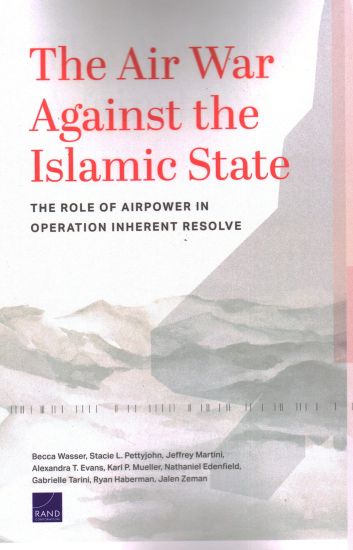
The Air War Against the Islamic State: The Role of Airpower in Operation Inherent Resolve

The Air War Against the Islamic State: The Role of Airpower in Operation Inherent Resolve

Becca Wasser; Stacie L Pettyjohn; Jeffrey Martini; Alexandra T Evans; Karl P Mueller; Nathaniel Edenfield; Gabrielle Tarini; Ryan Haberman; Jalen Zeman

RAND
2021
nidottu
Airpower played a pivotal role in the U.S.-led fight against the Islamic State from 2014 to 2019. This report sheds light on debates about the impact of air operations and how airpower was applied. The authors find that airpower was essential, but it alone would not have been likely to defeat the militant group. Instead, the combination of airpower and partner-led ground forces was needed to destroy the Islamic State as a territorial entity.
A History of the Third Offset, 2014-2018

A History of the Third Offset, 2014-2018

Gian Gentile; Michael Shurkin; Alexandra T Evans; Michelle Grisé; Mark Hvizda; Rebecca Jensen

RAND
2021
nidottu
The authors document the history of the Third Offset, a U.S. strategy that focused on the potential of technology to offset Chinese and Russian military advances and that shaped the 2018 National Defense Strategy. The authors describe efforts to effect change within the U.S. Department of Defense and interview key defense leaders who did so, providing an example of how to bring about organizational change in large military institutions.