Kirjojen hintavertailu. Mukana 12 595 353 kirjaa ja 12 kauppaa.

Kirjailija

Alexandre Guilherme

Kirjat ja teokset yhdessä paikassa: 9 kirjaa, julkaisuja vuosilta 2005-2021, suosituimpien joukossa Global Civilization. Vertaile teosten hintoja ja tarkista saatavuus suomalaisista kirjakaupoista.

9 kirjaa

Kirjojen julkaisuhaarukka 2005-2021.

Ilan Gur-Ze’ev and Education

Ilan Gur-Ze’ev and Education

Alexandre Guilherme

Taylor Francis Ltd
2021
nidottu
Ilan Gur-Ze'ev and Education: Pedagogies of Transformation and Peace critically analyses and introduces the main ideas of Ilan Gur-Ze’ev, reflecting on his continuing theoretical and practical relevance to the field of education. This book offers an accessible, higher-level critical discussion on the thought of Ilan Gur-Ze'ev with an impressive breadth and contemporary focus.The book focuses on Gur-Ze'ev's 'counter-pedagogy' project, which brought him much attention and attempts to establish an alternative and non-dogmatic form of education. Gur Ze'ev's views go against 'critical pedagogy' and 'neoliberalism', because while the former advocates achieving a utopia in which there is no oppression, the latter defends the idea that 'wants and desires' need to be satisfied through a process of 'marketisation'. This book brings to notice Gur-Ze’ev’s concepts of ‘counter-education’ and 'diasporic education' which seek to pursue the truth in everyday life, rather than achieving a utopian goal, or the promised land.This unique and up-to-date monograph will be of great interest for researchers, academics, and postgraduate students in the fields of philosophy of education, theory of education, peace education, Jewish education, neoliberalism, and sociology of education.
Ilan Gur-Ze’ev and Education

Ilan Gur-Ze’ev and Education

Alexandre Guilherme

Routledge
2019
sidottu
Ilan Gur-Ze'ev and Education: Pedagogies of Transformation and Peace critically analyses and introduces the main ideas of Ilan Gur-Ze’ev, reflecting on his continuing theoretical and practical relevance to the field of education. This book offers an accessible, higher-level critical discussion on the thought of Ilan Gur-Ze'ev with an impressive breadth and contemporary focus.The book focuses on Gur-Ze'ev's 'counter-pedagogy' project, which brought him much attention and attempts to establish an alternative and non-dogmatic form of education. Gur Ze'ev's views go against 'critical pedagogy' and 'neoliberalism', because while the former advocates achieving a utopia in which there is no oppression, the latter defends the idea that 'wants and desires' need to be satisfied through a process of 'marketisation'. This book brings to notice Gur-Ze’ev’s concepts of ‘counter-education’ and 'diasporic education' which seek to pursue the truth in everyday life, rather than achieving a utopian goal, or the promised land.This unique and up-to-date monograph will be of great interest for researchers, academics, and postgraduate students in the fields of philosophy of education, theory of education, peace education, Jewish education, neoliberalism, and sociology of education.
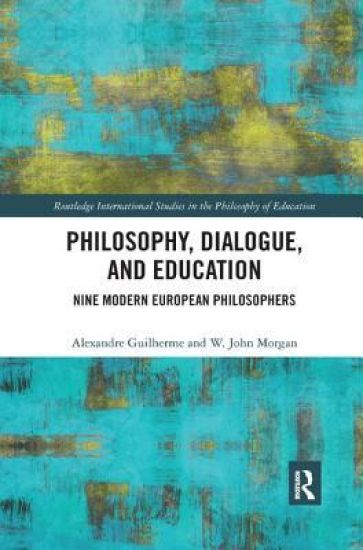
Philosophy, Dialogue, and Education

Philosophy, Dialogue, and Education

Alexandre Guilherme; W. John Morgan

Routledge
2019
nidottu
Philosophy, Dialogue, and Education is an advanced introduction to nine key European social philosophers: Martin Buber, Mikhail Bakhtin, Lev Vygotsky, Hannah Arendt, Emmanuel Levinas, Maurice Merleau-Ponty, Simone Weil, Michael Oakeshott, and Jürgen Habermas. This detailed yet highly readable work positions the socio-political views of each philosopher within a European tradition of dialogical philosophy; and reflects on the continuing theoretical relevance of the work of each to education generally and to critical pedagogy. The discussion in each chapter is informed by materials drawn from various scholarly sources in English and is enriched by materials from other languages, particularly French, German, and Russian. This enhances the comparative European cultural perspective of the book; and connects the work of each philosopher to wider intellectual, political, and social debates. The book will appeal to academics, postgraduates, and researchers working in philosophy, philosophy of education, and in educational, cultural, and social studies more generally. Advanced undergraduate students would also benefit from the book’s discussion of primary sources and the authors’ suggestions for further reading.
Philosophy, Dialogue, and Education

Philosophy, Dialogue, and Education

Alexandre Guilherme; W. John Morgan

Routledge
2017
sidottu
Philosophy, Dialogue, and Education is an advanced introduction to nine key European social philosophers: Martin Buber, Mikhail Bakhtin, Lev Vygotsky, Hannah Arendt, Emmanuel Levinas, Maurice Merleau-Ponty, Simone Weil, Michael Oakeshott, and Jürgen Habermas. This detailed yet highly readable work positions the socio-political views of each philosopher within a European tradition of dialogical philosophy; and reflects on the continuing theoretical relevance of the work of each to education generally and to critical pedagogy. The discussion in each chapter is informed by materials drawn from various scholarly sources in English and is enriched by materials from other languages, particularly French, German, and Russian. This enhances the comparative European cultural perspective of the book; and connects the work of each philosopher to wider intellectual, political, and social debates. The book will appeal to academics, postgraduates, and researchers working in philosophy, philosophy of education, and in educational, cultural, and social studies more generally. Advanced undergraduate students would also benefit from the book’s discussion of primary sources and the authors’ suggestions for further reading.
Buber and Education

Buber and Education

W. John Morgan; Alexandre Guilherme

Routledge
2016
nidottu
Martin Buber (1878-1965) is considered one of the 20th century’s greatest thinkers and his contributions to philosophy, theology and education are testimony to this. His thought is founded on the idea that people are capable of two kinds of relations, namely I-Thou and I-It, emphasising the centrality of dialogue in all spheres of human life. For this reason, Buber is considered by many to be the philosopher of dialogue par excellence. After Buber’s death the appreciation of his considerable legacy to the various disciplines in which he had worked became rather muted, but was never completely forgotten. There is now a renewed and growing interest in Buber’s thought, especially in his philosophy of education. This book brings together aspects of Buber’s philosophy and educational practice, and explains their significance for peace dialogue and for conflict resolution, both between individuals and communities. Buber's philosophy of dialogue and views on education are pivotal in demonstrating the personal and social benefits of dialogical education as well as the dangers of non-dialogical education. The book will be valuable reading for academics, researchers and postgraduate students interested in Martin Buber, education, peace dialogue and conflict resolution.
Buber and Education

Buber and Education

W. John Morgan; Alexandre Guilherme

Routledge
2013
sidottu
Martin Buber (1878-1965) is considered one of the 20th century’s greatest thinkers and his contributions to philosophy, theology and education are testimony to this. His thought is founded on the idea that people are capable of two kinds of relations, namely I-Thou and I-It, emphasising the centrality of dialogue in all spheres of human life. For this reason, Buber is considered by many to be the philosopher of dialogue par excellence. After Buber’s death the appreciation of his considerable legacy to the various disciplines in which he had worked became rather muted, but was never completely forgotten. There is now a renewed and growing interest in Buber’s thought, especially in his philosophy of education. This book brings together aspects of Buber’s philosophy and educational practice, and explains their significance for peace dialogue and for conflict resolution, both between individuals and communities. Buber's philosophy of dialogue and views on education are pivotal in demonstrating the personal and social benefits of dialogical education as well as the dangers of non-dialogical education. The book will be valuable reading for academics, researchers and postgraduate students interested in Martin Buber, education, peace dialogue and conflict resolution.
Global Civilization

Global Civilization

Leonardo Boff; Alexandre Guilherme

Equinox Publishing Ltd
2005
nidottu
Transportation, telecommunications and the internet are all part of a process of globalisation that affects every sphere of life. This new phase in human evolution is central to the thinking of Leonardo Boff - one of the founders of Liberation Theology. In 'Global Civilisation' Boff presents a philosophical and theological enquiry into all aspects of globalization - from market forces to politics, military force, technology and science, communication and spirituality. The book describes the revolution taking place - in consciousness, the meaning of life, holiness, the economy, politics, culture, work standards, and ethics. Boff explores the contribution of Christianity to the "new global civilisation" and presents a utopian future for humankind.
Global Civilization

Global Civilization

Leonardo Boff; Alexandre Guilherme

Equinox Publishing Ltd
2005
sidottu
Transportation, telecommunications and the internet are all part of a process of globalisation that affects every sphere of life. This new phase in human evolution is central to the thinking of Leonardo Boff - one of the founders of Liberation Theology. In 'Global Civilisation' Boff presents a philosophical and theological enquiry into all aspects of globalization - from market forces to politics, military force, technology and science, communication and spirituality. The book describes the revolution taking place - in consciousness, the meaning of life, holiness, the economy, politics, culture, work standards, and ethics. Boff explores the contribution of Christianity to the "new global civilisation" and presents a utopian future for humankind.