

Kirjailija
Alexis De Tocqueville
Kirjat ja teokset yhdessä paikassa: 311 kirjaa, julkaisuja vuosilta 1955-2026, suosituimpien joukossa Democracy in America: Introduction by Alan Ryan. Vertaile teosten hintoja ja tarkista saatavuus suomalaisista kirjakaupoista.
Mukana myös kirjoitusasut: Alexis ?de? Tocqueville
311 kirjaa
Kirjojen julkaisuhaarukka 1955-2026.

In what remains after more than a century the greatest study of American political life, Tocqueville describes American society and accounts for its nature and its conflicts in an historical analysis of the nation's origins among different parties of European settlers. Brilliantly written and vividly illustrated with vignettes and portraits, this is also more than an exploration of one society at one time. Tocqueville's assessment of America is as relevant as it ever was, and his explanation of how democratic societies work can illuminate our own nation now.

Volume 2 of the classic commentary on the influence of democracy on the intellect, feelings, and actions of Americans. With an introduction by Phillips Bradley.
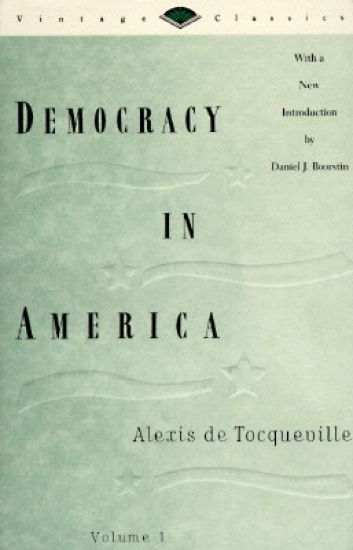
Out of Alex de Tocqueville's travels through the U.S. in the 1830's came an insightful study of a young democracy and its institutions. This 2 volume edition presents Tocqueville's original text. Footnotes, bibliography.
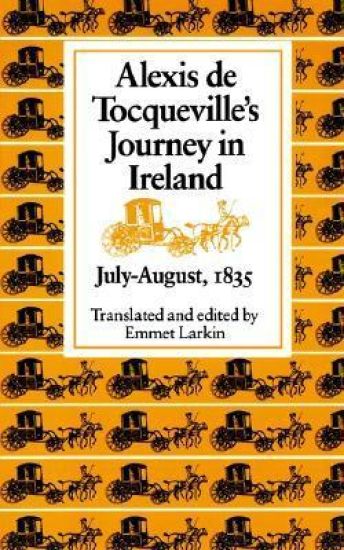
Alexis De Tocqueville's Journey in Ireland, July-August, 1835
Alexis de Tocqueville
The Catholic University of America Press
1990
nidottu
Alexis de Tocqueville visited Ireland in the company of his good friend Gustave de Beaumont in July and August of 1835. At the time of his visit, Tocqueville had just acquired an international reputation with the publication of the first two volumes of his celebrated Democracy in America. His profound interest in the great transition from aristocracy to democracy then taking place in the western world including Ireland was given special point in his observations. Of equal interest to Tocqueville were the problem of poverty, the pace of religion in civil society, and the intriguing ambivalence of the Irish peasant toward the law. The notes on conversations, letters to family, and vivid descriptions Tocqueville wrote on his visit to Ireland bring the problems of pre- and early-famine Ireland into sharp focus.Tocqueville was welcome everywhere, in the mansions of the Protestant bishops and in the simple homes of priests whom he accompanied on their rounds through their parishes. His visits to the poorhouse, the university, the sites of the Assizes and the Office of the Clerk of the Crown of Ireland are among the recorded visits and impressions of his journey. He noted the conditions of the towns and countryside, saw that people starved amid plenty and was told repeatedly that in Ireland the aristocracy made the problems and the poor sustained each other.He recorded conversations in their entirety. He made clear notes on what he saw and heard, often noting his own reactions. The diary and the letters that he wrote to his family about his visit to Ireland provide a rare insight into one of the seminal minds of the nineteenth century.This edition of his journal is perhaps the first serious scholarly effort to place Tocqueville's journey to Ireland in its proper intellectual, geographical, and historical context. The forty-seven episodes, with the exception of three, have been arranged in chronological order according to their occurrence. This volume includes a map of Irish roads originally produced in the atlas accompanying the ""Second Report of the Railway Commissioners, Ireland, 1838.
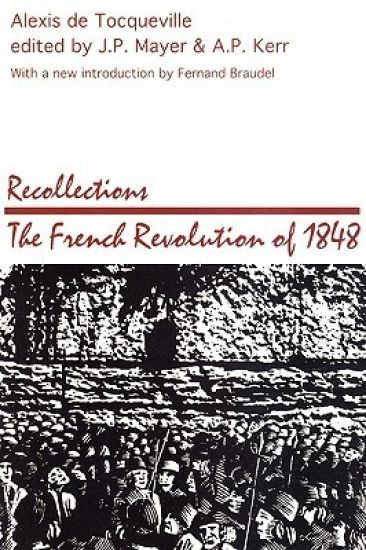
Tocqueville was not only an active participant in the French Revolution of 1848, he was also a deeply perceptive observer with a detached attitude of mind. He saw the pitfalls of the course his country was taking more clearly than any of his contemporaries, including Karl Marx. Recollections was first written for self-clarification. It is both an exciting, candid, behind-the-scenes account of what actually happened during those tumultuous months and a remarkably shrewd analysis that has become an accurate forecast of future societies wrestling with the dilemma of synthesizing equality and freedom. Thus the book has a relevance that extends beyond France, to our own country and others, a relevance that is explored in J.P. Mayer's new introduction.Out of print in English for several years, Recollections is presented here in a translation based on the definitive French edition of 1964. It captures the wit and subtlety of mind that have made this book one of the most popular of all Tocqueville's works. Tocqueville's own comments, which he wrote into the manuscript, including his variants, are given, and the editors have added explanatory notes.
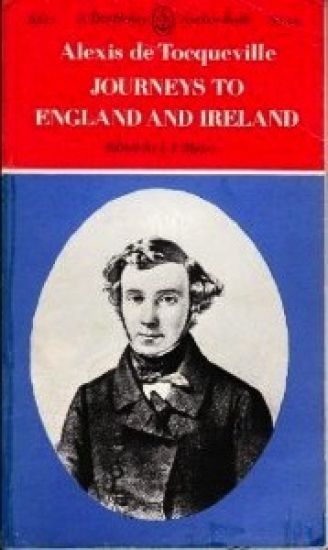
This extraordinary series of observations on England and Ireland complements de Tocqueville's masterpieces on the United States and France in the mid-nineteenth century. These pages are perhaps the most penetrating writings on the spirit of British politics. In effect, as indicated by John Stuart Mill, de Tocqueville was the Montesquieu of the nineteenth century. This is especially the case if one thinks of the present Irish situation. His political acumen reached into the future -which is now our present.
"…boldness of enterprise is the foremost cause of (America's) progress, its strength, and its greatness." With that succinct statement a young French aristocrat, Alexis de Tocqueville, expressed his perceptive analysis of the United States, following a nine-month tour of the young republic beginning in May of 1831. His remarkable two-volume study, Democracy in America, presented an insight that has withstood the test of time to the extent of being described by many scholars as the finest treatise of its kind in the past century and a half. As one of a few companies spanning that period of time, Cooper Industries represents an intriguing mirror for Tocqueville's long-range observations. Boldness of enterprise has indeed been reflected by the efforts of individual entrepreneurs whose companies have come together as Cooper Industries, and many of their names continue to identify successful company products. Among those men were Charles and Elias Cooper, Robert W. Gardner, Huntington B. Crouse, Jesse L. Hinds, Carl E. Weller, Charles W. Kirsch, E.T. Lufkin, William T. Nicholson, and Jacob Wiss. "They (men living in democracies) are therefore all led to engage in commerce, not only for the sake of the profit it holds out to them, but for the love of the constant excitement occasioned by that pursuit," wrote Tocqueville. Were profit the only motive, most of the men who have guided Cooper Industries through the fluctuating business cycles of 150 years would have given up in the depths of economic disasters created by depressions and market shifts. Cooper's growth by no means has been a steady uphill climb; but no reviewer could criticize its history as lacking excitement. Tocqueville contrasted the American "notion of labor" with that of Europeans, writing that, in the United States, "not only is labor not dishonorable among such a people, but it is held in honor; the prejudice is not against it, but in its favor." The history of Cooper Industries is sprinkled liberally with instances of employees rising from beginning "shop floor" jobs to high management positions. Respect for all positions and opportunities for advancement have remained key elements of company philosophy since Cooper was founded in 1833 in Mount Vernon, Ohio, on the edge of a huge, undeveloped frontier.

Das Zeitalter der Gleichheit
Alexis ?de? Tocqueville
Vs Verlag Fur Sozialwissenschaften
1967
nidottu
Alexis de Tocqueville, 1805 geboren, war ein um dreizehn Jahre älterer Zeitgenosse von Karl Marx. Beide beherrschte vom ersten Erwachen ihrer geistigen Regsamkeit an das Bewußtsein, in einer Zeit unerhörter Umwäl zungen aller Prinzipien und aller Bedingungen zu leben, die bis dahin für die Ordnung und den Geist des täglichen Lebens in der menschlichen Ge sellschaft maßgebend gewesen waren. Was die geistige Leidenschaft beider - so ver~chiedenartiger, so entgegengesetzter Menschen - von vornherein fesselte, war die Frage nach der Bedeutung, nach dem Wo-Hinaus dieser Entwicklung und ihr Verlangen, die entscheidenden Momente dieser Ver änderung bestimmen zu können. In der Unmittelbarkeit und Eindringlich keit der Beobachtung, in der Kraft und Schärfe der Analyse und was die grundsätzliche Bedeutung des Aspektes anbetrifft, unter dem sie die Er eignisse ihrer Zeit begriffen, konnte wohl einer dem anderen die Waage halten. Ja, in einer Hinsicht mindestens mochte Tocqueville sogar Marx übertreffen: in dem aufrichtigen Bemühen um vollständige Vorurteils losigkeit und in dem ernsten Bewußtsein der Verantwortung als Mitleben der seiner Zeit. Beide, Marx wie Tocqueville, konstatieren übereinstimmend - wenn auch aus sehr verschiedener Perspektive - zwei entscheidende Merkmale ihrer Zeit: einmal die Tendenz zu einer vollständigen Aufhebung aller gesell schaftlichen Unterscheidung, den Zug zu einer fortschreitenden Gleichheit der Vielen. Und ferner: den zwangsläufigen Charakter dieser Entwick lung, die ihre Antriebe aus der gesamten Vergangenheit und Geistesart des Abendlandes erhält.

On the Penitentiary System in the United States
Gustave De Beaumont; Alexis de Tocqueville; Thorsten (INT) Sellin
Southern Illinois Univ Pr
1964
sidottu

The most important contribution to our understanding of the French Revolution was written almost one hundred years ago by Alexis de Tocqueville.