Kirjojen hintavertailu. Mukana 12 595 353 kirjaa ja 12 kauppaa.

Kirjailija

Ali K. Kamrani

Kirjat ja teokset yhdessä paikassa: 13 kirjaa, julkaisuja vuosilta 2000-2016, suosituimpien joukossa Computer Based Design and Manufacturing. Vertaile teosten hintoja ja tarkista saatavuus suomalaisista kirjakaupoista.

13 kirjaa

Kirjojen julkaisuhaarukka 2000-2016.

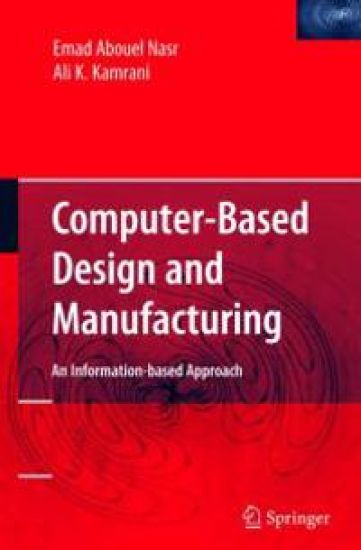
Computer Based Design and Manufacturing

Computer Based Design and Manufacturing

Emad Abouel Nasr; Ali K. Kamrani

Springer-Verlag New York Inc.
2006
sidottu
As industry adopts a consumer focus in its product development strategy, it offers broader product ranges, shorter model lifetimes, and the ability to process orders in arbitrary lot sizes. This offers the ability to conduct early product design and development trade-off analysis among these competing objectives. The use of information technologies and networking capabilities is essential in the dissemination of product knowledge in order to integrate the decision-making process among heterogeneous and distributed partners / units. "Computer-based Design and Manufacturing" offers insights into the methods and techniques that enable implementing a consumer-focused product design philosophy by integrating capabilities for intelligent information support and group decision-making utilizing a common enterprise network model and knowledge interface through shared technologies. The book will be a collection of the latest methods and state-of-the-art technologies in intelligent product and customer focused design. This book will offer: - Discussion of applied methods developed in field of the product design - Latest research results - Discussion on the need and solutions for new engineering paradigm and philosophy required for product design - Coverage of advances in information systems and technology in support of CFPD - Discussion of how to use web-based design environments
Engineering Design and Rapid Prototyping

Engineering Design and Rapid Prototyping

Ali K. Kamrani; Emad Abouel Nasr

Springer-Verlag New York Inc.
2014
nidottu
"Engineering Design and Rapid Prototyping" offers insight into the methods and techniques that allow for easily implementing engineering designs by incorporating advanced methodologies and technologies. This book contains advanced topics such as feature-based design and process planning, modularity and rapid manufacturing, along with a collection of the latest methods and technologies currently being utilized in the field. The volume also: -Provides axiomatic design and solution methodologies for both design and manufacturing -Discusses product life cycle development and analysis for ease of manufacture and assembly -Offers applied methods and technologies in rapid prototyping, tooling and manufacturing "Engineering Design and Rapid Prototyping" will be extremely valuable for any engineers and researchers and students working in engineering design.
Intelligent Transportation and Evacuation Planning

Intelligent Transportation and Evacuation Planning

Arab Naser; Ali K. Kamrani

Springer-Verlag New York Inc.
2014
nidottu
Intelligent Transportation and Evacuation Planning: A Modeling-Based Approach provides a new paradigm for evacuation planning strategies and techniques. Recently, evacuation planning and modeling have increasingly attracted interest among researchers as well as government officials. This interest stems from the recent catastrophic hurricanes and weather-related events that occurred in the southeastern United States (Hurricane Katrina and Rita). The evacuation methods that were in place before and during the hurricanes did not work well and resulted in thousands of deaths. This book offers insights into the methods and techniques that allow for implementing mathematical-based, simulation-based, and integrated optimization and simulation-based engineering approaches for evacuation planning.
Product Design for Modularity

Product Design for Modularity

Ali K. Kamrani; Sa'ed M. Salhieh

Springer-Verlag New York Inc.
2012
nidottu
The current marketplace is undergoing an accelerated pace of change that challenges corporations to innovate new techniques to respond rapidly to an ever-changing environment. At the center of this changing environment is a new generation of empowered buyers (customers) equipped with fast­ evolving technologies that allow them to buy from markets scattered across the globe. Empowering the customers has deprived organizations of what was once their right-to introduce new products slowly, at their own leisure. Organizations used to introduce new products every few years, and, for the most part, products offered limited functionalities and features. A low-priced quality product-irrespective of customer satisfaction-was a guaranteed ticket for success. New global economies and global markets changed business practices and focused on the customer as the major player in the economy. Organizations now fail or succeed based upon their ability to respond quickly to changing customer demands and to utilize new technological innovations. In such an environment, the advantage goes to the firm that can offer greater varieties of new products with higher performance and greater overall appeal. In order to compete in this fast-paced global market, organizations need to produce products that can be easily configured to offer distinctive capabilities compared to the competition. Furthermore, organizations need to develop new methods and techniques to react rapidly to required changes in products and market trends and to shorten the product development cycle, which will enable them to gain more economic competitiveness.
Mass Customization

Mass Customization

Charu Chandra; Ali K. Kamrani

Springer-Verlag New York Inc.
2012
nidottu
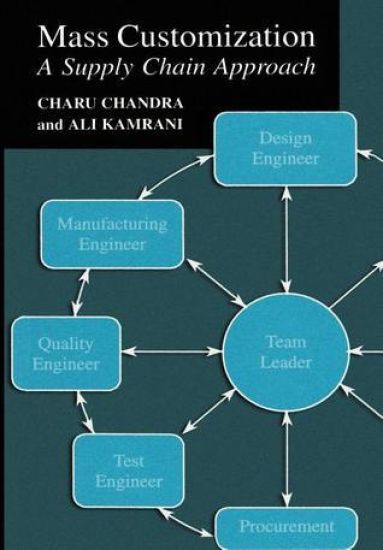
Mass Customization: A Supply Chain Approach is a text on the emerging topic of mass customization in manufacturing. The contributed chapters in this book provide a unified treatment to the topic by offering coverage in four main categories - concepts and current state of research; problem solving frameworks, models, and methodologies; supportive techniques and technologies for enabling mass customization; and future research agenda. The book blends theory and practice and includes prototypical applications to illustrate this complex, yet emerging field of inquiry.
Intelligent Transportation and Evacuation Planning

Intelligent Transportation and Evacuation Planning

Arab Naser; Ali K. Kamrani

Springer-Verlag New York Inc.
2012
sidottu
Intelligent Transportation and Evacuation Planning: A Modeling-Based Approach provides a new paradigm for evacuation planning strategies and techniques. Recently, evacuation planning and modeling have increasingly attracted interest among researchers as well as government officials. This interest stems from the recent catastrophic hurricanes and weather-related events that occurred in the southeastern United States (Hurricane Katrina and Rita). The evacuation methods that were in place before and during the hurricanes did not work well and resulted in thousands of deaths. This book offers insights into the methods and techniques that allow for implementing mathematical-based, simulation-based, and integrated optimization and simulation-based engineering approaches for evacuation planning.
Product Design for Modularity

Product Design for Modularity

Ali K. Kamrani; Sa'ed M. Salhieh

Springer-Verlag New York Inc.
2010
nidottu
Modular products are products that fulfill various overall functions through the combination of distinct building blocks or modules, in the sense that the overall function performed by the product can be divided into sub-functions that can be implemented by different modules or components. An important aspect of modular products is the creation of a basic core unit to which different components (modules) can be fitted, thus enabling a variety of versions of the same module to be produced. The core should have sufficient capacity to cope with all expected variations in performance and usage. Components used in a modular product must have features that enable them to be coupled together to form a complex product. Modularity will promote: reduction in product development time; customization and upgrades; cost efficiencies due to amortization; quality design standardization; and reduction in order lead time. The purpose of this book is to develop a structured approach to the design of products using the concept of modularity, assembly, and manufacturability. The book has proposed and developed a structured and systematic approach to product and systems design using the modularity concept. Mathematical and genetic algorithm models are developed to support the developed methodology.
Computer Based Design and Manufacturing

Computer Based Design and Manufacturing

Emad Abouel Nasr; Ali K. Kamrani

Springer-Verlag New York Inc.
2010
nidottu
As industry adopts a consumer focus in its product development strategy, it offers broader product ranges, shorter model lifetimes, and the ability to process orders in arbitrary lot sizes. This offers the ability to conduct early product design and development trade-off analysis among these competing objectives. The use of information technologies and networking capabilities is essential in the dissemination of product knowledge in order to integrate the decision-making process among heterogeneous and distributed partners / units. "Computer-based Design and Manufacturing" offers insights into the methods and techniques that enable implementing a consumer-focused product design philosophy by integrating capabilities for intelligent information support and group decision-making utilizing a common enterprise network model and knowledge interface through shared technologies. The book will be a collection of the latest methods and state-of-the-art technologies in intelligent product and customer focused design. This book will offer: - Discussion of applied methods developed in field of the product design - Latest research results - Discussion on the need and solutions for new engineering paradigm and philosophy required for product design - Coverage of advances in information systems and technology in support of CFPD - Discussion of how to use web-based design environments
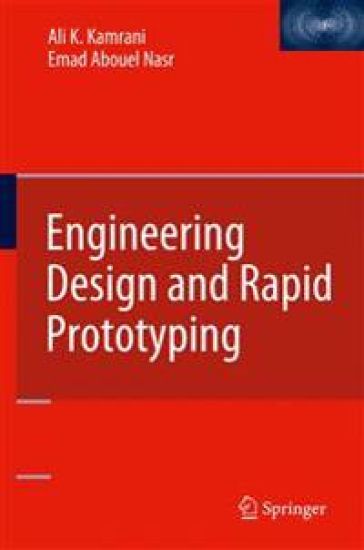
Engineering Design and Rapid Prototyping

Engineering Design and Rapid Prototyping

Ali K. Kamrani; Emad Abouel Nasr

Springer-Verlag New York Inc.
2010
sidottu
"Engineering Design and Rapid Prototyping" offers insight into the methods and techniques that allow for easily implementing engineering designs by incorporating advanced methodologies and technologies. This book contains advanced topics such as feature-based design and process planning, modularity and rapid manufacturing, along with a collection of the latest methods and technologies currently being utilized in the field. The volume also: -Provides axiomatic design and solution methodologies for both design and manufacturing -Discusses product life cycle development and analysis for ease of manufacture and assembly -Offers applied methods and technologies in rapid prototyping, tooling and manufacturing "Engineering Design and Rapid Prototyping" will be extremely valuable for any engineers and researchers and students working in engineering design.
Mass Customization

Mass Customization

Charu Chandra; Ali K. Kamrani

Kluwer Academic/Plenum Publishers
2004
sidottu
Mass Customization: A Supply Chain Approach is a text on the emerging topic of mass customization in manufacturing. The contributed chapters in this book provide a unified treatment to the topic by offering coverage in four main categories - concepts and current state of research; problem solving frameworks, models, and methodologies; supportive techniques and technologies for enabling mass customization; and future research agenda. The book blends theory and practice and includes prototypical applications to illustrate this complex, yet emerging field of inquiry.
Product Design for Modularity

Product Design for Modularity

Ali K. Kamrani; Sa'ed M. Salhieh

Springer-Verlag New York Inc.
2002
sidottu
Modular products are products that fulfill various overall functions through the combination of distinct building blocks or modules, in the sense that the overall function performed by the product can be divided into sub-functions that can be implemented by different modules or components. An important aspect of modular products is the creation of a basic core unit to which different components (modules) can be fitted, thus enabling a variety of versions of the same module to be produced. The core should have sufficient capacity to cope with all expected variations in performance and usage. Components used in a modular product must have features that enable them to be coupled together to form a complex product. Modularity will promote: reduction in product development time; customization and upgrades; cost efficiencies due to amortization; quality design standardization; and reduction in order lead time. The purpose of this book is to develop a structured approach to the design of products using the concept of modularity, assembly, and manufacturability. The book has proposed and developed a structured and systematic approach to product and systems design using the modularity concept. Mathematical and genetic algorithm models are developed to support the developed methodology.
Product Design for Modularity

Product Design for Modularity

Ali K. Kamrani; Sa'ed M. Salhieh

Springer
2000
sidottu
The current marketplace is undergoing an accelerated pace of change that challenges corporations to innovate new techniques to respond rapidly to an ever-changing environment. At the center of this changing environment is a new generation of empowered buyers (customers) equipped with fast­ evolving technologies that allow them to buy from markets scattered across the globe. Empowering the customers has deprived organizations of what was once their right-to introduce new products slowly, at their own leisure. Organizations used to introduce new products every few years, and, for the most part, products offered limited functionalities and features. A low-priced quality product-irrespective of customer satisfaction-was a guaranteed ticket for success. New global economies and global markets changed business practices and focused on the customer as the major player in the economy. Organizations now fail or succeed based upon their ability to respond quickly to changing customer demands and to utilize new technological innovations. In such an environment, the advantage goes to the firm that can offer greater varieties of new products with higher performance and greater overall appeal. In order to compete in this fast-paced global market, organizations need to produce products that can be easily configured to offer distinctive capabilities compared to the competition. Furthermore, organizations need to develop new methods and techniques to react rapidly to required changes in products and market trends and to shorten the product development cycle, which will enable them to gain more economic competitiveness.