Kirjojen hintavertailu. Mukana 12 595 353 kirjaa ja 12 kauppaa.

Kirjailija

Alice C. Harris

Kirjat ja teokset yhdessä paikassa: 4 kirjaa, julkaisuja vuosilta 1995-2017, suosituimpien joukossa Multiple Exponence. Vertaile teosten hintoja ja tarkista saatavuus suomalaisista kirjakaupoista.

4 kirjaa

Kirjojen julkaisuhaarukka 1995-2017.

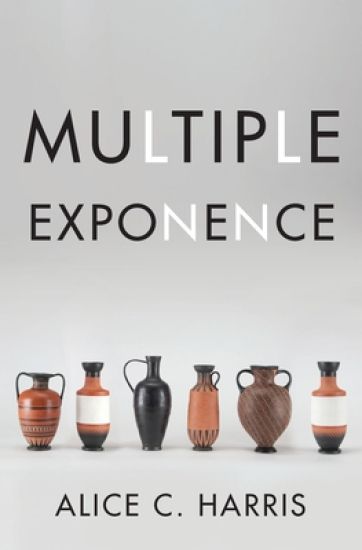
Multiple Exponence

Multiple Exponence

Alice C. Harris

Oxford University Press Inc
2017
sidottu
Multiple (or extended) exponence is the occurrence of multiple realizations of a single morphosemantic feature, bundle of features, or derivational category within a word. This book provides data and direction to the discussion of ME, which has gone in a variety of directions and suffers from lack of evidence. Alice Harris addresses the question of why ME is of interest to linguists and traces the discussion of this concept in the linguistic literature. The four most commonly encountered types of ME are characterized, with copious examples from a broad variety of languages; these types form the basis for discussion of the processing of ME, the acquisition of ME, the historical development of ME, and analysis of ME. The book addresses some of the most important questions involving ME, including why it exists at all.
Georgian Syntax

Georgian Syntax

Alice C. Harris

Cambridge University Press
2009
pokkari
Georgian has sometimes been described as a language that is 'totally irregular', where the notions of 'subject', 'object' and 'indirect object' have no relevance. Although it is often cited in work on general linguistics, language universals and language typology, no systematic account of the syntax of this morphologically complex language has been available for Western linguists. Dr Harris's work fills this important need, and indeed her book provides one of the best and most thorough studies available in English of the syntax of a non-Indo-European language. Working in the framework of relational grammar - a framework that is attracting great interest - Dr Harris shows that Georgian does have constructions found in better-known languages, and the study of individual languages to the development of linguistic theory.
Endoclitics and the Origins of Udi Morphosyntax

Endoclitics and the Origins of Udi Morphosyntax

Alice C. Harris

Oxford University Press
2002
sidottu
Endoclitics and the Origins of Udi Morphosyntax provides a synchronic description and analysis of a phenomenon that appears to be unique among languages that have been brought to the attention of linguists, namely the occurrence of endoclitics. Alice Harris demonstrates that syntactic rules must have access to the internal structure of the word. The early chapters of the book show that the morphemes at issue are clitics (as opposed to affixes), that the items inside which they may occur are words (as opposed to phrases), and that the clitics occur inside these words under specifiable conditions. The second part of the book describes how Udi came to be so different from other languages, and in doing so explains the origins of the phenomenon explored in the first part. The book will appeal to theoretical linguists, especially those interested in the interface between syntax and morphology. It will also be of considerable interest to historical linguists and students of Caucasian languages.
Historical Syntax in Cross-Linguistic Perspective

Historical Syntax in Cross-Linguistic Perspective

Alice C. Harris; Lyle Campbell

Cambridge University Press
1995
pokkari
In this major new work Alice Harris and Lyle Campbell set out to establish a general framework for the investigation of linguistic change. Systematic cross-linguistic comparison of syntactic change across a wide variety of languages is used to construct hypotheses about the universals and limits of language change more generally. In particular, the authors seek to move closer towards describing the range of causes of syntactic change to develop an understanding of the mechanisms of syntactic change, and to provide an understanding of why some languages undergo certain changes and not others. The authors draw on languages as diverse as Pipil and French, Georgian and Estonian, and the data presented is one of the book’s great strengths. Rigor and precision are combined here with a great breadth of scholarship to produce a unique resource for the study of linguistic change, which will be of use to scholars and students alike.