Kirjojen hintavertailu. Mukana 12 595 353 kirjaa ja 12 kauppaa.
Kirjailija
Alina A. von Davier
Kirjat ja teokset yhdessä paikassa: 5 kirjaa, julkaisuja vuosilta 2003-2024, suosituimpien joukossa Computerized Adaptive and Multistage Testing with R. Vertaile teosten hintoja ja tarkista saatavuus suomalaisista kirjakaupoista.
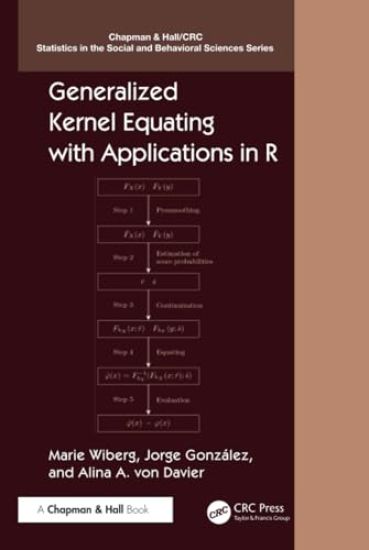
Generalized Kernel Equating is a comprehensive guide for statisticians, psychometricians, and educational researchers aiming to master test score equating. This book introduces the Generalized Kernel Equating (GKE) framework, providing the necessary tools and methodologies for accurate and fair score comparisons.The book presents test score equating as a statistical problem and covers all commonly used data collection designs. It details the five steps of the GKE framework: presmoothing, estimating score probabilities, continuization, equating transformation, and evaluating the equating transformation. Various presmoothing strategies are explored, including log-linear models, item response theory models, beta4 models, and discrete kernel estimators. The estimation of score probabilities when using IRT models is described and Gaussian kernel continuization is extended to other kernels such as uniform, logistic, epanechnikov and adaptive kernels. Several bandwidth selection methods are described. The kernel equating transformation and variants of it are defined, and both equating-specific and statistical measures for evaluating equating transformations are included. Real data examples, guiding readers through the GKE steps with detailed R code and explanations are provided. Readers are equipped with an advanced knowledge and practical skills for implementing test score equating methods.
The goal of this guide and manual is to provide a practical and brief overview of the theory on computerized adaptive testing (CAT) and multistage testing (MST) and to illustrate the methodologies and applications using R open source language and several data examples. Implementation relies on the R packages catR and mstR that have been already or are being developed by the first author (with the team) and that include some of the newest research algorithms on the topic. The book covers many topics along with the R-code: the basics of R, theoretical overview of CAT and MST, CAT designs, CAT assembly methodologies, CAT simulations, catR package, CAT applications, MST designs, IRT-based MST methodologies, tree-based MST methodologies, mstR package, and MST applications. CAT has been used in many large-scale assessments over recent decades, and MST has become very popular in recent years. R open source language also has become one of the most useful tools for applications in almost all fields, including business and education. Though very useful and popular, R is a difficult language to learn, with a steep learning curve. Given the obvious need for but with the complex implementation of CAT and MST, it is very difficult for users to simulate or implement CAT and MST. Until this manual, there has been no book for users to design and use CAT and MST easily and without expense; i.e., by using the free R software. All examples and illustrations are generated using predefined scripts in R language, available for free download from the book's website.
The goal of this guide and manual is to provide a practical and brief overview of the theory on computerized adaptive testing (CAT) and multistage testing (MST) and to illustrate the methodologies and applications using R open source language and several data examples. Implementation relies on the R packages catR and mstR that have been already or are being developed by the first author (with the team) and that include some of the newest research algorithms on the topic. The book covers many topics along with the R-code: the basics of R, theoretical overview of CAT and MST, CAT designs, CAT assembly methodologies, CAT simulations, catR package, CAT applications, MST designs, IRT-based MST methodologies, tree-based MST methodologies, mstR package, and MST applications. CAT has been used in many large-scale assessments over recent decades, and MST has become very popular in recent years. R open source language also has become one of the most useful tools for applications in almost all fields, including business and education. Though very useful and popular, R is a difficult language to learn, with a steep learning curve. Given the obvious need for but with the complex implementation of CAT and MST, it is very difficult for users to simulate or implement CAT and MST. Until this manual, there has been no book for users to design and use CAT and MST easily and without expense; i.e., by using the free R software. All examples and illustrations are generated using predefined scripts in R language, available for free download from the book's website.
Kernel Equating (KE) is a powerful, modern and unified approach to test equating. It is based on a flexible family of equipercentile-like equating functions and contains the linear equating function as a special case. Any equipercentile equating method has five steps or parts. They are: 1) pre-smoothing; 2) estimation of the score-probabilities on the target population; 3) continuization; 4) computing and diagnosing the equating function; 5) computing the standard error of equating and related accuracy measures. KE brings these steps together in an organized whole rather than treating them as disparate problems. KE exploits pre-smoothing by fitting log-linear models to score data, and incorporates it into step 5) above. KE provides new tools for diagnosing a given equating function, and for comparing two or more equating functions in order to choose between them. In this book, KE is applied to the four major equating designs and to both Chain Equating and Post-Stratification Equating for the Non-Equivalent groups with Anchor Test Design. This book will be an important reference for several groups: (a) Statisticians and others interested in the theory behind equating methods and the use of model-based statistical methods for data smoothing in applied work; (b) Practitioners who need to equate tests—including those with these responsibilities in testing companies, state testing agencies and school districts; and (c) Instructors in psychometric and measurement programs. The authors assume some familiarity with linear and equipercentile test equating, and with matrix algebra. Alina von Davier is an Associate Research Scientist in the Center for Statistical Theory and Practice, at Educational Testing Service. She has been a research collaborator at the Universities of Trier, Magdeburg, and Kiel, an assistant professor at the Politechnical University of Bucharest and a research scientist at the Institute for Psychology inBucharest. Paul Holland holds the Frederic M. Lord Chair in Measurement and Statistics at Educational Testing Service. He held faculty positions in the Graduate School of Education, University of California, Berkeley and the Harvard Department of Statistics. He is a Fellow of the American Statistical Association, the Institute of Mathematical Statistics, and the American Association for the Advancement of Science. He is an elected Member of the International Statistical Institute and a past president of the Psychometric society. He was awarded the (AERA/ACT) E. F. Lindquist Award, in 2000, and was designated a National Associate of the National Academies of Science in 2002. Dorothy Thayer currently is a consultant in the Center of Statistical Theory and Practice, at Educational Testing Service. Her research interests include computational and statistical methodology, empirical Bayes techniques, missing data procedures and exploratory data analysis techniques. From the reviews: "The book is nicely laid out, is extremely well written, and is an excellent text for a semester course or a short course…The book is highly recommended." Short Book Reviews of the International Statistical Institute, December 2004 "This book is well-written and the presentation is clear, rigorous, and concise...A rich set of applications is used to illustrate the methods...This book is a gem! I highly recommend it to any statistician or psychometrician who has even a passing interest in test equating." Pscyhometrika, March 2006 "This is a great book, and it is the first to focus on the kernel method of test equating." Applied Psychological Measurement, September 2005
Kernel Equating (KE) is a powerful, modern and unified approach to test equating. It is based on a flexible family of equipercentile-like equating functions and contains the linear equating function as a special case. Any equipercentile equating method has five steps or parts. They are: 1) pre-smoothing; 2) estimation of the score-probabilities on the target population; 3) continuization; 4) computing and diagnosing the equating function; 5) computing the standard error of equating and related accuracy measures. KE brings these steps together in an organized whole rather than treating them as disparate problems. KE exploits pre-smoothing by fitting log-linear models to score data, and incorporates it into step 5) above. KE provides new tools for diagnosing a given equating function, and for comparing two or more equating functions in order to choose between them. In this book, KE is applied to the four major equating designs and to both Chain Equating and Post-Stratification Equating for the Non-Equivalent groups with Anchor Test Design. This book will be an important reference for several groups: (a) Statisticians and others interested in the theory behind equating methods and the use of model-based statistical methods for data smoothing in applied work; (b) Practitioners who need to equate tests—including those with these responsibilities in testing companies, state testing agencies and school districts; and (c) Instructors in psychometric and measurement programs. The authors assume some familiarity with linear and equipercentile test equating, and with matrix algebra. Alina von Davier is an Associate Research Scientist in the Center for Statistical Theory and Practice, at Educational Testing Service. She has been a research collaborator at the Universities of Trier, Magdeburg, and Kiel, an assistant professor at the Politechnical University of Bucharest and a research scientist at the Institute for Psychology inBucharest. Paul Holland holds the Frederic M. Lord Chair in Measurement and Statistics at Educational Testing Service. He held faculty positions in the Graduate School of Education, University of California, Berkeley and the Harvard Department of Statistics. He is a Fellow of the American Statistical Association, the Institute of Mathematical Statistics, and the American Association for the Advancement of Science. He is an elected Member of the International Statistical Institute and a past president of the Psychometric society. He was awarded the (AERA/ACT) E. F. Lindquist Award, in 2000, and was designated a National Associate of the National Academies of Science in 2002. Dorothy Thayer currently is a consultant in the Center of Statistical Theory and Practice, at Educational Testing Service. Her research interests include computational and statistical methodology, empirical Bayes techniques, missing data procedures and exploratory data analysis techniques. From the reviews: "The book is nicely laid out, is extremely well written, and is an excellent text for a semester course or a short course…The book is highly recommended." Short Book Reviews of the International Statistical Institute, December 2004 "This book is well-written and the presentation is clear, rigorous, and concise...A rich set of applications is used to illustrate the methods...This book is a gem! I highly recommend it to any statistician or psychometrician who has even a passing interest in test equating." Pscyhometrika, March 2006 "This is a great book, and it is the first to focus on the kernel method of test equating." Applied Psychological Measurement, September 2005