Kirjojen hintavertailu. Mukana 12 294 300 kirjaa ja 12 kauppaa.

Kirjailija

Alison Bashford

Kirjat ja teokset yhdessä paikassa: 15 kirjaa, julkaisuja vuosilta 2001-2025, suosituimpien joukossa Contagion. Vertaile teosten hintoja ja tarkista saatavuus suomalaisista kirjakaupoista.

15 kirjaa

Kirjojen julkaisuhaarukka 2001-2025.

Decoding the Hand

Decoding the Hand

Alison Bashford

THE UNIVERSITY OF CHICAGO PRESS
2025
sidottu
The astonishing history of palmistry and biometrics—from occult physicians to the very foundations of modern science and medicine. Why did Isaac Newton read books on chiromancy, the occult science of hand reading that revealed the secrets of the soul? Why did Charles Darwin claim that the hand gave humans dominion over all other species? Why did psychoanalyst Charlotte Wolff climb into the primate cages of the London Zoo, taking hundreds of delicate palm prints? Why did Francis Galton, the father of fingerprinting, take palm prints too? And why did world-leading geneticists study the geometry of palm lines in their search for the secrets of chromosomal syndromes?Decoding the Hand is an astounding history of magic, medicine, and science, of an enduring search for how our bodily surfaces might reveal an inner self—a soul, a character, an identity. From sixteenth-century occult physicians influenced by the Kabbalah to twentieth-century geneticists, and from criminologists to eugenicists, award-winning historian Alison Bashford takes us on a remarkable journey into the strange world of hand readers, revealing how signs on the hand—their shape, lines, marks, and patterns—have been elaborately decoded over the centuries. Sometimes learned, sometimes outrageously deceptive, sometimes earnest, and more often than we ever expected, medically and scientifically trained, these palm-readers of the past prove to be essential links in the human quest to peer into bodies, souls, minds, and selves. Not only for fortune-telling palmists were the future and the past, health, and character laid bare in the hand, but for other experts in bodies and minds as well: anatomists, psychiatrists, embryologists, primatologists, evolutionary biologists, geneticists, and more. Drawing telling parallels between the divination promised by palmistry and the appeal to self-knowledge offered by modern genetic testing, Decoding the Hand also makes clear that palm-reading is far from a relic or simple charlatanism. Bashford’s sagacious history of human hands touching and connecting opens wide the essential human pursuit of what lies within and beyond.
Evolutionens förvaltare : en biografi över Huxleyfamiljen
»Ett biografiskt mästerverk.«– New Statesman»Hela det brittiska kulturlivet blir synligt genom ett spretigt släktträds förgreningar.«– The GuardianUnder 1800- och 1900-talet förnyade tre färgstarka män vid namn Huxley det brittiska vetenskaps- och kulturlivet: Thomas Henry Huxley, Julian Huxley och Aldous Huxley. Thomas Henry Huxley, »Darwins bulldogg«, var en av evolutionsteorins tidigaste ambassadörer och förespråkade en värld styrd av förnuft och rationalitet. Hur kom det sig att hans söner sökte något helt annat? Tillsammans med sin bror Aldous var Julian Huxley en fixperson i det brittiska kulturlivet, där hans originella tankar om natur och kultur ställde honom i kontrast till sin rationelle morfar: men var inte hans idéer i själva verket bara en utveckling av Darwins läror?I Evolutionens förvaltare tecknar Alison Bashford ett levande porträtt över en familj djupt präglad av Darwins evolutionsteori, både som en motorrelse till 1800-talets vidskeplighet och som en katalysator för att återför trolla världen under 1900-talet.Vetenskapliga klassiker ges ut i samarbete med Kungl. Vetenskapsakademien.
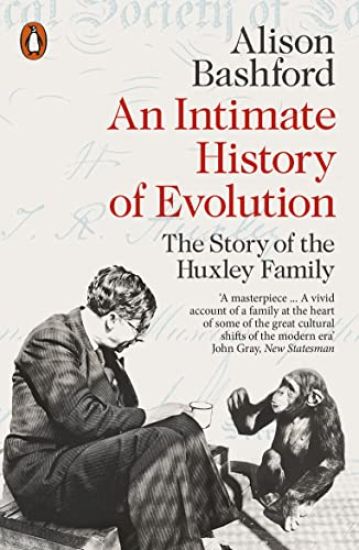
The Huxleys: An Intimate History of Evolution

The Huxleys: An Intimate History of Evolution

Alison Bashford

University of Chicago Press
2024
nidottu
A New Yorker and Economist Best Book of the Year Two hundred years of modern science and culture told through one family history. This momentous biography tells the story of the Huxleys: the Victorian natural historian T. H. Huxley ("Darwin's Bulldog") and his grandson, the scientist, conservationist, and zoologist Julian Huxley. Between them, they communicated to the world the great modern story of the theory of evolution by natural selection. In The Huxleys, celebrated historian Alison Bashford writes seamlessly about these omnivorous intellects together, almost as if they were a single man whose long, vital life bookended the colossal shifts in world history from the age of sail to the Space Age, and from colonial wars to world wars to the cold war. The Huxleys' specialty was evolution in all its forms--at the grandest level of species, deep time, the Earth, and at the most personal and intimate. They illuminated the problems and wonders of the modern world and they fundamentally shaped how we see ourselves, as individuals and as a species. But perhaps their greatest subject was themselves. Bashford's engaging, brilliantly ambitious book interweaves the Huxleys' momentous public achievements with their private triumphs and tragedies. The result is the history of a family, but also a history of humanity grappling with its place in nature. This book shows how much we owe--for better or worse--to the unceasing curiosity, self-absorption, and enthusiasm of a small, strange group of men and women.
The Huxleys: An Intimate History of Evolution

The Huxleys: An Intimate History of Evolution

Alison Bashford

University of Chicago Press
2022
sidottu
A New Yorker and Economist Best Book of the Year Two hundred years of modern science and culture told through one family history. This momentous biography tells the story of the Huxleys: the Victorian natural historian T. H. Huxley ("Darwin's Bulldog") and his grandson, the scientist, conservationist, and zoologist Julian Huxley. Between them, they communicated to the world the great modern story of the theory of evolution by natural selection. In The Huxleys, celebrated historian Alison Bashford writes seamlessly about these omnivorous intellects together, almost as if they were a single man whose long, vital life bookended the colossal shifts in world history from the age of sail to the Space Age, and from colonial wars to world wars to the cold war. The Huxleys' specialty was evolution in all its forms--at the grandest level of species, deep time, the Earth, and at the most personal and intimate. They illuminated the problems and wonders of the modern world and they fundamentally shaped how we see ourselves, as individuals and as a species. But perhaps their greatest subject was themselves. Bashford's engaging, brilliantly ambitious book interweaves the Huxleys' momentous public achievements with their private triumphs and tragedies. The result is the history of a family, but also a history of humanity grappling with its place in nature. This book shows how much we owe--for better or worse--to the unceasing curiosity, self-absorption, and enthusiasm of a small, strange group of men and women.
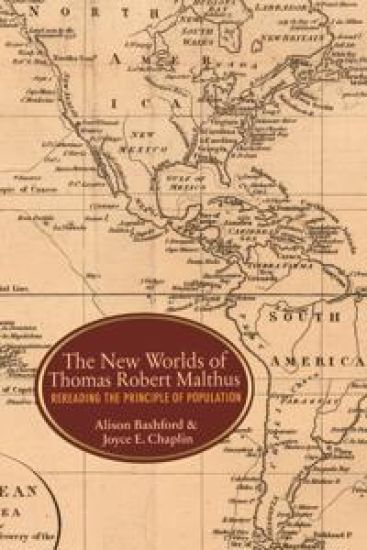
The New Worlds of Thomas Robert Malthus

The New Worlds of Thomas Robert Malthus

Alison Bashford; Joyce E. Chaplin

Princeton University Press
2017
pokkari
The New Worlds of Thomas Robert Malthus is a sweeping global and intellectual history that radically recasts our understanding of Malthus's Essay on the Principle of Population, the most famous book on population ever written or ever likely to be. Malthus's Essay is also persistently misunderstood. First published anonymously in 1798, the Essay systematically argues that population growth tends to outpace its means of subsistence unless kept in check by factors such as disease, famine, or war, or else by lowering the birth rate through such means as sexual abstinence. Challenging the widely held notion that Malthus's Essay was a product of the British and European context in which it was written, Alison Bashford and Joyce Chaplin demonstrate that it was the new world, as well as the old, that fundamentally shaped Malthus's ideas. They explore what the Atlantic and Pacific new worlds--from the Americas and the Caribbean to New Zealand and Tahiti--meant to Malthus, and how he treated them in his Essay. Bashford and Chaplin reveal how Malthus, long vilified as the scourge of the English poor, drew from his principle of population to conclude that the extermination of native populations by European settlers was unjust. Elegantly written and forcefully argued, The New Worlds of Thomas Robert Malthus relocates Malthus's Essay from the British economic and social context that has dominated its reputation to the colonial and global history that inspired its genesis.
Global Population

Global Population

Alison Bashford

Columbia University Press
2016
pokkari
Concern about the size of the world's population did not begin with the "population bomb" in 1968. It arose in the aftermath of World War I and was understood as an issue with far-reaching ecological, agricultural, economic, and geopolitical consequences. The world population problem concerned the fertility of soil as much as the fertility of women, always involving both "earth" and "life." Global Population traces the idea of a world population problem as it evolved from the 1920s through the 1960s. The growth and distribution of the human population over the planet's surface came deeply to shape the characterization of "civilizations" with different standards of living. It forged the very ideas of development, demographically defined three worlds, and, for some, an aspirational "one world." Drawing on international conference transcripts and personal and organizational archives, this book reconstructs the twentieth-century population problem in terms of migration, colonial expansion, globalization, and world food plans. Population was a problem in which international relations and intimate relations were one. Global Population ultimately shows how a geopolitical problem about sovereignty over land morphed into a biopolitical solution, entailing sovereignty over one's person.
Quarantine

Quarantine

Alison Bashford

Red Globe Press
2016
sidottu
Over five centuries, a global archipelago of quarantine stations came to connect the world's oceans from the Mediterranean to the South Pacific, from Atlantic coasts to the Red Sea. In the process, great new carceral structures materialised, many surviving into the present as magnificent ruins or as 5 star hotels with a dark tourism edge. This book offers new histories and geographies of quarantine islands and isolation hospitals across the world, bringing their local and global pasts and present into view. An international cast of leading experts examine the enduring historical problems of migration and mobility, segregation, prevention and protection by states with different interests in freedoms, health and commerce. With case studies from as far afield as the Red Sea, Hong Kong and New Zealand, and from the early modern period forward, this book provides an invaluable insight into the history of quarantine.
Quarantine

Quarantine

Alison Bashford

Red Globe Press
2016
nidottu
Over five centuries, a global archipelago of quarantine stations came to connect the world's oceans from the Mediterranean to the South Pacific, from Atlantic coasts to the Red Sea. In the process, great new carceral structures materialised, many surviving into the present as magnificent ruins or as 5 star hotels with a dark tourism edge. This book offers new histories and geographies of quarantine islands and isolation hospitals across the world, bringing their local and global pasts and present into view. An international cast of leading experts examine the enduring historical problems of migration and mobility, segregation, prevention and protection by states with different interests in freedoms, health and commerce. With case studies from as far afield as the Red Sea, Hong Kong and New Zealand, and from the early modern period forward, this book provides an invaluable insight into the history of quarantine.
The New Worlds of Thomas Robert Malthus

The New Worlds of Thomas Robert Malthus

Alison Bashford; Joyce E. Chaplin

PRINCETON UNIVERSITY PRESS
2016
sidottu
The New Worlds of Thomas Robert Malthus is a sweeping global and intellectual history that radically recasts our understanding of Malthus's Essay on the Principle of Population, the most famous book on population ever written or ever likely to be. Malthus's Essay is also persistently misunderstood. First published anonymously in 1798, the Essay systematically argues that population growth tends to outpace its means of subsistence unless kept in check by factors such as disease, famine, or war, or else by lowering the birth rate through such means as sexual abstinence. Challenging the widely held notion that Malthus's Essay was a product of the British and European context in which it was written, Alison Bashford and Joyce Chaplin demonstrate that it was the new world, as well as the old, that fundamentally shaped Malthus's ideas. They explore what the Atlantic and Pacific new worlds--from the Americas and the Caribbean to New Zealand and Tahiti--meant to Malthus, and how he treated them in his Essay. Bashford and Chaplin reveal how Malthus, long vilified as the scourge of the English poor, drew from his principle of population to conclude that the extermination of native populations by European settlers was unjust. Elegantly written and forcefully argued, The New Worlds of Thomas Robert Malthus relocates Malthus's Essay from the British economic and social context that has dominated its reputation to the colonial and global history that inspired its genesis.
Contagion

Contagion

Alison Bashford; Claire Hooker

Routledge
2014
nidottu
In the age of HIV, antibiotic-resistant bacteria, the Ebola Virus and BSE, metaphors and experience of contagion are a central concern of government, biomedicine and popular culture.Contagion explores cultural responses of infectious diseases and their biomedical management over the nineteenth and twentieth centuries. It also investigates the use of 'contagion' as a concept in postmodern reconceptualisations of embodied subjectivity.The essays are written from within the fields of cultural studies, biomedical history and critical sociology. The contributors examine the geographies, policies and identities which have been produced in the massive social effort to contain diseases. They explore both social responses to infectious diseases in the past, and contemporary theoretical and biomedical sites for the study of contagion.
Global Population

Global Population

Alison Bashford

Columbia University Press
2014
sidottu
Concern about the size of the world's population did not begin with the "population bomb" in 1968. It arose in the aftermath of World War I and was understood as an issue with far-reaching ecological, agricultural, economic, and geopolitical consequences. The world population problem concerned the fertility of soil as much as the fertility of women, always involving both "earth" and "life." Global Population traces the idea of a world population problem as it evolved from the 1920s through the 1960s. The growth and distribution of the human population over the planet's surface came deeply to shape the characterization of "civilizations" with different standards of living. It forged the very ideas of development, demographically defined three worlds, and, for some, an aspirational "one world." Drawing on international conference transcripts and personal and organizational archives, this book reconstructs the twentieth-century population problem in terms of migration, colonial expansion, globalization, and world food plans. Population was a problem in which international relations and intimate relations were one. Global Population ultimately shows how a geopolitical problem about sovereignty over land morphed into a biopolitical solution, entailing sovereignty over one's person.
Pacific Histories

Pacific Histories

David Armitage; Alison Bashford

Red Globe Press
2013
nidottu
The first comprehensive account to place the Pacific Islands, the Pacific Rim and the Pacific Ocean into the perspective of world history. A distinguished international team of historians provides a multidimensional account of the Pacific, its inhabitants and the lands within and around it over 50,000 years, with special attention to the peoples of Oceania. It providing chronological coverage along with analyses of themes such as the environment, migration and the economy; religion, law and science; race, gender and politics.
Griffith Taylor

Griffith Taylor

Carolyn Strange; Alison Bashford

University of Toronto Press
2008
pokkari
Thomas Griffith Taylor (1880-1963) was a geographer, anthropologist, and world explorer. His travels took him from Captain Scott's final expedition in Antarctica to every continent on earth, in a professional life that stretched from the Boer War to the Cold War. Taylor's research ranged from microscopic analysis of fossils to the "races of man," the geographic basis of global politics, while his work as a professor led him from his Cambridge education to the Universities of Chicago and Sydney, as well as Harold A. Innis' recently-founded geography department in the University of Toronto. As a scientific secularist, Taylor made it his lifelong mission to enlighten the public on humankind's relation to the environment and was an early environmentalist. His progressive views on interracial marriage, as well as his criticisms of social Darwinist doctrines, anti-Semitism, and twentieth-century nationalism caused him to be constantly embroiled in controversy. Often dismissed by his contemporary political and intellectual opponents, many subsequent scientists and thinkers have come to regard his life as prophetic. This timely, beautifully produced, and copiously illustrated biography recounts and analyses the fascinating life of a remarkably contemporary man.
Contagion

Contagion

Alison Bashford; Claire Hooker

Routledge
2001
sidottu
In the age of HIV, antibiotic-resistant bacteria, the Ebola Virus and BSE, metaphors and experience of contagion are a central concern of government, biomedicine and popular culture.Contagion explores cultural responses of infectious diseases and their biomedical management over the nineteenth and twentieth centuries. It also investigates the use of 'contagion' as a concept in postmodern reconceptualisations of embodied subjectivity.The essays are written from within the fields of cultural studies, biomedical history and critical sociology. The contributors examine the geographies, policies and identities which have been produced in the massive social effort to contain diseases. They explore both social responses to infectious diseases in the past, and contemporary theoretical and biomedical sites for the study of contagion.