Kirjojen hintavertailu. Mukana 12 501 272 kirjaa ja 12 kauppaa.

Kirjailija

Allison Burkette

Kirjat ja teokset yhdessä paikassa: 9 kirjaa, julkaisuja vuosilta 2018-2025, suosituimpien joukossa The Social Life of Appalachian Englishes. Vertaile teosten hintoja ja tarkista saatavuus suomalaisista kirjakaupoista.

9 kirjaa

Kirjojen julkaisuhaarukka 2018-2025.

Dialectology and the Linguistic Atlas Project

Dialectology and the Linguistic Atlas Project

Allison Burkette

Cambridge University Press
2025
pokkari
People from different places use different words for things, even everyday things such as carbonated beverages (e.g. soda, coke, pop) or bread roll-based sandwiches (e.g. hoagie, grinder, sub). Regional variation in vocabulary is one of the foci of dialectology, a subfield of linguistics that examines the geographic distribution of specific words, along with distributions of different pronunciations and grammatical constructions. This Element will provide readers with a basic understanding of traditional dialectological study and will demonstrate through examples (audio, text, maps) how Linguistic Atlas Project research has changed and expanded over time. Readers will be introduced to the key concepts of dialectology with a focus on the North American Linguistic Atlas Project (LAP) and its materials. This Element will also discuss today's LAP with reference to third-wave sociolinguistics, outlining the ways in which the LAP has changed over time to meet the needs and goals of contemporary sociolinguistic study.
Dialectology and the Linguistic Atlas Project

Dialectology and the Linguistic Atlas Project

Allison Burkette

Cambridge University Press
2025
sidottu
People from different places use different words for things, even everyday things such as carbonated beverages (e.g. soda, coke, pop) or bread roll-based sandwiches (e.g. hoagie, grinder, sub). Regional variation in vocabulary is one of the foci of dialectology, a subfield of linguistics that examines the geographic distribution of specific words, along with distributions of different pronunciations and grammatical constructions. This Element will provide readers with a basic understanding of traditional dialectological study and will demonstrate through examples (audio, text, maps) how Linguistic Atlas Project research has changed and expanded over time. Readers will be introduced to the key concepts of dialectology with a focus on the North American Linguistic Atlas Project (LAP) and its materials. This Element will also discuss today's LAP with reference to third-wave sociolinguistics, outlining the ways in which the LAP has changed over time to meet the needs and goals of contemporary sociolinguistic study.
The Language of Artifacts

The Language of Artifacts

Allison Burkette

De Gruyter
2025
sidottu
This work applies the concept of chaîne opératoire to the discourses that surround artifacts by examining the history, evaluation, and interpretation of specific archaeological objects. The chaîne approach to archaeological artifacts entails discussion of the entire ‘life cycle’ of an artifact from production to use and discard and will be applied here to the discourses that surround specific artifacts as they move through different contexts, time-periods, research groups, etc. to demonstrate that, at every link in the chain, the meaning of an artifact is contextually dependent. Chapters focus on particular objects and are arranged such that topics move further back in time, from a colonial American artifact to prehistoric European artifacts. The chaîne approach offers linguists a new vocabulary with which to discuss how language changes over time. What makes this book unique is its application of chaîne opératoire to discourse, an application that underscores a commitment to interdisciplinarity.
The Social Life of Appalachian Englishes

The Social Life of Appalachian Englishes

Jennifer Cramer; Allison Burkette

TAYLOR FRANCIS LTD
2024
nidottu
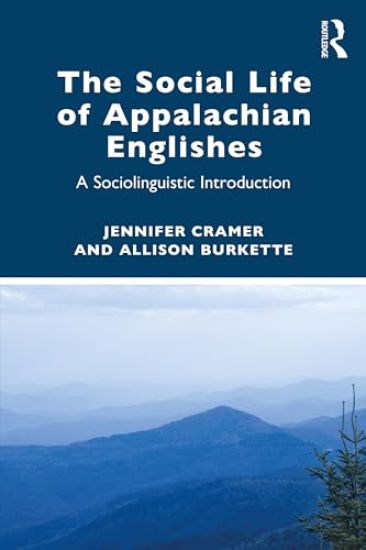
Appalachian Englishes (AEs) possess an array of linguistic features that distinguish them from other American Englishes, yet the rich history of language in the United States has created a wealth of linguistic resources through factors such as immigration and contact, providing the environment for AEs to grow and adapt in ways that are also similar to other varieties of English. AEs have a long history of representation in linguistic literature, but until now no single work has examined the interplay of language production and perception with an eye toward the role that language plays in the construction of personal and social identities.The Social Life of Appalachian Englishes takes a sociolinguistic/sociocultural approach to exploring specific linguistic features highlighted in the Linguistic Atlas Projects and the social life of Appalachian varieties in terms of perceptions and use. Focusing on the single theme of the social life of language in Appalachia, the book aims to explore the implications of the kinds of variation found, reinforce the notion that social meaning and variation are inseparable, and illustrate how linguistic production and perception are interrelated. It uses new data to amplify this theme, presenting a novel combination of data from different sociolinguistic traditions (specifically, perceptual dialectology and traditional atlas-style dialectology). Opportunities for engagement are provided through QR codes linking to additional resources and discussion questions and exercises at the end of each chapter.This book is designed for students and researchers interested in general linguistics, sociolinguistics, American Englishes, language variation, linguistic anthropology, and Appalachian studies.
The Social Life of Appalachian Englishes

The Social Life of Appalachian Englishes

Jennifer Cramer; Allison Burkette

TAYLOR FRANCIS LTD
2024
sidottu
Appalachian Englishes (AEs) possess an array of linguistic features that distinguish them from other American Englishes, yet the rich history of language in the United States has created a wealth of linguistic resources through factors such as immigration and contact, providing the environment for AEs to grow and adapt in ways that are also similar to other varieties of English. AEs have a long history of representation in linguistic literature, but until now no single work has examined the interplay of language production and perception with an eye toward the role that language plays in the construction of personal and social identities.The Social Life of Appalachian Englishes takes a sociolinguistic/sociocultural approach to exploring specific linguistic features highlighted in the Linguistic Atlas Projects and the social life of Appalachian varieties in terms of perceptions and use. Focusing on the single theme of the social life of language in Appalachia, the book aims to explore the implications of the kinds of variation found, reinforce the notion that social meaning and variation are inseparable, and illustrate how linguistic production and perception are interrelated. It uses new data to amplify this theme, presenting a novel combination of data from different sociolinguistic traditions (specifically, perceptual dialectology and traditional atlas-style dialectology). Opportunities for engagement are provided through QR codes linking to additional resources and discussion questions and exercises at the end of each chapter.This book is designed for students and researchers interested in general linguistics, sociolinguistics, American Englishes, language variation, linguistic anthropology, and Appalachian studies.
Language and Classification

Language and Classification

Allison Burkette

Routledge
2020
nidottu
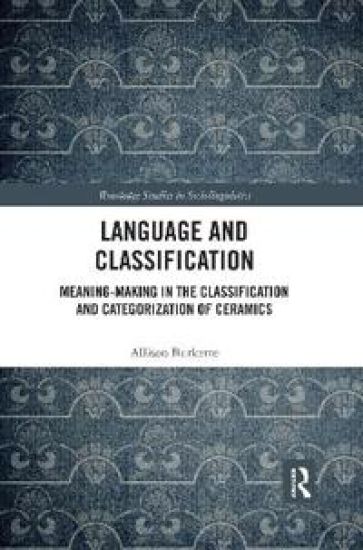
This volume adopts a practice-based approach to examine the different ways in which classification is communicated and negotiated in different environments within archaeology. The book looks specifically at the archaeological classification of ceramics as a lens through which to examine the discursive and social practices inherent in the classification and categorization process, with perspectives from such areas as corpus linguistics, discourse analysis, linguistic anthropology, and archaeology forming the foundation of the book’s theoretical framework. The volume then looks at the process of classification in practice in a variety of settings, including a university course on ceramics classification, an archaeological field school, an intensive petrography course, and archaeometry laboratory at a nuclear research reactor, and highlights participant observation and audiovisual data taken from fieldwork practice completed in these environments. This volume offers a valuable contribution to the growing literature on language and material culture, making this a key resource for students and scholars in sociolinguistic, anthropological linguistics, archaeology, discourse analysis, and anthropology.
Exploring Linguistic Science

Exploring Linguistic Science

Allison Burkette; William A. Kretzschmar Jr.

Cambridge University Press
2018
sidottu
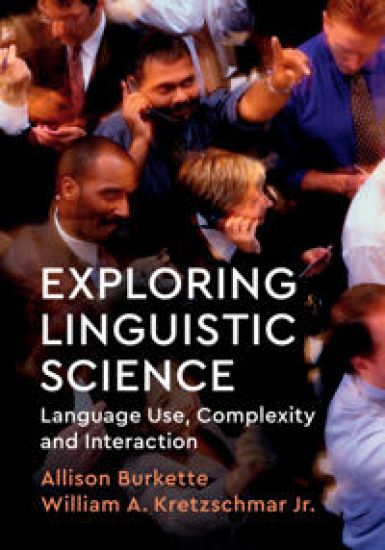
Exploring Linguistic Science introduces students to the basic principles of complexity theory and then applies these principles to the scientific study of language. It demonstrates how, at every level of linguistic study, we find evidence of language as a complex system. Designed for undergraduate courses in language and linguistics, this essential textbook brings cutting-edge concepts to bear on the traditional components of general introductions to the study of language, such as phonetics, morphology and grammar. The authors maintain a narrative thread throughout the book of 'interaction and emergence', both of which are key terms from the study of complex systems, a new science currently useful in physics, genetics, evolutionary biology, and economics, but also a perfect fit for the humanities. The application of complexity to language highlights the fact that language is an ever-changing, ever-varied product of human behavior.
Exploring Linguistic Science

Exploring Linguistic Science

Allison Burkette; William A. Kretzschmar Jr.

Cambridge University Press
2018
pokkari
Exploring Linguistic Science introduces students to the basic principles of complexity theory and then applies these principles to the scientific study of language. It demonstrates how, at every level of linguistic study, we find evidence of language as a complex system. Designed for undergraduate courses in language and linguistics, this essential textbook brings cutting-edge concepts to bear on the traditional components of general introductions to the study of language, such as phonetics, morphology and grammar. The authors maintain a narrative thread throughout the book of 'interaction and emergence', both of which are key terms from the study of complex systems, a new science currently useful in physics, genetics, evolutionary biology, and economics, but also a perfect fit for the humanities. The application of complexity to language highlights the fact that language is an ever-changing, ever-varied product of human behavior.
Language and Classification

Language and Classification

Allison Burkette

Routledge
2018
sidottu
This volume adopts a practice-based approach to examine the different ways in which classification is communicated and negotiated in different environments within archaeology. The book looks specifically at the archaeological classification of ceramics as a lens through which to examine the discursive and social practices inherent in the classification and categorization process, with perspectives from such areas as corpus linguistics, discourse analysis, linguistic anthropology, and archaeology forming the foundation of the book’s theoretical framework. The volume then looks at the process of classification in practice in a variety of settings, including a university course on ceramics classification, an archaeological field school, an intensive petrography course, and archaeometry laboratory at a nuclear research reactor, and highlights participant observation and audiovisual data taken from fieldwork practice completed in these environments. This volume offers a valuable contribution to the growing literature on language and material culture, making this a key resource for students and scholars in sociolinguistic, anthropological linguistics, archaeology, discourse analysis, and anthropology.