Kirjojen hintavertailu. Mukana 12 390 323 kirjaa ja 12 kauppaa.

Kirjailija

Alma Y Alanis

Kirjat ja teokset yhdessä paikassa: 11 kirjaa, julkaisuja vuosilta 2008-2025, suosituimpien joukossa Bio-Inspired Strategies for Modeling and Detection in Diabetes Mellitus Treatment. Vertaile teosten hintoja ja tarkista saatavuus suomalaisista kirjakaupoista.

Mukana myös kirjoitusasut: Alma y. Alanis, Alma Y. Alanís

11 kirjaa

Kirjojen julkaisuhaarukka 2008-2025.

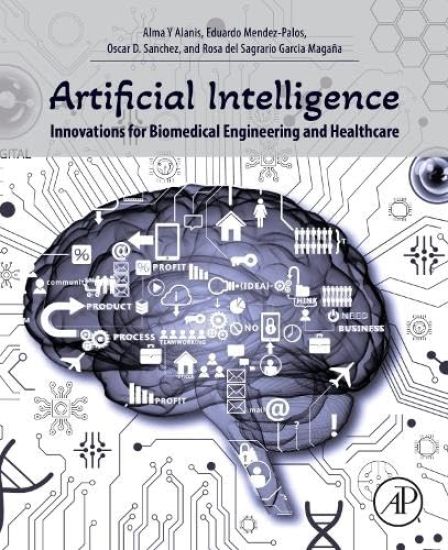
Artificial Intelligence Innovations for Biomedical Engineering and Healthcare

Artificial Intelligence Innovations for Biomedical Engineering and Healthcare

Alma Y Alanis; Eduardo Mendez-Palos; Oscar D. Sanchez; Rosa del Sagrario Garcia Magaña

ELSEVIER SCIENCE PUBLISHING CO INC
2025
nidottu
Artificial Intelligence Innovations for Biomedical Engineering and Healthcare bridges the evolving domains of artificial intelligence and biomedical engineering and healthcare. In an era where data-driven insights and precision medicine are essential in healthcare, this book explores emerging trends and showcases AI's potential in transforming patient care, diagnosis, and the treatment of chronic diseases. It simplifies the relationship between artificial intelligence and biomedical engineering, elucidating how these technologies are revolutionizing self-care. The book goes on to examine how advanced technologies, including complex networks and AI-driven diagnostics are reshaping the healthcare landscape. From decoding complex networks to revealing AI's role in treating chronic diseases, this book serves as a guide to understanding how innovation is reshaping the healthcare landscape.

Bio-Inspired Strategies for Modeling and Detection in Diabetes Mellitus Treatment

Bio-Inspired Strategies for Modeling and Detection in Diabetes Mellitus Treatment

Alma Y Alanis; Oscar D Sánchez; Alonso Vaca Gonzalez; Marco Perez Cisneros

ELSEVIER SCIENCE TECHNOLOGY
2024
nidottu
Bio-Inspired Strategies for Modeling and Detection in Diabetes Mellitus Treatment focuses on bioinspired techniques such as modeling to generate control algorithms for the treatment of diabetes mellitus. The book addresses the identification of diabetes mellitus using a high-order recurrent neural network trained by an extended Kalman filter. The authors also describe the use of metaheuristic algorithms for the parametric identification of compartmental models of diabetes mellitus widely used in research works such as the Sorensen model and the Dallaman model. In addition, the book addresses the modeling of time series for the prediction of risk scenarios such as hyperglycaemia and hypoglycaemia using deep neural networks. The detection of diabetes mellitus in the early stages or when current diagnostic techniques cannot detect glucose intolerance or prediabetes is proposed, carried out by means of deep neural networks present in the literature. Readers will find leading-edge research in diabetes identification based on discrete high-order neural networks trained with an extended Kalman filter; parametric identification of compartmental models used to describe diabetes mellitus; modeling of data obtained by continuous glucose-monitoring sensors for the prediction of risk scenarios such as hyperglycaemia and hypoglycaemia; and screening for glucose intolerance using glucose-tolerance test data and deep neural networks. Application of the proposed approaches is illustrated via simulation and real-time implementations for modeling, prediction, and classification.
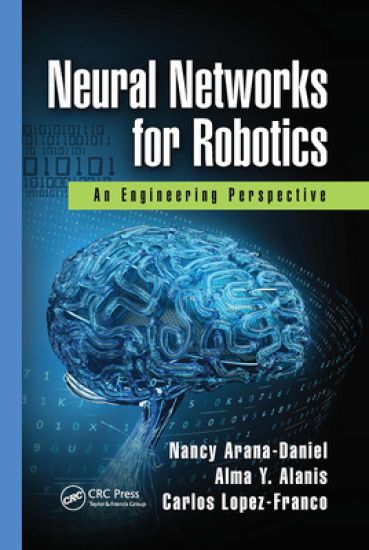
Neural Networks for Robotics

Neural Networks for Robotics

Nancy Arana-Daniel; Alma Y. Alanis; Carlos Lopez-Franco

CRC Press
2020
nidottu
The book offers an insight on artificial neural networks for giving a robot a high level of autonomous tasks, such as navigation, cost mapping, object recognition, intelligent control of ground and aerial robots, and clustering, with real-time implementations. The reader will learn various methodologies that can be used to solve each stage on autonomous navigation for robots, from object recognition, clustering of obstacles, cost mapping of environments, path planning, and vision to low level control. These methodologies include real-life scenarios to implement a wide range of artificial neural network architectures. Includes real-time examples for various robotic platforms. Discusses real-time implementation for land and aerial robots. Presents solutions for problems encountered in autonomous navigation. Explores the mathematical preliminaries needed to understand the proposed methodologies. Integrates computing, communications, control, sensing, planning, and other techniques by means of artificial neural networks for robotics.
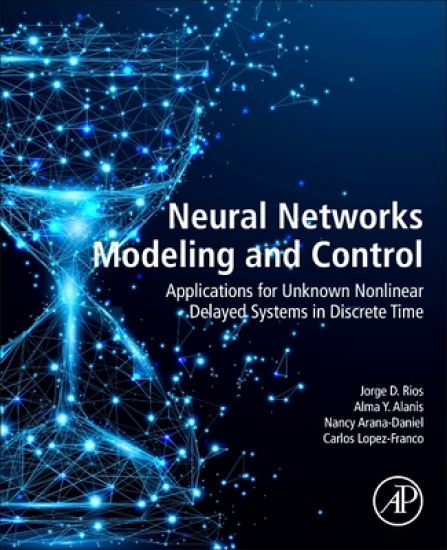
Neural Networks Modeling and Control

Neural Networks Modeling and Control

Jorge D. Rios; Alma Y Alanis; Nancy Arana-Daniel; Carlos Lopez-Franco

Academic Press Inc
2020
nidottu
Neural Networks Modelling and Control: Applications for Unknown Nonlinear Delayed Systems in Discrete Time focuses on modeling and control of discrete-time unknown nonlinear delayed systems under uncertainties based on Artificial Neural Networks. First, a Recurrent High Order Neural Network (RHONN) is used to identify discrete-time unknown nonlinear delayed systems under uncertainties, then a RHONN is used to design neural observers for the same class of systems. Therefore, both neural models are used to synthesize controllers for trajectory tracking based on two methodologies: sliding mode control and Inverse Optimal Neural Control. As well as considering the different neural control models and complications that are associated with them, this book also analyzes potential applications, prototypes and future trends.
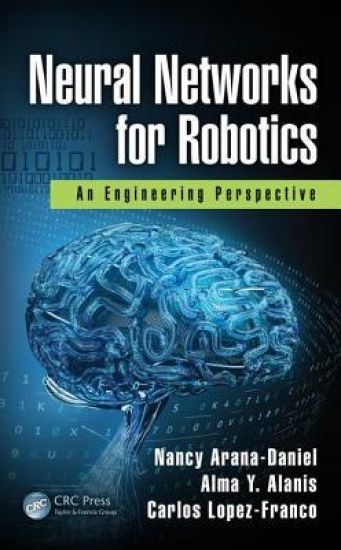
Neural Networks for Robotics

Neural Networks for Robotics

Nancy Arana-Daniel; Alma Y. Alanis; Carlos Lopez-Franco

CRC Press Inc
2018
sidottu
The book offers an insight on artificial neural networks for giving a robot a high level of autonomous tasks, such as navigation, cost mapping, object recognition, intelligent control of ground and aerial robots, and clustering, with real-time implementations. The reader will learn various methodologies that can be used to solve each stage on autonomous navigation for robots, from object recognition, clustering of obstacles, cost mapping of environments, path planning, and vision to low level control. These methodologies include real-life scenarios to implement a wide range of artificial neural network architectures. Includes real-time examples for various robotic platforms. Discusses real-time implementation for land and aerial robots. Presents solutions for problems encountered in autonomous navigation. Explores the mathematical preliminaries needed to understand the proposed methodologies. Integrates computing, communications, control, sensing, planning, and other techniques by means of artificial neural networks for robotics.
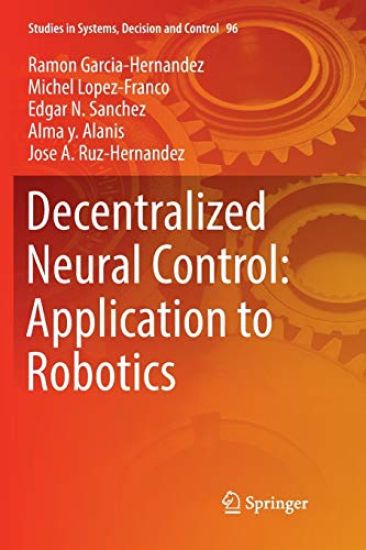
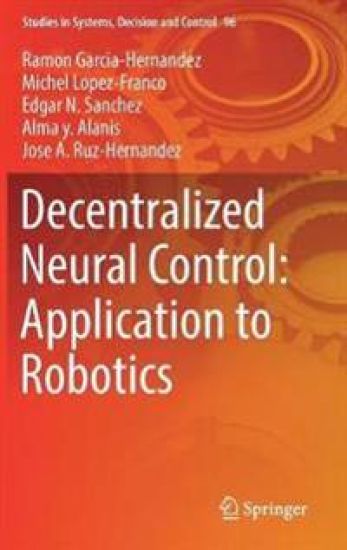
Decentralized Neural Control: Application to Robotics

Decentralized Neural Control: Application to Robotics

Ramon Garcia-Hernandez; Michel Lopez-Franco; Edgar N. Sanchez; Alma y. Alanis; Jose A. Ruz-Hernandez

Springer International Publishing AG
2018
nidottu
This book provides a decentralized approach for the identification and control of robotics systems. It also presents recent research in decentralized neural control and includes applications to robotics. Decentralized control is free from difficulties due to complexity in design, debugging, data gathering and storage requirements, making it preferable for interconnected systems. Furthermore, as opposed to the centralized approach, it can be implemented with parallel processors.This approach deals with four decentralized control schemes, which are able to identify the robot dynamics. The training of each neural network is performed on-line using an extended Kalman filter (EKF).The first indirect decentralized control scheme applies the discrete-time block control approach, to formulate a nonlinear sliding manifold.The second direct decentralized neural control scheme is based on the backstepping technique, approximated by a high order neural network.The thirdcontrol scheme applies a decentralized neural inverse optimal control for stabilization.The fourth decentralized neural inverse optimal control is designed for trajectory tracking.This comprehensive work on decentralized control of robot manipulators and mobile robots is intended for professors, students and professionals wanting to understand and apply advanced knowledge in their field of work.
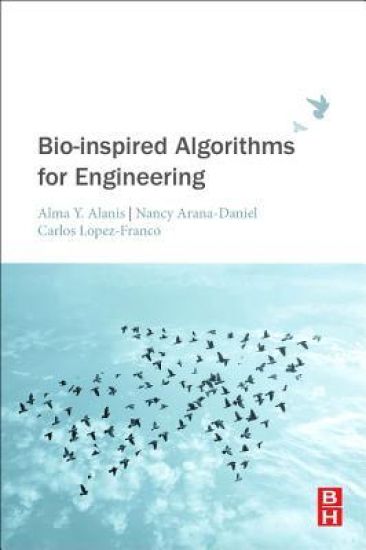
Bio-inspired Algorithms for Engineering

Bio-inspired Algorithms for Engineering

Nancy Arana-Daniel; Carlos Lopez-Franco; Alma Y Alanis

Butterworth-Heinemann Inc
2018
nidottu
Bio-inspired Algorithms for Engineering builds a bridge between the proposed bio-inspired algorithms developed in the past few decades and their applications in real-life problems, not only in an academic context, but also in the real world. The book proposes novel algorithms to solve real-life, complex problems, combining well-known bio-inspired algorithms with new concepts, including both rigorous analyses and unique applications. It covers both theoretical and practical methodologies, allowing readers to learn more about the implementation of bio-inspired algorithms. This book is a useful resource for both academic and industrial engineers working on artificial intelligence, robotics, machine learning, vision, classification, pattern recognition, identification and control.
Decentralized Neural Control: Application to Robotics

Decentralized Neural Control: Application to Robotics

Ramon Garcia-Hernandez; Michel Lopez-Franco; Edgar N. Sanchez; Alma y. Alanis; Jose A. Ruz-Hernandez

Springer International Publishing AG
2017
sidottu
This book provides a decentralized approach for the identification and control of robotics systems. It also presents recent research in decentralized neural control and includes applications to robotics. Decentralized control is free from difficulties due to complexity in design, debugging, data gathering and storage requirements, making it preferable for interconnected systems. Furthermore, as opposed to the centralized approach, it can be implemented with parallel processors.This approach deals with four decentralized control schemes, which are able to identify the robot dynamics. The training of each neural network is performed on-line using an extended Kalman filter (EKF).The first indirect decentralized control scheme applies the discrete-time block control approach, to formulate a nonlinear sliding manifold.The second direct decentralized neural control scheme is based on the backstepping technique, approximated by a high order neural network.The thirdcontrol scheme applies a decentralized neural inverse optimal control for stabilization.The fourth decentralized neural inverse optimal control is designed for trajectory tracking.This comprehensive work on decentralized control of robot manipulators and mobile robots is intended for professors, students and professionals wanting to understand and apply advanced knowledge in their field of work.
Discrete-Time Neural Observers

Discrete-Time Neural Observers

Alma Y Alanis; Edgar N. Sanchez

Academic Press Inc
2017
nidottu
Discrete-Time Neural Observers: Analysis and Applications presents recent advances in the theory of neural state estimation for discrete-time unknown nonlinear systems with multiple inputs and outputs. The book includes rigorous mathematical analyses, based on the Lyapunov approach, that guarantee their properties. In addition, for each chapter, simulation results are included to verify the successful performance of the corresponding proposed schemes. In order to complete the treatment of these schemes, the authors also present simulation and experimental results related to their application in meaningful areas, such as electric three phase induction motors and anaerobic process, which show the applicability of such designs. The proposed schemes can be employed for different applications beyond those presented. The book presents solutions for the state estimation problem of unknown nonlinear systems based on two schemes. For the first one, a full state estimation problem is considered; the second one considers the reduced order case with, and without, the presence of unknown delays. Both schemes are developed in discrete-time using recurrent high order neural networks in order to design the neural observers, and the online training of the respective neural networks is performed by Kalman Filtering.
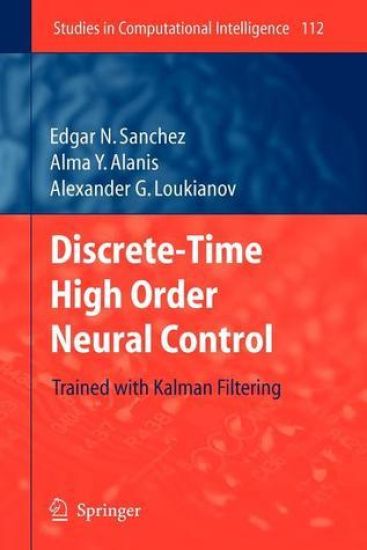
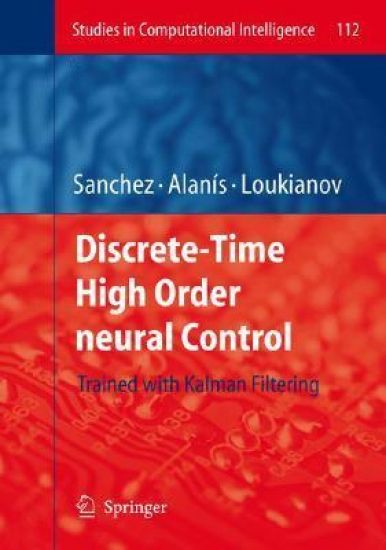
Discrete-Time High Order Neural Control

Discrete-Time High Order Neural Control

Edgar N. Sanchez; Alma Y. Alanís; Alexander G. Loukianov

Springer-Verlag Berlin and Heidelberg GmbH Co. K
2010
nidottu
Neural networks have become a well-established methodology as exempli?ed by their applications to identi?cation and control of general nonlinear and complex systems; the use of high order neural networks for modeling and learning has recently increased. Usingneuralnetworks,controlalgorithmscanbedevelopedtoberobustto uncertainties and modeling errors. The most used NN structures are Feedf- ward networks and Recurrent networks. The latter type o?ers a better suited tool to model and control of nonlinear systems. There exist di?erent training algorithms for neural networks, which, h- ever, normally encounter some technical problems such as local minima, slow learning, and high sensitivity to initial conditions, among others. As a viable alternative, new training algorithms, for example, those based on Kalman ?ltering, have been proposed. There already exists publications about trajectory tracking using neural networks; however, most of those works were developed for continuous-time systems. On the other hand, while extensive literature is available for linear discrete-timecontrolsystem,nonlineardiscrete-timecontroldesigntechniques have not been discussed to the same degree. Besides, discrete-time neural networks are better ?tted for real-time implementations.
Discrete-Time High Order Neural Control

Discrete-Time High Order Neural Control

Edgar N. Sanchez; Alma Y. Alanís; Alexander G. Loukianov

Springer-Verlag Berlin and Heidelberg GmbH Co. K
2008
sidottu
Neural networks have become a well-established methodology as exempli?ed by their applications to identi?cation and control of general nonlinear and complex systems; the use of high order neural networks for modeling and learning has recently increased. Usingneuralnetworks,controlalgorithmscanbedevelopedtoberobustto uncertainties and modeling errors. The most used NN structures are Feedf- ward networks and Recurrent networks. The latter type o?ers a better suited tool to model and control of nonlinear systems. There exist di?erent training algorithms for neural networks, which, h- ever, normally encounter some technical problems such as local minima, slow learning, and high sensitivity to initial conditions, among others. As a viable alternative, new training algorithms, for example, those based on Kalman ?ltering, have been proposed. There already exists publications about trajectory tracking using neural networks; however, most of those works were developed for continuous-time systems. On the other hand, while extensive literature is available for linear discrete-timecontrolsystem,nonlineardiscrete-timecontroldesigntechniques have not been discussed to the same degree. Besides, discrete-time neural networks are better ?tted for real-time implementations.