Kirjojen hintavertailu. Mukana 12 152 606 kirjaa ja 12 kauppaa.

Kirjailija

Alyssa Demus

Kirjat ja teokset yhdessä paikassa: 21 kirjaa, julkaisuja vuosilta 2018-2025, suosituimpien joukossa Rivalry in the Information Sphere. Vertaile teosten hintoja ja tarkista saatavuus suomalaisista kirjakaupoista.

21 kirjaa

Kirjojen julkaisuhaarukka 2018-2025.

Insights from the Plan Blue 21 Game

Insights from the Plan Blue 21 Game

Elizabeth M Bartels; David A Ochmanek; Nathaniel Edenfield; Brien Alkire; Katherine Anania; Michael Bohnert; Julia Brackup; Hannah Jane Byrne; Rachel Costello; Alyssa Demus; John J Drennan; Emily Ellinger; David R Frelinger; Michelle Grisé; Russell Hanson; Mace Moesner; Stephanie Pezard; Stephanie Anne Pillion; Clint Reach; Melissa Shostak; Gabrielle Tarini; Abbie Tingstad

RAND Corporation
2024
pokkari
This report describes the 2021 U.S. Air Force-sponsored Plan Blue game, which examined competition against Russia in the Arctic with a focus on the role of sensing in competition and featured robust participation from regional partners and allies. The purpose of the game was to increase understanding of the capabilities, postures, and alliance command, control, and communication relationships that may be called for in future Arctic operations.
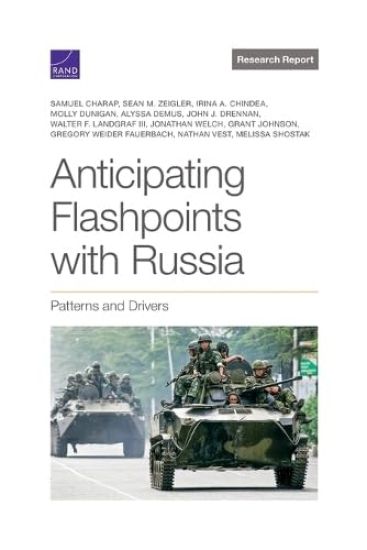
Anticipating Flashpoints with Russia

Anticipating Flashpoints with Russia

Samuel Charap; Sean M Zeigler; Irina a Chindea; Molly Dunigan; Alyssa Demus; John J Drennan; Walter F Landgraf; Jonathan Welch; Grant Johnson; Gregory Weider Fauerbach; Nathan Vest; Melissa Shostak

RAND Corporation
2023
pokkari
The authors sought to identify possible Russian flashpoints in Europe that could entangle the United States. Using quantitative and qualitative methods to analyze historical data on Russian disputes and conflicts, they identified the key drivers of such flashpoints. They derive planning implications for the United States and the U.S. Army in particular. This research was completed prior to Russia's full-scale invasion of Ukraine in February 2022.
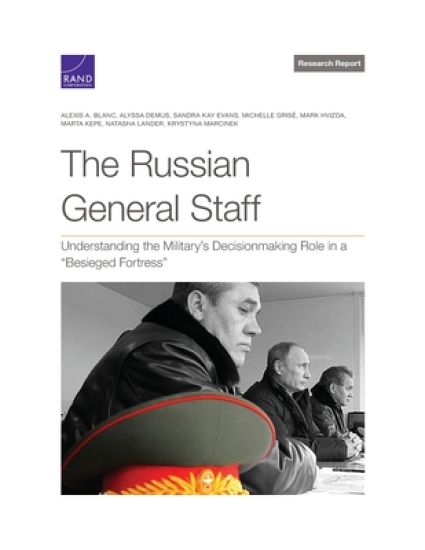
The Russian General Staff

The Russian General Staff

Alexis A Blanc; Alyssa Demus; Sandra Kay Evans; Michelle Grisé; Mark Hvizda; Marta Kepe; Natasha Lander; Krystyna Marcinek

RAND Corporation
2023
pokkari
Because of the increasing militarization of Russian foreign policy since 2008, it is important to understand the formal authorities and responsibilities of the Russian General Staff as well as its capacity to influence Russia's national security decisionmaking process. In this report, the authors develop a foundational text for policymakers and warfighters to improve collective understanding of this institution.
Russia's Evolution Toward a Unified Strategic Operation

Russia's Evolution Toward a Unified Strategic Operation

Clint Reach; Alyssa Demus; Michelle Grisé; Khrystyna Holynska; Christopher Lynch; Dara Massicot; David Woodworth

RAND Corporation
2023
pokkari
In this report, RAND researchers examine the reasons behind Russia's evolution toward a unified strategic operation, as well as the capabilities that would be necessary to execute key conventional offensive tasks in such an operation. They focus on four capability areas: long-range conventional strikes against critical military and civilian targets, electronic warfare, counterspace actions, and cyberattacks against critical infrastructure.
Stabilizing Great-Power Rivalries

Stabilizing Great-Power Rivalries

Michael J Mazarr; Samuel Charap; Abigail Casey; Irina a Chindea; Christian Curriden; Alyssa Demus; Bryan Frederick; Arthur Chan; John P Godges; Eugene Han; Timothy R Heath; Logan Ma; Elina Treyger; Teddy Ulin; Ali Wyne

RAND
2021
nidottu
The international system appears headed for a renewed era of intense competition among major powers. The authors sought to identify the factors that keep such rivalries stable and those that lead to conflictual outcomes. Leveraging theory and historical case studies, the authors created a framework for assessing the stability of a strategic rivalry, then applied it to the current U.S.-Russia and U.S.-China competitions.
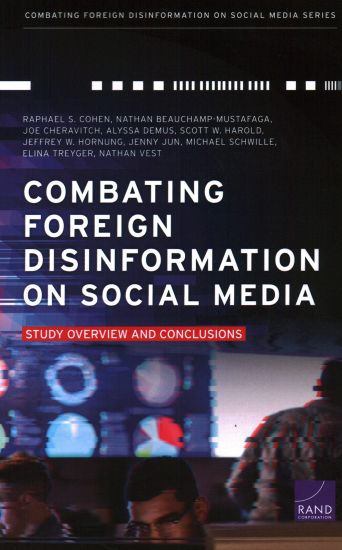
Combating Foreign Disinformation on Social Media

Combating Foreign Disinformation on Social Media

Raphael S Cohen; Nathan Beauchamp-Mustafaga; Joe Cheravitch; Alyssa Demus; Scott W Harold; Jeffrey W Hornung; Jenny Jun; Michael Schwille; Elina Treyger; Nathan Vest

RAND
2021
nidottu
How are state adversaries using disinformation on social media to advance their interests? What does the joint force?and the U.S. Air Force in particular?need to be prepared to do in response? Disinformation campaigns on social media pose a nuanced threat to the United States, but the response remains ad hoc and uncoordinated. This series overview presents recommendations to better prepare for this new age of information warfare.
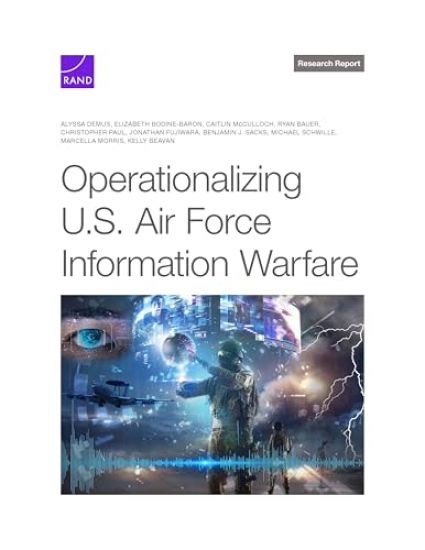
Operationalizing U.S. Air Force Information Warfare

Operationalizing U.S. Air Force Information Warfare

Alyssa Demus; Elizabeth Bodine-Baron; Caitlin McCulloch

RAND Corporation
2025
nidottu
Information warfare (IW) and analogous terms of art are not new to the U.S. military's vocabulary or that of the U.S. Air Force (USAF). Yet even with the decades-old recognition by USAF leadership that IW is fundamental to all aspects of air operations, the USAF's approach to conducting IW remains relatively nascent. In this report, RAND researchers provide actionable recommendations for how the USAF should organize, train, and equip for IW.
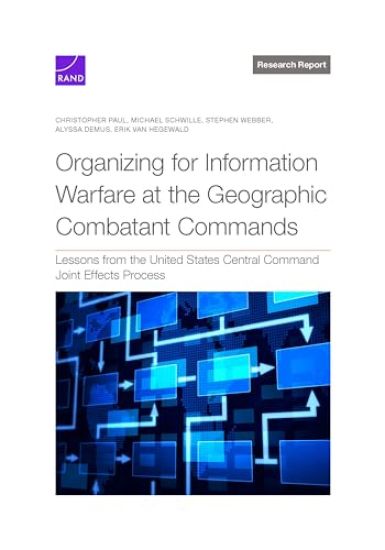
Organizing for Information Warfare at the Geographic Combatant Commands

Organizing for Information Warfare at the Geographic Combatant Commands

Christopher Paul; Michael Schwille; Stephen Webber; Alyssa Demus; Erik Van Hegewald

RAND Corporation
2024
pokkari
The authors document the planning processes used at U.S. Central Command (2020-2023) to better integrate information and information warfare issues into its battle rhythm and assess their effects in the information environment, include lessons relevant to other elements within the joint force, and present a framework for drawing further lessons from the commander's decisionmaking cycle and for the execution of future operations.
The Limits of Russian Manipulation

The Limits of Russian Manipulation

Clint Reach; Ryan Bauer; Alyssa Demus; Khrystyna Holynska

RAND Corporation
2023
pokkari
Russia's manipulation of Ukraine, which culminated in the 2022 invasion, demonstrated that Russia was willing to resort to all means necessary to secure a regional sphere of influence that included Ukraine. But events could have taken a different direction. Using the concept of national identity as a starting point, RAND researchers developed a framework to illuminate the underlying causes of the Russia-Ukraine war.
Deterring Russia and Iran

Deterring Russia and Iran

Jeffrey Martini; Andrew Radin; Alyssa Demus; Krystyna Marcinek; Dara Massicot; Katherine Pfrommer; Ashley L Rhoades; Chandler Sachs; Karen M Sudkamp; David E Thaler; David Woodworth; Sean M Zeigler

RAND Corporation
2023
pokkari
To support defense planners in crafting effective deterrence strategies for Europe and the Middle East, RAND researchers conducted a multimethod analysis--consisting of a literature review, roundtables with subject-matter experts, quantitative analysis, and a case study of Ukraine--to assess the effectiveness of U.S. forward presence, exercises and short-term deployments, and security cooperation for deterring Russian and Iranian aggression.
Resisting Russia

Resisting Russia

Marta Kepe; Alyssa Demus

RAND Corporation
2023
pokkari
The authors examine Ukrainian civilians' contributions to support Ukraine's defense against Russia's full-scale invasion in 2022. Civilian-based resistance is integral to Ukraine's territorial defense efforts and has potential value in helping ensure victory by regaining territorial integrity and maintaining political sovereignty. The war in Ukraine also offers insight into potential trends in civilian actions in future wars.
Russian Military Forecasting and Analysis

Russian Military Forecasting and Analysis

Clint Reach; Alyssa Demus; Eugeniu Han; Bilyana Lilly; Krystyna Marcinek; Yuliya Shokh

RAND Corporation
2022
pokkari
Military forecasting informs long-term military planning of the Russian Ministry of Defense. In this report, the authors draw on a framework developed by the Russian military science community to examine several key indicators related to military forecasting to gain insight into the likelihood and character of future war and the correlation of military potential between Russia and potential adversaries.
Understanding and Defending Against Russia's Malign and Subversive Information Efforts in Europe

Understanding and Defending Against Russia's Malign and Subversive Information Efforts in Europe

Miriam Matthews; Alyssa Demus; Elina Treyger; Marek N Posard; Hilary Reininger; Christopher Paul

RAND
2021
nidottu
As targets of information aggression, the United States and its European allies must protect themselves against the effects of psychological manipulation and influence. The authors describe apparent efforts by Russia and its agents to use information to shape Russia's operating environment, and they identify possible defensive approaches for United States European Command and its partners.
Russia's Limit of Advance

Russia's Limit of Advance

Ben Connable; Abby Doll; Alyssa Demus

RAND
2020
nidottu
Analysis of Russian military capabilities reveals stark limitations in Russia's ability to safely and effectively deploy and sustain ground forces around the world. Notional deployment scenarios highlight a lack of readily deployable forces and transportation assets and limited freedom of movement. Collectively, these challenges suggest a modern Russian force that is far less deployable than the Soviet military it replaced.
Russia's Limit of Advance

Russia's Limit of Advance

Ben Connable; Abby Doll; Alyssa Demus

RAND
2020
nidottu
Russia's ability to deploy military forces around the world is significantly depleted from the Soviet era. This report describes the strengths and weaknesses of Russia's ground force deployment capacity. Russia's armed forces are much improved from the 1990s, but lack of adequate transportation, political limitations, shortfalls in sustainment, limits on conscript deployment, and other factors constrain its global ground force deployment.
What Deters and Why

What Deters and Why

Michael J Mazarr; Arthur Chan; Alyssa Demus; Bryan Frederick; Alireza Nader; Stephanie Pezard; Julia A Thompson; Elina Treyger

RAND
2019
nidottu
The challenge of deterring territorial aggression is taking on renewed importance, yet discussion of it has lagged in U.S. military and strategy circles. The authors aim to provide a fresh look, with two primary purposes: to review established concepts about deterrence, and to provide a framework for evaluating the strength of deterrent relationships. They focus on a specific type of deterrence: extended deterrence of interstate aggression.
Promoting Joint Warfighting Proficiency

Promoting Joint Warfighting Proficiency

Miranda Priebe; Laurinda L Rohn; Alyssa Demus

RAND
2018
nidottu
This report describes the current differences and similarities between Air Force and joint doctrine and identifies ways to increase doctrinal alignment. It also evaluates the potential role of doctrine in increasing airmen's joint warfighting proficiency and proposes additional ways to give airmen more exposure to joint constructs throughout their careers.