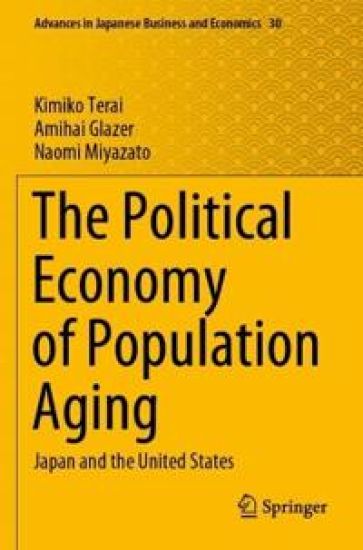
Kirjojen hintavertailu. Mukana 12 595 353 kirjaa ja 12 kauppaa.

Kirjailija

Amihai Glazer

Kirjat ja teokset yhdessä paikassa: 4 kirjaa, julkaisuja vuosilta 2005-2022, suosituimpien joukossa The Political Economy of Population Aging. Vertaile teosten hintoja ja tarkista saatavuus suomalaisista kirjakaupoista.

4 kirjaa

Kirjojen julkaisuhaarukka 2005-2022.

The Political Economy of Population Aging

The Political Economy of Population Aging

Kimiko Terai; Amihai Glazer; Naomi Miyazato

SPRINGER VERLAG, SINGAPORE
2022
nidottu
This book integrates the economics of aging and insight based on political economy and explores generational conflict in the context of governmental spending. This problem is general, as the Covid-19 pandemic has highlighted: lockdowns protect the elderly, but hurt the young. Policies to address global warming impose taxes on the elderly, but would bring benefits largely in the future. This book addresses intergenerational problems by placing its focus on budget allocation, taxation, and regulation. By using Japanese and US data, the authors conduct statistical analysis of whether regions with aging populations may adopt policies that generate benefits during a short period of time instead of policies that could benefit current young generations for an extended period of time. If the policy preferences of voters depend on their age, and if policy adoption by a government reflects public opinion, the change in demographic composition in a region may affect governmental policies. In an aged society, the elderly are pivotal voters. Budgets may be reallocated from policies favored by younger generations, such as education, to policies the elderly prefer, such as welfare programs. This generates an intergenerational externality problem: voters with short life expectancy do not take into consideration long-term benefits. Moreover, the current tax bases may be replaced by other tax bases that do not harm the elderly. The results reported in the book largely support these hypotheses. Evidence also shows that the gender and racial composition and institutional factors, including the extent of fiscal decentralization, are important in anticipating effects of population aging in other countries.
The Political Economy of Population Aging

The Political Economy of Population Aging

Kimiko Terai; Amihai Glazer; Naomi Miyazato

SPRINGER VERLAG, SINGAPORE
2021
sidottu
This book integrates the economics of aging and insight based on political economy and explores generational conflict in the context of governmental spending. This problem is general, as the Covid-19 pandemic has highlighted: lockdowns protect the elderly, but hurt the young. Policies to address global warming impose taxes on the elderly, but would bring benefits largely in the future. This book addresses intergenerational problems by placing its focus on budget allocation, taxation, and regulation. By using Japanese and US data, the authors conduct statistical analysis of whether regions with aging populations may adopt policies that generate benefits during a short period of time instead of policies that could benefit current young generations for an extended period of time. If the policy preferences of voters depend on their age, and if policy adoption by a government reflects public opinion, the change in demographic composition in a region may affect governmental policies. In an aged society, the elderly are pivotal voters. Budgets may be reallocated from policies favored by younger generations, such as education, to policies the elderly prefer, such as welfare programs. This generates an intergenerational externality problem: voters with short life expectancy do not take into consideration long-term benefits. Moreover, the current tax bases may be replaced by other tax bases that do not harm the elderly. The results reported in the book largely support these hypotheses. Evidence also shows that the gender and racial composition and institutional factors, including the extent of fiscal decentralization, are important in anticipating effects of population aging in other countries.

Price Theory and Applications

Price Theory and Applications

Jack Hirshleifer; Amihai Glazer; David Hirshleifer

Cambridge University Press
2005
pokkari
This new seventh edition of the book offers extensive discussion of information, uncertainty, and game theory. It contains over a hundred examples illustrating the applicability of economic analysis not only to mainline economic topics but also issues in politics, history, biology, the family, and many other areas. These discussions generally describe recent research published in scholarly books and articles, giving students a good idea of the scientific work done by professional economists. In addition, at appropriate places the text provides 'applications' representing more extended discussions of selected topics including rationing in wartime (Chapter 5), import quotas (Chapter 7), alleged monopolistic suppression of inventions (Chapter 9), minimum wage laws (Chapter 11), the effects of Social Security upon saving (Chapter 15), fair division of disrupted property (Chapter 16) and whether individuals should pay ransom to a kidnapper (Chapter 17).
Why Government Succeeds and Why It Fails

Why Government Succeeds and Why It Fails

Amihai Glazer; Lawrence S. Rothenberg

Harvard University Press
2005
nidottu
This book looks beyond politics to show how the ability of the U.S. government to implement policies is strongly affected by various economic constraints. These include the credibility of the policies, the ability of government to commit to them, the extent to which firms and consumers rationally anticipate their effects, whether the success of a policy further encourages firms and individuals to behave in intended ways, and whether the behavior of such actors can be sustained without continued government intervention.The authors apply these concepts to four areas of policy: macroeconomic policies to promote employment and economic growth, redistributive policies to benefit the poor and the elderly, production policies to provide goods and services, and regulatory policies to guide the behavior of firms and individuals. In doing so they provide plausible explanations of many puzzling phenomena—for example, why government has been successful in reducing cigarette smoking, but has failed to get people to install and maintain emission-control devices in their cars.This book recasts debates about public policy, avoiding conventional “pro-government” or “anti-government” positions; rather, it helps to predict when public policy will succeed.