Kirjojen hintavertailu. Mukana 12 278 937 kirjaa ja 12 kauppaa.

Kirjailija

Amin Termehyousefi

Kirjat ja teokset yhdessä paikassa: 3 kirjaa, julkaisuja vuosilta 2015-2018, suosituimpien joukossa Progress on Antimicrobial Latex and its Applications. Vertaile teosten hintoja ja tarkista saatavuus suomalaisista kirjakaupoista.

3 kirjaa

Kirjojen julkaisuhaarukka 2015-2018.

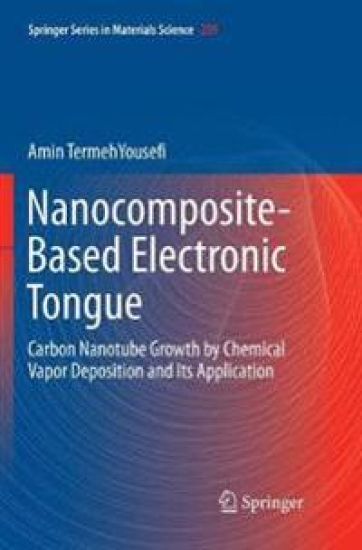
Nanocomposite-Based Electronic Tongue

Nanocomposite-Based Electronic Tongue

Amin TermehYousefi

Springer International Publishing AG
2018
nidottu
This book describes the fabrication of a frequency-based electronic tongue using a modified glassy carbon electrode (GCE), opening a new field of applying organic precursors to achieve nanostructure growth. It also presents a new approach to optimizing nanostructures by means of statistical analysis. The chemical vapor deposition (CVD) method was utilized to grow vertically aligned carbon nanotubes (CNTs) with various aspect ratios. To increase the graphitic ratio of synthesized CNTs, sequential experimental strategies based on response surface methodology were employed to investigate the crystallinity of CNTs. In the next step, glucose oxidase (GOx) was immobilized on the optimized multiwall carbon nanotubes/gelatin (MWCNTs/Gl) composite using the entrapment technique to achieve enzyme-catalyzed oxidation of glucose at anodic potentials, which was drop-casted onto the GCE. The modified GCE’s performance indicates that a GOx/MWCNTs/Gl/GC electrode can be utilized as a glucose biosensor with a high direct electron transfer rate between GOx and MWCNTs/Gl. It was possible to use the fabricated biosensor as an electronic tongue thanks to a frequency-based circuit attached to the electrochemical cell. The results indicate that the modified GCE (with GOx/MWCNTs/Gl) holds promising potential for application in voltammetric electronic tongues.
Nanocomposite-Based Electronic Tongue

Nanocomposite-Based Electronic Tongue

Amin TermehYousefi

Springer International Publishing AG
2017
sidottu
This book describes the fabrication of a frequency-based electronic tongue using a modified glassy carbon electrode (GCE), opening a new field of applying organic precursors to achieve nanostructure growth. It also presents a new approach to optimizing nanostructures by means of statistical analysis. The chemical vapor deposition (CVD) method was utilized to grow vertically aligned carbon nanotubes (CNTs) with various aspect ratios. To increase the graphitic ratio of synthesized CNTs, sequential experimental strategies based on response surface methodology were employed to investigate the crystallinity of CNTs. In the next step, glucose oxidase (GOx) was immobilized on the optimized multiwall carbon nanotubes/gelatin (MWCNTs/Gl) composite using the entrapment technique to achieve enzyme-catalyzed oxidation of glucose at anodic potentials, which was drop-casted onto the GCE. The modified GCE’s performance indicates that a GOx/MWCNTs/Gl/GC electrode can be utilized as a glucose biosensor with a high direct electron transfer rate between GOx and MWCNTs/Gl. It was possible to use the fabricated biosensor as an electronic tongue thanks to a frequency-based circuit attached to the electrochemical cell. The results indicate that the modified GCE (with GOx/MWCNTs/Gl) holds promising potential for application in voltammetric electronic tongues.