Kirjojen hintavertailu. Mukana 12 595 353 kirjaa ja 12 kauppaa.

Kirjailija

Amit Konar

Kirjat ja teokset yhdessä paikassa: 20 kirjaa, julkaisuja vuosilta 1999-2021, suosituimpien joukossa Metaheuristic Clustering. Vertaile teosten hintoja ja tarkista saatavuus suomalaisista kirjakaupoista.

20 kirjaa

Kirjojen julkaisuhaarukka 1999-2021.

Multi-Agent Coordination

Multi-Agent Coordination

Arup Kumar Sadhu; Amit Konar

Wiley-Blackwell
2021
sidottu
Discover the latest developments in multi-robot coordination techniques with this insightful and original resource Multi-Agent Coordination: A Reinforcement Learning Approach delivers a comprehensive, insightful, and unique treatment of the development of multi-robot coordination algorithms with minimal computational burden and reduced storage requirements when compared to traditional algorithms. The accomplished academics, engineers, and authors provide readers with both a high-level introduction to, and overview of, multi-robot coordination, and in-depth analyses of learning-based planning algorithms. You'll learn about how to accelerate the exploration of the team-goal and alternative approaches to speeding up the convergence of TMAQL by identifying the preferred joint action for the team. The authors also propose novel approaches to consensus Q-learning that address the equilibrium selection problem and a new way of evaluating the threshold value for uniting empires without imposing any significant computation overhead. Finally, the book concludes with an examination of the likely direction of future research in this rapidly developing field. Readers will discover cutting-edge techniques for multi-agent coordination, including: An introduction to multi-agent coordination by reinforcement learning and evolutionary algorithms, including topics like the Nash equilibrium and correlated equilibriumImproving convergence speed of multi-agent Q-learning for cooperative task planningConsensus Q-learning for multi-agent cooperative planningThe efficient computing of correlated equilibrium for cooperative q-learning based multi-agent planningA modified imperialist competitive algorithm for multi-agent stick-carrying applications Perfect for academics, engineers, and professionals who regularly work with multi-agent learning algorithms, Multi-Agent Coordination: A Reinforcement Learning Approach also belongs on the bookshelves of anyone with an advanced interest in machine learning and artificial intelligence as it applies to the field of cooperative or competitive robotics.
Cognitive Modeling of Human Memory and Learning

Cognitive Modeling of Human Memory and Learning

Lidia Ghosh; Amit Konar; Pratyusha Rakshit

Wiley-Blackwell
2020
sidottu
Proposes computational models of human memory and learning using a brain-computer interfacing (BCI) approach Human memory modeling is important from two perspectives. First, the precise fitting of the model to an individual's short-term or working memory may help in predicting memory performance of the subject in future. Second, memory models provide a biological insight to the encoding and recall mechanisms undertaken by the neurons present in active brain lobes, participating in the memorization process. This book models human memory from a cognitive standpoint by utilizing brain activations acquired from the cortex by electroencephalographic (EEG) and functional near-infrared-spectroscopic (f-NIRs) means. Cognitive Modeling of Human Memory and Learning A Non-invasive Brain-Computer Interfacing Approach begins with an overview of the early models of memory. The authors then propose a simplistic model of Working Memory (WM) built with fuzzy Hebbian learning. A second perspective of memory models is concerned with Short-Term Memory (STM)-modeling in the context of 2-dimensional object-shape reconstruction from visually examined memorized instances. A third model assesses the subjective motor learning skill in driving from erroneous motor actions. Other models introduce a novel strategy of designing a two-layered deep Long Short-Term Memory (LSTM) classifier network and also deal with cognitive load assessment in motor learning tasks associated with driving. The book ends with concluding remarks based on principles and experimental results acquired in previous chapters. Examines the scope of computational models of memory and learning with special emphasis on classification of memory tasks by deep learning-based modelsProposes two algorithms of type-2 fuzzy reasoning: Interval Type-2 fuzzy reasoning (IT2FR) and General Type-2 Fuzzy Sets (GT2FS)Considers three classes of cognitive loads in the motor learning tasks for driving learners Cognitive Modeling of Human Memory and Learning A Non-invasive Brain-Computer Interfacing Approach will appeal to researchers in cognitive neuro-science and human/brain-computer interfaces. It is also beneficial to graduate students of computer science/electrical/electronic engineering.
Principles in Noisy Optimization

Principles in Noisy Optimization

Pratyusha Rakshit; Amit Konar

Springer Verlag, Singapore
2018
sidottu
Noisy optimization is a topic of growing interest for researchers working on mainstream optimization problems. Although several techniques for dealing with stochastic noise in optimization problems are covered in journals and conference proceedings, today there are virtually no books that approach noisy optimization from a layman’s perspective; this book remedies that gap. Beginning with the foundations of evolutionary optimization, the book subsequently explores the principles of noisy optimization in single and multi-objective settings, and presents detailed illustrations of the principles developed for application in real-world multi-agent coordination problems. Special emphasis is given to the design of intelligent algorithms for noisy optimization in real-time applications. The book is unique in terms of its content, writing style and above all its simplicity, which will appeal to readers with a broad range of backgrounds.The book is divided into 7 chapters, the first of which provides an introduction to Swarm and Evolutionary Optimization algorithms. Chapter 2 includes a thorough review of agent architectures for multi-agent coordination. In turn, Chapter 3 provides an extensive review of noisy optimization, while Chapter 4 addresses issues of noise handling in the context of single-objective optimization problems. An illustrative case study on multi-robot path-planning in the presence of measurement noise is also highlighted in this chapter. Chapter 5 deals with noisy multi-objective optimization and includes a case study on noisy multi-robot box-pushing. In Chapter 6, the authors examine the scope of various algorithms in noisy optimization problems. Lastly, Chapter 7 summarizes the main results obtained in the previous chapters and elaborates on the book’s potential with regard to real-world noisy optimization problems.
Gesture Recognition

Gesture Recognition

Amit Konar; Sriparna Saha

Springer International Publishing AG
2018
nidottu
This book presents a thorough analysis of gestural data extracted from raw images and/or range data with an aim to recognize the gestures conveyed by the data. It covers image morphological analysis, type-2 fuzzy logic, neural networks and evolutionary computation for classification of gestural data. The application areas include the recognition of primitive postures in ballet/classical Indian dances, detection of pathological disorders from gestural data of elderly people, controlling motion of cars in gesture-driven gaming and gesture-commanded robot control for people with neuro-motor disability. The book is unique in terms of its content, originality and lucid writing style. Primarily intended for graduate students and researchers in the field of electrical/computer engineering, the book will prove equally useful to computer hobbyists and professionals engaged in building firmware for human-computer interfaces. A prerequisite of high school level mathematics issufficient to understand most of the chapters in the book. A basic background in image processing, although not mandatory, would be an added advantage for certain sections.
Time-Series Prediction and Applications

Time-Series Prediction and Applications

Amit Konar; Diptendu Bhattacharya

Springer International Publishing AG
2018
nidottu
This book presents machine learning and type-2 fuzzy sets for the prediction of time-series with a particular focus on business forecasting applications. It also proposes new uncertainty management techniques in an economic time-series using type-2 fuzzy sets for prediction of the time-series at a given time point from its preceding value in fluctuating business environments. It employs machine learning to determine repetitively occurring similar structural patterns in the time-series and uses stochastic automaton to predict the most probabilistic structure at a given partition of the time-series. Such predictions help in determining probabilistic moves in a stock index time-series Primarily written for graduate students and researchers in computer science, the book is equally useful for researchers/professionals in business intelligence and stock index prediction. A background of undergraduate level mathematics is presumed, although not mandatory, for most of the sections. Exercises with tips are provided at the end of each chapter to the readers’ ability and understanding of the topics covered.
Gesture Recognition

Gesture Recognition

Amit Konar; Sriparna Saha

Springer International Publishing AG
2017
sidottu
This book presents a thorough analysis of gestural data extracted from raw images and/or range data with an aim to recognize the gestures conveyed by the data. It covers image morphological analysis, type-2 fuzzy logic, neural networks and evolutionary computation for classification of gestural data. The application areas include the recognition of primitive postures in ballet/classical Indian dances, detection of pathological disorders from gestural data of elderly people, controlling motion of cars in gesture-driven gaming and gesture-commanded robot control for people with neuro-motor disability. The book is unique in terms of its content, originality and lucid writing style. Primarily intended for graduate students and researchers in the field of electrical/computer engineering, the book will prove equally useful to computer hobbyists and professionals engaged in building firmware for human-computer interfaces. A prerequisite of high school level mathematics issufficient to understand most of the chapters in the book. A basic background in image processing, although not mandatory, would be an added advantage for certain sections.
Time-Series Prediction and Applications

Time-Series Prediction and Applications

Amit Konar; Diptendu Bhattacharya

Springer International Publishing AG
2017
sidottu
This book presents machine learning and type-2 fuzzy sets for the prediction of time-series with a particular focus on business forecasting applications. It also proposes new uncertainty management techniques in an economic time-series using type-2 fuzzy sets for prediction of the time-series at a given time point from its preceding value in fluctuating business environments. It employs machine learning to determine repetitively occurring similar structural patterns in the time-series and uses stochastic automaton to predict the most probabilistic structure at a given partition of the time-series. Such predictions help in determining probabilistic moves in a stock index time-series Primarily written for graduate students and researchers in computer science, the book is equally useful for researchers/professionals in business intelligence and stock index prediction. A background of undergraduate level mathematics is presumed, although not mandatory, for most of the sections. Exercises with tips are provided at the end of each chapter to the readers’ ability and understanding of the topics covered.
Emotion Recognition

Emotion Recognition

Amit Konar; Aruna Chakraborty

John Wiley Sons Inc
2015
sidottu
A timely book containing foundations and current research directions on emotion recognition by facial expression, voice, gesture and biopotential signalsThis book provides a comprehensive examination of the research methodology of different modalities of emotion recognition. Key topics of discussion include facial expression, voice and biopotential signal-based emotion recognition. Special emphasis is given to feature selection, feature reduction, classifier design and multi-modal fusion to improve performance of emotion-classifiers.Written by several experts, the book includes several tools and techniques, including dynamic Bayesian networks, neural nets, hidden Markov model, rough sets, type-2 fuzzy sets, support vector machines and their applications in emotion recognition by different modalities. The book ends with a discussion on emotion recognition in automotive fields to determine stress and anger of the drivers, responsible for degradation of their performance and driving-ability.There is an increasing demand of emotion recognition in diverse fields, including psycho-therapy, bio-medicine and security in government, public and private agencies. The importance of emotion recognition has been given priority by industries including Hewlett Packard in the design and development of the next generation human-computer interface (HCI) systems.Emotion Recognition: A Pattern Analysis Approach would be of great interest to researchers, graduate students and practitioners, as the book Offers both foundations and advances on emotion recognition in a single volumeProvides a thorough and insightful introduction to the subject by utilizing computational tools of diverse domainsInspires young researchers to prepare themselves for their own researchDemonstrates direction of future research through new technologies, such as Microsoft Kinect, EEG systems etc.
Call Admission Control in Mobile Cellular Networks

Call Admission Control in Mobile Cellular Networks

Sanchita Ghosh; Amit Konar

Springer-Verlag Berlin and Heidelberg GmbH Co. K
2014
nidottu
Call Admission Control (CAC) and Dynamic Channel Assignments (DCA) are important decision-making problems in mobile cellular communication systems. Current research in mobile communication considers them as two independent problems, although the former greatly depends on the resulting free channels obtained as the outcome of the latter. This book provides a solution to the CAC problem, considering DCA as an integral part of decision-making for call admission. Further, current technical resources ignore movement issues of mobile stations and fluctuation in network load (incoming calls) in the control strategy used for call admission. In addition, the present techniques on call admission offers solution globally for the entire network, instead of considering the cells independently. CAC here has been formulated by two alternative approaches. The first approach aimed at handling the uncertainty in the CAC problem by employing fuzzy comparators. The second approach is concerned with formulation of CAC as an optimization problem to minimize call drop, satisfying a set of constraints on feasibility and availability of channels, hotness of cells, and velocity and angular displacement of mobile stations. Evolutionary techniques, including Genetic Algorithm and Biogeography Based Optimization, have been employed to solve the optimization problems. The proposed approaches outperform traditional methods with respect to grade and quality of services.
Call Admission Control in Mobile Cellular Networks

Call Admission Control in Mobile Cellular Networks

Sanchita Ghosh; Amit Konar

Springer-Verlag Berlin and Heidelberg GmbH Co. K
2012
sidottu
Call Admission Control (CAC) and Dynamic Channel Assignments (DCA) are important decision-making problems in mobile cellular communication systems. Current research in mobile communication considers them as two independent problems, although the former greatly depends on the resulting free channels obtained as the outcome of the latter. This book provides a solution to the CAC problem, considering DCA as an integral part of decision-making for call admission. Further, current technical resources ignore movement issues of mobile stations and fluctuation in network load (incoming calls) in the control strategy used for call admission. In addition, the present techniques on call admission offers solution globally for the entire network, instead of considering the cells independently. CAC here has been formulated by two alternative approaches. The first approach aimed at handling the uncertainty in the CAC problem by employing fuzzy comparators. The second approach is concerned with formulation of CAC as an optimization problem to minimize call drop, satisfying a set of constraints on feasibility and availability of channels, hotness of cells, and velocity and angular displacement of mobile stations. Evolutionary techniques, including Genetic Algorithm and Biogeography Based Optimization, have been employed to solve the optimization problems. The proposed approaches outperform traditional methods with respect to grade and quality of services.
Emotional Intelligence

Emotional Intelligence

Aruna Chakraborty; Amit Konar

Springer-Verlag Berlin and Heidelberg GmbH Co. K
2012
nidottu
Emotional Intelligence is a new discipline of knowledge, dealing with modeling, recognition and control of human emotions. The book Emotional Intelligence: A Cybernetic Approach, to the best of the authors’ knowledge is a first compreh- sive text of its kind that provides a clear introduction to the subject in a precise and insightful writing style. It begins with a philosophical introduction to E- tional Intelligence, and gradually explores the mathematical models for emotional dynamics to study the artificial control of emotion using music and videos, and also to determine the interactions between emotion and logic from the points of view of reasoning. The later part of the book covers the chaotic behavior of - existing emotions under certain conditions of emotional dynamics. Finally, the book attempts to cluster emotions using electroencephalogram signals, and d- onstrates the scope of application of emotional intelligence in several engineering systems, such as human-machine interfaces, psychotherapy, user assistance s- tems, and many others. The book includes ten chapters. Chapter 1 provides an introduction to the s- ject from a philosophical and psychological standpoint. It outlines the fundamental causes of emotion arousal, and typical characteristics of the phenomenon of an emotive experience. The relation between emotion and rationality of thoughts is also introduced here. Principles of natural regulation of emotions are discussed in brief, and the biological basis of emotion arousal using an affective neu- scientific model is introduced next.
Parallel and Distributed Logic Programming

Parallel and Distributed Logic Programming

Alakananda Bhattacharya; Amit Konar; Ajit K. Mandal

Springer-Verlag Berlin and Heidelberg GmbH Co. K
2010
nidottu
Foundation of logic historically dates back to the times of Aristotle, who pioneered the concept of truth/falsehood paradigm in reasoning. Mathematical logic of propositions and predicates, which are based on the classical models of Aristotle, underwent a dramatic evolution during the last 50 years for its increasing applications in automated reasoning on digital computers. The subject of Logic Programming is concerned with automated reasoning with facts and knowledge to answer a user’s query following the syntax and semantics of the logic of propositions/predicates. The credit of automated reasoning by logic programs goes to Professor Robinson for his well-known resolution theorem that provides a general scheme to select two program clauses for deriving an inference. Until now Robinson’s theorem is being used in PROLOG/DATALOG compilers to automatically build a Select Linear Definite (SLD) clause based resolution tree for answering a user’s query. The SLD-tree based scheme for reasoning undoubtedly opened a new era in logic programming for its simplicity in implementation in the compilers. In fact, SLD-tree construction suffices the need for users with a limited set of program clauses. But with increase in the number of program clauses, the execution time of the program also increases linearly by the SLD-tree based approach. An inspection of a large number of logic programs, however, reveals that more than one pair of program clauses can be resolved simultaneously without violating the syntax and the semantics of logic programming. This book employs this principle to speed up the execution time of logic programs.
Metaheuristic Clustering

Metaheuristic Clustering

Swagatam Das; Ajith Abraham; Amit Konar

Springer-Verlag Berlin and Heidelberg GmbH Co. K
2010
nidottu
Cluster analysis means the organization of an unlabeled collection of objects or patterns into separate groups based on their similarity. The task of computerized data clustering has been approached from diverse domains of knowledge like graph theory, multivariate analysis, neural networks, fuzzy set theory, and so on. Clustering is often described as an unsupervised learning method but most of the traditional algorithms require a prior specification of the number of clusters in the data for guiding the partitioning process, thus making it not completely unsupervised. Modern data mining tools that predict future trends and behaviors for allowing businesses to make proactive and knowledge-driven decisions, demand fast and fully automatic clustering of very large datasets with minimal or no user intervention. In this volume, we formulate clustering as an optimization problem, where the best partitioning of a given dataset is achieved by minimizing/maximizing one (single-objective clustering) or more (multi-objective clustering) objective functions. Using several real world applications, we illustrate the performance of several metaheuristics, particularly the Differential Evolution algorithm when applied to both single and multi-objective clustering problems, where the number of clusters is not known beforehand and must be determined on the run. This volume comprises of 7 chapters including an introductory chapter giving the fundamental definitions and the last Chapter provides some important research challenges. Academics, scientists as well as engineers engaged in research, development and application of optimization techniques and data mining will find the comprehensive coverage of this book invaluable.
Cognitive Engineering

Cognitive Engineering

Amit Konar

Springer London Ltd
2010
nidottu
What we profoundly witness these days is a growing number of human-centric systems and a genuine interest in a comprehensive understanding of their underlying paradigms and the development of solid and efficient design practices. We are indeed in the midst of the next information revolution, which very likely brings us into a completely new world of ubiquitous and invisible computing, Ambient Intelligent (AMI), and wearable hardware. This requires a totally new way of thinking in which cognitive aspects of design, cognitive system engineering and distributed approach play a pivotal role. This book fully addresses these timely needs by filling a gap between the two well-established disciplines of cognitive sciences and cognitive systems engineering. As we put succinctly in the preface, with the psychological perspective of human cognition in mind, “the book explores the computational models of reasoning, learning, planning and multi-agent coordination and control of the human moods”. This is an excellent, up to the point description of the book. The treatise is focused on the underlying fundamentals, spans across a vast territory embracing logic perspectives of human cognition, distributed models, parallel computing, expert systems, and intelligent robotics.
Emotional Intelligence

Emotional Intelligence

Aruna Chakraborty; Amit Konar

Springer-Verlag Berlin and Heidelberg GmbH Co. K
2009
sidottu
Emotional Intelligence is a new discipline of knowledge, dealing with modeling, recognition and control of human emotions. The book Emotional Intelligence: A Cybernetic Approach, to the best of the authors’ knowledge is a first compreh- sive text of its kind that provides a clear introduction to the subject in a precise and insightful writing style. It begins with a philosophical introduction to E- tional Intelligence, and gradually explores the mathematical models for emotional dynamics to study the artificial control of emotion using music and videos, and also to determine the interactions between emotion and logic from the points of view of reasoning. The later part of the book covers the chaotic behavior of - existing emotions under certain conditions of emotional dynamics. Finally, the book attempts to cluster emotions using electroencephalogram signals, and d- onstrates the scope of application of emotional intelligence in several engineering systems, such as human-machine interfaces, psychotherapy, user assistance s- tems, and many others. The book includes ten chapters. Chapter 1 provides an introduction to the s- ject from a philosophical and psychological standpoint. It outlines the fundamental causes of emotion arousal, and typical characteristics of the phenomenon of an emotive experience. The relation between emotion and rationality of thoughts is also introduced here. Principles of natural regulation of emotions are discussed in brief, and the biological basis of emotion arousal using an affective neu- scientific model is introduced next.
Metaheuristic Clustering

Metaheuristic Clustering

Swagatam Das; Ajith Abraham; Amit Konar

Springer-Verlag Berlin and Heidelberg GmbH Co. K
2009
sidottu
Cluster analysis means the organization of an unlabeled collection of objects or patterns into separate groups based on their similarity. The task of computerized data clustering has been approached from diverse domains of knowledge like graph theory, multivariate analysis, neural networks, fuzzy set theory, and so on. Clustering is often described as an unsupervised learning method but most of the traditional algorithms require a prior specification of the number of clusters in the data for guiding the partitioning process, thus making it not completely unsupervised. Modern data mining tools that predict future trends and behaviors for allowing businesses to make proactive and knowledge-driven decisions, demand fast and fully automatic clustering of very large datasets with minimal or no user intervention. In this volume, we formulate clustering as an optimization problem, where the best partitioning of a given dataset is achieved by minimizing/maximizing one (single-objective clustering) or more (multi-objective clustering) objective functions. Using several real world applications, we illustrate the performance of several metaheuristics, particularly the Differential Evolution algorithm when applied to both single and multi-objective clustering problems, where the number of clusters is not known beforehand and must be determined on the run. This volume comprises of 7 chapters including an introductory chapter giving the fundamental definitions and the last Chapter provides some important research challenges. Academics, scientists as well as engineers engaged in research, development and application of optimization techniques and data mining will find the comprehensive coverage of this book invaluable.
Parallel and Distributed Logic Programming

Parallel and Distributed Logic Programming

Alakananda Bhattacharya; Amit Konar; Ajit K. Mandal

Springer-Verlag Berlin and Heidelberg GmbH Co. K
2006
sidottu
Foundation of logic historically dates back to the times of Aristotle, who pioneered the concept of truth/falsehood paradigm in reasoning. Mathematical logic of propositions and predicates, which are based on the classical models of Aristotle, underwent a dramatic evolution during the last 50 years for its increasing applications in automated reasoning on digital computers. The subject of Logic Programming is concerned with automated reasoning with facts and knowledge to answer a user’s query following the syntax and semantics of the logic of propositions/predicates. The credit of automated reasoning by logic programs goes to Professor Robinson for his well-known resolution theorem that provides a general scheme to select two program clauses for deriving an inference. Until now Robinson’s theorem is being used in PROLOG/DATALOG compilers to automatically build a Select Linear Definite (SLD) clause based resolution tree for answering a user’s query. The SLD-tree based scheme for reasoning undoubtedly opened a new era in logic programming for its simplicity in implementation in the compilers. In fact, SLD-tree construction suffices the need for users with a limited set of program clauses. But with increase in the number of program clauses, the execution time of the program also increases linearly by the SLD-tree based approach. An inspection of a large number of logic programs, however, reveals that more than one pair of program clauses can be resolved simultaneously without violating the syntax and the semantics of logic programming. This book employs this principle to speed up the execution time of logic programs.
Cognitive Engineering

Cognitive Engineering

Amit Konar

Springer London Ltd
2005
sidottu
What we profoundly witness these days is a growing number of human-centric systems and a genuine interest in a comprehensive understanding of their underlying paradigms and the development of solid and efficient design practices. We are indeed in the midst of the next information revolution, which very likely brings us into a completely new world of ubiquitous and invisible computing, Ambient Intelligent (AMI), and wearable hardware. This requires a totally new way of thinking in which cognitive aspects of design, cognitive system engineering and distributed approach play a pivotal role. This book fully addresses these timely needs by filling a gap between the two well-established disciplines of cognitive sciences and cognitive systems engineering. As we put succinctly in the preface, with the psychological perspective of human cognition in mind, “the book explores the computational models of reasoning, learning, planning and multi-agent coordination and control of the human moods”. This is an excellent, up to the point description of the book. The treatise is focused on the underlying fundamentals, spans across a vast territory embracing logic perspectives of human cognition, distributed models, parallel computing, expert systems, and intelligent robotics.
Computational Intelligence

Computational Intelligence

Amit Konar

Springer-Verlag Berlin and Heidelberg GmbH Co. K
2005
sidottu
Computational Intelligence: Principles, Techniques and Applications presents both theories and applications of computational intelligence in a clear, precise and highly comprehensive style. The textbook addresses the fundamental aspects of fuzzy sets and logic, neural networks, evolutionary computing and belief networks. The application areas include fuzzy databases, fuzzy control, image understanding, expert systems, object recognition, criminal investigation, telecommunication networks, and intelligent robots. The book contains many numerical examples and homework problems with sufficient hints so that the students can solve them on their own.
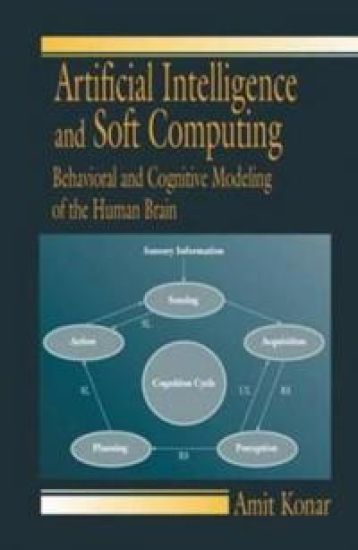
Artificial Intelligence and Soft Computing
With all the material available in the field of artificial intelligence (AI) and soft computing-texts, monographs, and journal articles-there remains a serious gap in the literature. Until now, there has been no comprehensive resource accessible to a broad audience yet containing a depth and breadth of information that enables the reader to fully understand and readily apply AI and soft computing concepts. Artificial Intelligence and Soft Computing fills this gap. It presents both the traditional and the modern aspects of AI and soft computing in a clear, insightful, and highly comprehensive style. It provides an in-depth analysis of mathematical models and algorithms and demonstrates their applications in real world problems. Beginning with the behavioral perspective of "human cognition," the text covers the tools and techniques required for its intelligent realization on machines. The author addresses the classical aspects-search, symbolic logic, planning, and machine learning-in detail and includes the latest research in these areas. He introduces the modern aspects of soft computing from first principles and discusses them in a manner that enables a beginner to grasp the subject. He also covers a number of other leading aspects of AI research, including nonmonotonic and spatio-temporal reasoning, knowledge acquisition, and much more. Artificial Intelligence and Soft Computing: Behavioral and Cognitive Modeling of the Human Brain is unique for its diverse content, clear presentation, and overall completeness. It provides a practical, detailed introduction that will prove valuable to computer science practitioners and students as well as to researchers migrating to the subject from other disciplines.