Kirjojen hintavertailu. Mukana 12 595 353 kirjaa ja 12 kauppaa.

Kirjailija

Amita Kapoor

Kirjat ja teokset yhdessä paikassa: 7 kirjaa, julkaisuja vuosilta 2016-2023, suosituimpien joukossa TensorFlow 1.x Deep Learning Cookbook. Vertaile teosten hintoja ja tarkista saatavuus suomalaisista kirjakaupoista.

7 kirjaa

Kirjojen julkaisuhaarukka 2016-2023.

Platform and Model Design for Responsible AI

Platform and Model Design for Responsible AI

Amita Kapoor; Sharmistha Chatterjee

PACKT PUBLISHING LIMITED
2023
nidottu
Craft ethical AI projects with privacy, fairness, and risk assessment features for scalable and distributed systems while maintaining explainability and sustainability Purchase of the print or Kindle book includes a free PDF eBook Key Features Learn risk assessment for machine learning frameworks in a global landscape Discover patterns for next-generation AI ecosystems for successful product design Make explainable predictions for privacy and fairness-enabled ML training Book DescriptionAI algorithms are ubiquitous and used for tasks, from recruiting to deciding who will get a loan. With such widespread use of AI in the decision-making process, it’s necessary to build an explainable, responsible, transparent, and trustworthy AI-enabled system. With Platform and Model Design for Responsible AI, you’ll be able to make existing black box models transparent. You’ll be able to identify and eliminate bias in your models, deal with uncertainty arising from both data and model limitations, and provide a responsible AI solution. You’ll start by designing ethical models for traditional and deep learning ML models, as well as deploying them in a sustainable production setup. After that, you’ll learn how to set up data pipelines, validate datasets, and set up component microservices in a secure and private way in any cloud-agnostic framework. You’ll then build a fair and private ML model with proper constraints, tune the hyperparameters, and evaluate the model metrics. By the end of this book, you’ll know the best practices to comply with data privacy and ethics laws, in addition to the techniques needed for data anonymization. You’ll be able to develop models with explainability, store them in feature stores, and handle uncertainty in model predictions.What you will learn Understand the threats and risks involved in ML models Discover varying levels of risk mitigation strategies and risk tiering tools Apply traditional and deep learning optimization techniques efficiently Build auditable and interpretable ML models and feature stores Understand the concept of uncertainty and explore model explainability tools Develop models for different clouds including AWS, Azure, and GCP Explore ML orchestration tools such as Kubeflow and Vertex AI Incorporate privacy and fairness in ML models from design to deployment Who this book is forThis book is for experienced machine learning professionals looking to understand the risks and leakages of ML models and frameworks, and learn to develop and use reusable components to reduce effort and cost in setting up and maintaining the AI ecosystem.
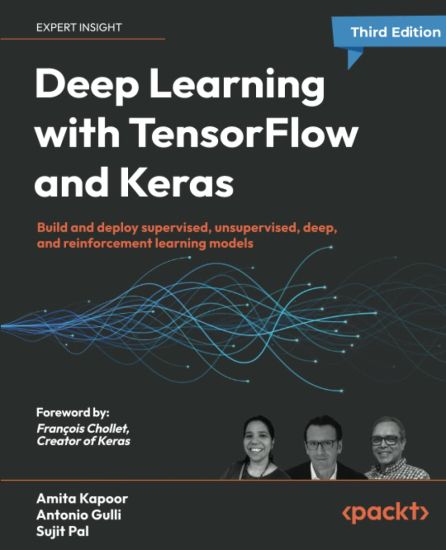
Deep Learning with TensorFlow and Keras

Deep Learning with TensorFlow and Keras

Amita Kapoor; Antonio Gulli; Sujit Pal; Francois Chollet

PACKT PUBLISHING LIMITED
2022
nidottu
Build cutting edge machine and deep learning systems for the lab, production, and mobile devices.Purchase of the print or Kindle book includes a free eBook in PDF format.Key FeaturesUnderstand the fundamentals of deep learning and machine learning through clear explanations and extensive code samplesImplement graph neural networks, transformers using Hugging Face and TensorFlow Hub, and joint and contrastive learningLearn cutting-edge machine and deep learning techniquesBook DescriptionDeep Learning with TensorFlow and Keras teaches you neural networks and deep learning techniques using TensorFlow (TF) and Keras. You'll learn how to write deep learning applications in the most powerful, popular, and scalable machine learning stack available.TensorFlow 2.x focuses on simplicity and ease of use, with updates like eager execution, intuitive higher-level APIs based on Keras, and flexible model building on any platform. This book uses the latest TF 2.0 features and libraries to present an overview of supervised and unsupervised machine learning models and provides a comprehensive analysis of deep learning and reinforcement learning models using practical examples for the cloud, mobile, and large production environments.This book also shows you how to create neural networks with TensorFlow, runs through popular algorithms (regression, convolutional neural networks (CNNs), transformers, generative adversarial networks (GANs), recurrent neural networks (RNNs), natural language processing (NLP), and graph neural networks (GNNs)), covers working example apps, and then dives into TF in production, TF mobile, and TensorFlow with AutoML.What you will learnLearn how to use the popular GNNs with TensorFlow to carry out graph mining tasksDiscover the world of transformers, from pretraining to fine-tuning to evaluating themApply self-supervised learning to natural language processing, computer vision, and audio signal processingCombine probabilistic and deep learning models using TensorFlow ProbabilityTrain your models on the cloud and put TF to work in real environmentsBuild machine learning and deep learning systems with TensorFlow 2.x and the Keras APIWho this book is forThis hands-on machine learning book is for Python developers and data scientists who want to build machine learning and deep learning systems with TensorFlow. This book gives you the theory and practice required to use Keras, TensorFlow, and AutoML to build machine learning systems.Some machine learning knowledge would be useful. We don't assume TF knowledge.
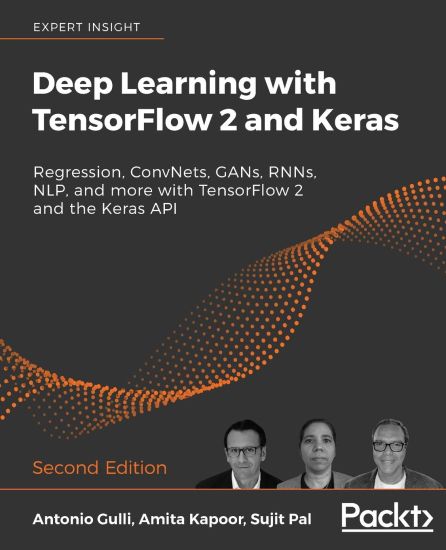
Deep Learning with TensorFlow 2 and Keras

Deep Learning with TensorFlow 2 and Keras

Antonio Gulli; Amita Kapoor; Sujit Pal

Packt Publishing Limited
2019
nidottu
Build machine and deep learning systems with the newly released TensorFlow 2 and Keras for the lab, production, and mobile devicesKey FeaturesIntroduces and then uses TensorFlow 2 and Keras right from the startTeaches key machine and deep learning techniquesUnderstand the fundamentals of deep learning and machine learning through clear explanations and extensive code samplesBook DescriptionDeep Learning with TensorFlow 2 and Keras, Second Edition teaches neural networks and deep learning techniques alongside TensorFlow (TF) and Keras. You’ll learn how to write deep learning applications in the most powerful, popular, and scalable machine learning stack available.TensorFlow is the machine learning library of choice for professional applications, while Keras offers a simple and powerful Python API for accessing TensorFlow. TensorFlow 2 provides full Keras integration, making advanced machine learning easier and more convenient than ever before.This book also introduces neural networks with TensorFlow, runs through the main applications (regression, ConvNets (CNNs), GANs, RNNs, NLP), covers two working example apps, and then dives into TF in production, TF mobile, and using TensorFlow with AutoML.What you will learnBuild machine learning and deep learning systems with TensorFlow 2 and the Keras APIUse Regression analysis, the most popular approach to machine learningUnderstand ConvNets (convolutional neural networks) and how they are essential for deep learning systems such as image classifiersUse GANs (generative adversarial networks) to create new data that fits with existing patternsDiscover RNNs (recurrent neural networks) that can process sequences of input intelligently, using one part of a sequence to correctly interpret anotherApply deep learning to natural human language and interpret natural language texts to produce an appropriate responseTrain your models on the cloud and put TF to work in real environmentsExplore how Google tools can automate simple ML workflows without the need for complex modelingWho this book is forThis book is for Python developers and data scientists who want to build machine learning and deep learning systems with TensorFlow. This book gives you the theory and practice required to use Keras, TensorFlow 2, and AutoML to build machine learning systems. Some knowledge of machine learning is expected.
Hands-On Artificial Intelligence for IoT

Hands-On Artificial Intelligence for IoT

Amita Kapoor

Packt Publishing Limited
2019
nidottu
Build smarter systems by combining artificial intelligence and the Internet of Things—two of the most talked about topics todayKey FeaturesLeverage the power of Python libraries such as TensorFlow and Keras to work with real-time IoT dataProcess IoT data and predict outcomes in real time to build smart IoT modelsCover practical case studies on industrial IoT, smart cities, and home automationBook DescriptionThere are many applications that use data science and analytics to gain insights from terabytes of data. These apps, however, do not address the challenge of continually discovering patterns for IoT data. In Hands-On Artificial Intelligence for IoT, we cover various aspects of artificial intelligence (AI) and its implementation to make your IoT solutions smarter.This book starts by covering the process of gathering and preprocessing IoT data gathered from distributed sources. You will learn different AI techniques such as machine learning, deep learning, reinforcement learning, and natural language processing to build smart IoT systems. You will also leverage the power of AI to handle real-time data coming from wearable devices. As you progress through the book, techniques for building models that work with different kinds of data generated and consumed by IoT devices such as time series, images, and audio will be covered. Useful case studies on four major application areas of IoT solutions are a key focal point of this book. In the concluding chapters, you will leverage the power of widely used Python libraries, TensorFlow and Keras, to build different kinds of smart AI models.By the end of this book, you will be able to build smart AI-powered IoT apps with confidence.What you will learnApply different AI techniques including machine learning and deep learning using TensorFlow and KerasAccess and process data from various distributed sourcesPerform supervised and unsupervised machine learning for IoT dataImplement distributed processing of IoT data over Apache Spark using the MLLib and H2O.ai platformsForecast time-series data using deep learning methodsImplementing AI from case studies in Personal IoT, Industrial IoT, and Smart CitiesGain unique insights from data obtained from wearable devices and smart devicesWho this book is forIf you are a data science professional or a machine learning developer looking to build smart systems for IoT, Hands-On Artificial Intelligence for IoT is for you. If you want to learn how popular artificial intelligence (AI) techniques can be used in the Internet of Things domain, this book will also be of benefit. A basic understanding of machine learning concepts will be required to get the best out of this book.
TensorFlow Machine Learning Projects

TensorFlow Machine Learning Projects

Ankit Jain; Armando Fandango; Amita Kapoor

Packt Publishing Limited
2018
nidottu
Implement TensorFlow's offerings such as TensorBoard, TensorFlow.js, TensorFlow Probability, and TensorFlow Lite to build smart automation projectsKey FeaturesUse machine learning and deep learning principles to build real-world projectsGet to grips with TensorFlow's impressive range of module offeringsImplement projects on GANs, reinforcement learning, and capsule networkBook DescriptionTensorFlow has transformed the way machine learning is perceived. TensorFlow Machine Learning Projects teaches you how to exploit the benefits—simplicity, efficiency, and flexibility—of using TensorFlow in various real-world projects. With the help of this book, you’ll not only learn how to build advanced projects using different datasets but also be able to tackle common challenges using a range of libraries from the TensorFlow ecosystem.To start with, you’ll get to grips with using TensorFlow for machine learning projects; you’ll explore a wide range of projects using TensorForest and TensorBoard for detecting exoplanets, TensorFlow.js for sentiment analysis, and TensorFlow Lite for digit classification.As you make your way through the book, you’ll build projects in various real-world domains, incorporating natural language processing (NLP), the Gaussian process, autoencoders, recommender systems, and Bayesian neural networks, along with trending areas such as Generative Adversarial Networks (GANs), capsule networks, and reinforcement learning. You’ll learn how to use the TensorFlow on Spark API and GPU-accelerated computing with TensorFlow to detect objects, followed by how to train and develop a recurrent neural network (RNN) model to generate book scripts.By the end of this book, you’ll have gained the required expertise to build full-fledged machine learning projects at work.What you will learnUnderstand the TensorFlow ecosystem using various datasets and techniquesCreate recommendation systems for quality product recommendationsBuild projects using CNNs, NLP, and Bayesian neural networksPlay Pac-Man using deep reinforcement learningDeploy scalable TensorFlow-based machine learning systemsGenerate your own book script using RNNsWho this book is forTensorFlow Machine Learning Projects is for you if you are a data analyst, data scientist, machine learning professional, or deep learning enthusiast with basic knowledge of TensorFlow. This book is also for you if you want to build end-to-end projects in the machine learning domain using supervised, unsupervised, and reinforcement learning techniques
TensorFlow 1.x Deep Learning Cookbook

TensorFlow 1.x Deep Learning Cookbook

Antonio Gulli; Amita Kapoor

Packt Publishing Limited
2017
nidottu
Take the next step in implementing various common and not-so-common neural networks with Tensorflow 1.x About This Book • Skill up and implement tricky neural networks using Google's TensorFlow 1.x • An easy-to-follow guide that lets you explore reinforcement learning, GANs, autoencoders, multilayer perceptrons and more. • Hands-on recipes to work with Tensorflow on desktop, mobile, and cloud environment Who This Book Is For This book is intended for data analysts, data scientists, machine learning practitioners and deep learning enthusiasts who want to perform deep learning tasks on a regular basis and are looking for a handy guide they can refer to. People who are slightly familiar with neural networks, and now want to gain expertise in working with different types of neural networks and datasets, will find this book quite useful. What You Will Learn • Install TensorFlow and use it for CPU and GPU operations • Implement DNNs and apply them to solve different AI-driven problems. • Leverage different data sets such as MNIST, CIFAR-10, and Youtube8m with TensorFlow and learn how to access and use them in your code. • Use TensorBoard to understand neural network architectures, optimize the learning process, and peek inside the neural network black box. • Use different regression techniques for prediction and classification problems • Build single and multilayer perceptrons in TensorFlow • Implement CNN and RNN in TensorFlow, and use it to solve real-world use cases. • Learn how restricted Boltzmann Machines can be used to recommend movies. • Understand the implementation of Autoencoders and deep belief networks, and use them for emotion detection. • Master the different reinforcement learning methods to implement game playing agents. • GANs and their implementation using TensorFlow. In Detail Deep neural networks (DNNs) have achieved a lot of success in the field of computer vision, speech recognition, and natural language processing. The entire world is filled with excitement about how deep networks are revolutionizing artificial intelligence. This exciting recipe-based guide will take you from the realm of DNN theory to implementing them practically to solve the real-life problems in artificial intelligence domain. In this book, you will learn how to efficiently use TensorFlow, Google's open source framework for deep learning. You will implement different deep learning networks such as Convolutional Neural Networks (CNNs), Recurrent Neural Networks (RNNs), Deep Q-learning Networks (DQNs), and Generative Adversarial Networks (GANs) with easy to follow independent recipes. You will learn how to make Keras as backend with TensorFlow. With a problem-solution approach, you will understand how to implement different deep neural architectures to carry out complex tasks at work. You will learn the performance of different DNNs on some popularly used data sets such as MNIST, CIFAR-10, Youtube8m, and more. You will not only learn about the different mobile and embedded platforms supported by TensorFlow but also how to set up cloud platforms for deep learning applications. Get a sneak peek of TPU architecture and how they will affect DNN future. By using crisp, no-nonsense recipes, you will become an expert in implementing deep learning techniques in growing real-world applications and research areas such as reinforcement learning, GANs, autoencoders and more. Style and approach This book consists of hands-on recipes where you'll deal with real-world problems. You'll execute a series of tasks as you walk through data mining challenges using TensorFlow 1.x. Your one-stop solution for common and not-so-common pain points, this is a book that you must have on the shelf.