Kirjojen hintavertailu. Mukana 12 595 353 kirjaa ja 12 kauppaa.

Kirjailija

Amitava Chatterjee

Kirjat ja teokset yhdessä paikassa: 4 kirjaa, julkaisuja vuosilta 2012-2018, suosituimpien joukossa Vision Based Autonomous Robot Navigation. Vertaile teosten hintoja ja tarkista saatavuus suomalaisista kirjakaupoista.

4 kirjaa

Kirjojen julkaisuhaarukka 2012-2018.

Intelligent Control

Intelligent Control

Kaushik Das Sharma; Amitava Chatterjee; Anjan Rakshit

Springer Verlag, Singapore
2018
nidottu
This book discusses systematic designs of stable adaptive fuzzy logic controllers employing hybridizations of Lyapunov strategy-based approaches/H8 theory-based approaches and contemporary stochastic optimization techniques. The text demonstrates how candidate stochastic optimization techniques like Particle swarm optimization (PSO), harmony search (HS) algorithms, covariance matrix adaptation (CMA) etc. can be utilized in conjunction with the Lyapunov theory/H8 theory to develop such hybrid control strategies. The goal of developing a series of such hybridization processes is to combine the strengths of both Lyapunov theory/H8 theory-based local search methods and stochastic optimization-based global search methods, so as to attain superior control algorithms that can simultaneously achieve desired asymptotic performance and provide improved transient responses. The book also demonstrates how these intelligent adaptive control algorithms can be effectively utilized in real-life applications such as in temperature control for air heater systems with transportation delay, vision-based navigation of mobile robots, intelligent control of robot manipulators etc.
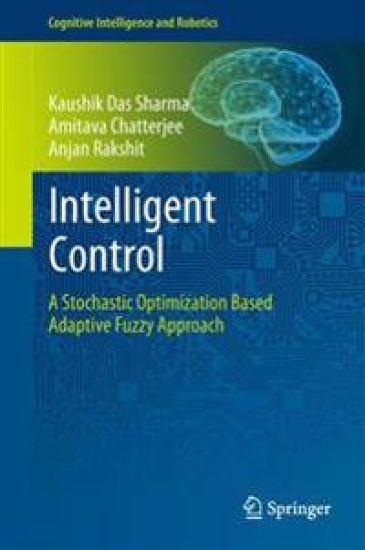
Intelligent Control

Intelligent Control

Kaushik Das Sharma; Amitava Chatterjee; Anjan Rakshit

Springer Verlag, Singapore
2018
sidottu
This book discusses systematic designs of stable adaptive fuzzy logic controllers employing hybridizations of Lyapunov strategy-based approaches/H8 theory-based approaches and contemporary stochastic optimization techniques. The text demonstrates how candidate stochastic optimization techniques like Particle swarm optimization (PSO), harmony search (HS) algorithms, covariance matrix adaptation (CMA) etc. can be utilized in conjunction with the Lyapunov theory/H8 theory to develop such hybrid control strategies. The goal of developing a series of such hybridization processes is to combine the strengths of both Lyapunov theory/H8 theory-based local search methods and stochastic optimization-based global search methods, so as to attain superior control algorithms that can simultaneously achieve desired asymptotic performance and provide improved transient responses. The book also demonstrates how these intelligent adaptive control algorithms can be effectively utilized in real-life applications such as in temperature control for air heater systems with transportation delay, vision-based navigation of mobile robots, intelligent control of robot manipulators etc.
Vision Based Autonomous Robot Navigation

Vision Based Autonomous Robot Navigation

Amitava Chatterjee; Anjan Rakshit; N. Nirmal Singh

Springer-Verlag Berlin and Heidelberg GmbH Co. K
2014
nidottu
This monograph is devoted to the theory and development of autonomous navigation of mobile robots using computer vision based sensing mechanism. The conventional robot navigation systems, utilizing traditional sensors like ultrasonic, IR, GPS, laser sensors etc., suffer several drawbacks related to either the physical limitations of the sensor or incur high cost. Vision sensing has emerged as a popular alternative where cameras can be used to reduce the overall cost, maintaining high degree of intelligence, flexibility and robustness.This book includes a detailed description of several new approaches for real life vision based autonomous navigation algorithms and SLAM. It presents the concept of how subgoal based goal-driven navigation can be carried out using vision sensing. The development concept of vision based robots for path/line tracking using fuzzy logic is presented, as well as how a low-cost robot can be indigenously developed in the laboratory with microcontroller based sensor systems. The book describes successful implementation of integration of low-cost, external peripherals, with off-the-shelf procured robots. An important highlight of the book is that it presents a detailed, step-by-step sample demonstration of how vision-based navigation modules can be actually implemented in real life, under 32-bit Windows environment. The book also discusses the concept of implementing vision based SLAM employing a two camera based system.
Vision Based Autonomous Robot Navigation

Vision Based Autonomous Robot Navigation

Amitava Chatterjee; Anjan Rakshit; N. Nirmal Singh

Springer-Verlag Berlin and Heidelberg GmbH Co. K
2012
sidottu
This monograph is devoted to the theory and development of autonomous navigation of mobile robots using computer vision based sensing mechanism. The conventional robot navigation systems, utilizing traditional sensors like ultrasonic, IR, GPS, laser sensors etc., suffer several drawbacks related to either the physical limitations of the sensor or incur high cost. Vision sensing has emerged as a popular alternative where cameras can be used to reduce the overall cost, maintaining high degree of intelligence, flexibility and robustness.This book includes a detailed description of several new approaches for real life vision based autonomous navigation algorithms and SLAM. It presents the concept of how subgoal based goal-driven navigation can be carried out using vision sensing. The development concept of vision based robots for path/line tracking using fuzzy logic is presented, as well as how a low-cost robot can be indigenously developed in the laboratory with microcontroller based sensor systems. The book describes successful implementation of integration of low-cost, external peripherals, with off-the-shelf procured robots. An important highlight of the book is that it presents a detailed, step-by-step sample demonstration of how vision-based navigation modules can be actually implemented in real life, under 32-bit Windows environment. The book also discusses the concept of implementing vision based SLAM employing a two camera based system.