

Kirjailija
Amy C. Edmondson
Kirjat ja teokset yhdessä paikassa: 28 kirjaa, julkaisuja vuosilta 1986-2026, suosituimpien joukossa Psychological Safety. Vertaile teosten hintoja ja tarkista saatavuus suomalaisista kirjakaupoista.
Mukana myös kirjoitusasut: Amy C Edmondson
28 kirjaa
Kirjojen julkaisuhaarukka 1986-2026.
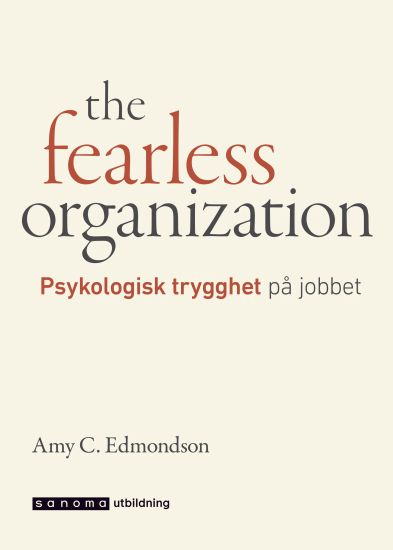
The fearless organization - Psykologisk trygghet på jobbet
Amy C Edmondson
Sanoma Utbildning
2019
sidottu
The Fearless Organization handlar om psykologisk trygghet, ett vetenskapligt utvärderat mått på hur orädd en organisation är. Psykologisk trygghet innebär ett gruppklimat där tilliten är hög och där medarbetare både vågar kommunicera halvfärdiga idéer och öppet granska och kritisera ogenomtänkta så väl som genomtänkta idéer. Det finns samtidigt en hög tolerans för att misslyckas vilket medför att medarbetare delar med sig och allt fler tar utrymme. Författaren beskriver steg för steg ett ramverk för att skapa psykologisk trygghet inom ett team eller en organisation. Boken innehåller många fallbaserade exempel och visar en tydlig väg framåt för den som vill bygga en framgångsrik organisationskultur genom att främja engagemang och ansvarstagande. Med Harvardprofessorn Amy Edmondsons tjugo år av forskning som grund hjälper denna värdefulla bok företag och andra organisationer att hantera den mänskliga sidan av innovationsekvationen, med målet att skapa arbetsplatser som är trygga, orädda och har potential att utvecklas.

Conquer the most essential adaptation to the knowledge economy The Fearless Organization: Creating Psychological Safety in the Workplace for Learning, Innovation, and Growth offers practical guidance for teams and organizations who are serious about success in the modern economy. With so much riding on innovation, creativity, and spark, it is essential to attract and retain quality talent—but what good does this talent do if no one is able to speak their mind? The traditional culture of "fitting in" and "going along" spells doom in the knowledge economy. Success requires a continuous influx of new ideas, new challenges, and critical thought, and the interpersonal climate must not suppress, silence, ridicule or intimidate. Not every idea is good, and yes there are stupid questions, and yes dissent can slow things down, but talking through these things is an essential part of the creative process. People must be allowed to voice half-finished thoughts, ask questions from left field, and brainstorm out loud; it creates a culture in which a minor flub or momentary lapse is no big deal, and where actual mistakes are owned and corrected, and where the next left-field idea could be the next big thing. This book explores this culture of psychological safety, and provides a blueprint for bringing it to life. The road is sometimes bumpy, but succinct and informative scenario-based explanations provide a clear path forward to constant learning and healthy innovation. Explore the link between psychological safety and high performanceCreate a culture where it’s “safe” to express ideas, ask questions, and admit mistakesNurture the level of engagement and candor required in today’s knowledge economyFollow a step-by-step framework for establishing psychological safety in your team or organization Shed the "yes-men" approach and step into real performance. Fertilize creativity, clarify goals, achieve accountability, redefine leadership, and much more. The Fearless Organization helps you bring about this most critical transformation.

Extreme Teaming
Amy C. Edmondson; Jean-François Harvey; Henry W. Chesbrough
Emerald Publishing Limited
2017
sidottu
Today’s global enterprises increasingly involve collaborative work by teams of experts operating across different professions, organizations, and industries. Extreme Teaming provides new insights into the world of complex, cross industry projects and the ways they must be managed. Leading experts Amy Edmondson and Jean-François Harvey analyze contemporary cases that expose the complex demands of cross-boundary collaboration on management, and inform our understanding of teams. Containing powerful insights and practical guidelines that allow managers to bridge professional divides and organizational boundaries in order to work together effectively, this is a new exploration of the challenges involved in today’s global enterprises. The authors demonstrate that the work done in the modern organization is less and less about looking inward and creating strong teams inside the company, and more about teaming across boundaries – that often are in flux. Extreme Teaming is a must-read book for all courses related to leading open innovation; teamwork and collaboration; project management; and cross-boundary work.
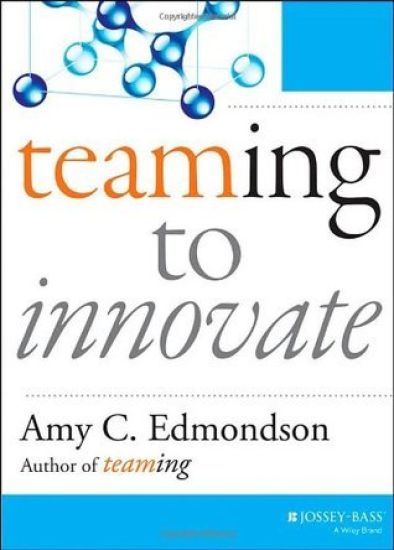
Innovation requires teaming. (Put another way, teaming is to innovation what assembly lines are to car production.) This book brings together key insights on teaming, as they pertain to innovation. How do you build a culture of innovation? What does that culture look like? How does it evolve and grow? How are teams most effectively created and then nurtured in this context? What is a leader's role in this culture? This little book is a roadmap for teaming to innovate. We describe five necessary steps along that road: Aim High, Team Up, Fail Well, Learn Fast, and Repeat. This path is not smooth. To illustrate each critical step, we look at real-life scenarios that show how teaming to innovate provides the spark that can fertilize creativity, clarify goals, and redefine the meaning of leadership.
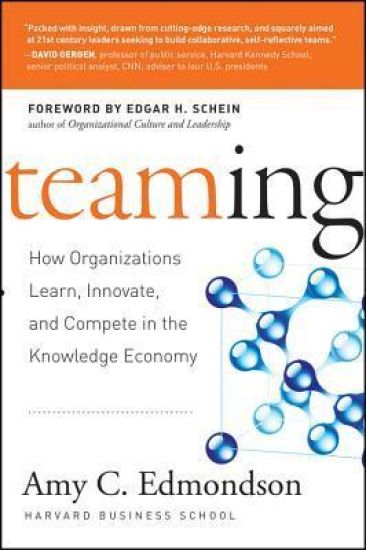
New breakthrough thinking in organizational learning, leadership, and change Continuous improvement, understanding complex systems, and promoting innovation are all part of the landscape of learning challenges today's companies face. Amy Edmondson shows that organizations thrive, or fail to thrive, based on how well the small groups within those organizations work. In most organizations, the work that produces value for customers is carried out by teams, and increasingly, by flexible team-like entities. The pace of change and the fluidity of most work structures means that it's not really about creating effective teams anymore, but instead about leading effective teaming. Teaming shows that organizations learn when the flexible, fluid collaborations they encompass are able to learn. The problem is teams, and other dynamic groups, don't learn naturally. Edmondson outlines the factors that prevent them from doing so, such as interpersonal fear, irrational beliefs about failure, groupthink, problematic power dynamics, and information hoarding. With Teaming, leaders can shape these factors by encouraging reflection, creating psychological safety, and overcoming defensive interpersonal dynamics that inhibit the sharing of ideas. Further, they can use practical management strategies to help organizations realize the benefits inherent in both success and failure. Presents a clear explanation of practical management concepts for increasing learning capability for business resultsIntroduces a framework that clarifies how learning processes must be altered for different kinds of workExplains how Collaborative Learning works, and gives tips for how to do it wellIncludes case-study research on Intermountain healthcare, Prudential, GM, Toyota, IDEO, the IRS, and both Cincinnati and Minneapolis Children's Hospitals, among others Based on years of research, this book shows how leaders can make organizational learning happen by building teams that learn.


In a broad sense Design Science is the grammar of a language of images rather than of words. Modern communication techniques enable us to transmit and reconstitute images without the need of knowing a specific verbal sequential language such as the Morse code or Hungarian. International traffic signs use international image symbols which are not specific to any particular verbal language. An image language differs from a verbal one in that the latter uses a linear string of symbols, whereas the former is multidimensional. Architectural renderings commonly show projections onto three mutually perpendicular planes, or consist of cross sections at differ ent altitudes representing a stack of floor plans. Such renderings make it difficult to imagine buildings containing ramps and other features which disguise the separation between floors; consequently, they limit the creativity of the architect. Analogously, we tend to analyze natural structures as if nature had used similar stacked renderings, rather than, for instance, a system of packed spheres, with the result that we fail to perceive the system of organization determining the form of such structures.