Kirjojen hintavertailu. Mukana 12 312 001 kirjaa ja 12 kauppaa.

Kirjailija

Ana Deumert

Kirjat ja teokset yhdessä paikassa: 7 kirjaa, julkaisuja vuosilta 2004-2024, suosituimpien joukossa Introducing Sociolinguistics 3rd Edition. Vertaile teosten hintoja ja tarkista saatavuus suomalaisista kirjakaupoista.

7 kirjaa

Kirjojen julkaisuhaarukka 2004-2024.

Introducing Sociolinguistics 3rd Edition

Introducing Sociolinguistics 3rd Edition

Rajend Mesthrie; Joan Swann; Ana Deumert; Rebecca Lurie Starr

EDINBURGH UNIVERSITY PRESS
2024
pokkari
Sociolinguistics is one of the central branches of modern linguistics and deals with the place of language in human societies. This second edition of Introducing Sociolinguistics expertly synthesises the main approaches to the subject. The book covers areas such as multilingualism, code-choice, language variation, dialectology, interactional studies, gender, language contact, language and inequality, and language and power. At the same time it provides an integrated perspective on these themes by examining sociological theories of human interaction. In this regard power and inequality are particularly significant. The book also contains two chapters on the applications of sociolinguistics (in education and in language policy and planning) and a concluding chapter on the sociolinguistics of sign language. New topics covered include speaking style and stylisation, while current debates in areas like creolisation, globalisation and language death, language planning, and gender are reflected.Written collaboratively by teachers and scholars with first hand experience of sociolinguistic developments on four continents, this book provides the broadest introduction currently available to the central topics in sociolinguistics.Features: * Provides a solid foundation in all aspects of sociolinguistics and explores important themes such as power and inequality, sign language, gender and the internet* Well illustrated with maps, diagrams, inset boxes, drawings and cartoons* Accessibly written with the beginner in mind* Uses numerous examples from multilingual settings* Explains basic concepts, supported by a glossary* Further Reading lists, a full bibliography, and a section on 'next steps' provide valuable guidance
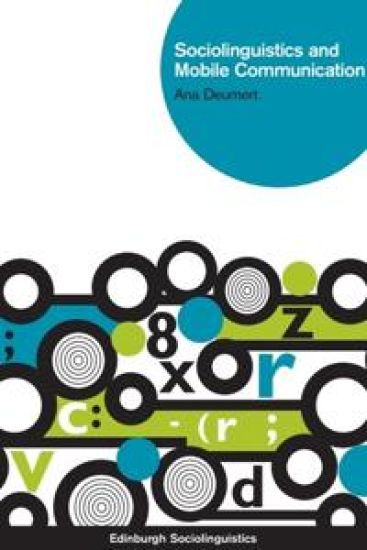
Sociolinguistics and Mobile Communication

Sociolinguistics and Mobile Communication

Ana Deumert

Edinburgh University Press
2014
nidottu
This book applies sociolinguistic methodologies and theories to mobile communication. Have wireless mobile communication technologies changed the way people talk to one another? What does it mean to be able to speak or write to anyone, anywhere, 24/7/365, and get an immediate response? And what does the current profusion of these technologies mean for the study of language in social life? This volume takes a global perspective and provides readers with a nuanced, ethnographically-informed understanding of mobile communication and sociolinguistics. It explores a wide range of digital applications, including SMS, email, Twitter, Facebook, YouTube, chatting, blogging, Wikipedia, Second Life and gaming. It raises important questions about the nature of language, the roles of multimodality and intertextuality in creating meaning, and the realities and consequences of digital linguistic inequality. It explores the formation of virtual communities, ways of online socialising and the performance of the digital 'self'. Based on a multicultural and multilingual approach, it gives a comprehensive and intriguing overview of digital communication. It contains a glossary of relevant terms. It provides a global context which highlights common trends and practices in mobile communication. It utilises extensive original multilingual data within case studies. It discusses new research insights and innovative interdisciplinary approaches.
Sociolinguistics and Mobile Communication

Sociolinguistics and Mobile Communication

Ana Deumert

Edinburgh University Press
2014
sidottu
Have wireless, mobile communication technologies changed the way people talk to one another? What does it mean to be able to speak or write to anyone, anywhere, 24/7/365, and get an immediate response? And what does the current profusion of these technologies mean for the study of language in social life? Do we need to develop new approaches, methodologies and theories? Taking a global perspective, this volume provides readers with a nuanced, ethnographically-informed understanding of mobile communication and sociolinguistics. The text explores a wide range of digital applications, including SMS, email, tweeting, Facebook, YouTube, chatting, blogging, Wikipedia, Second Life and gaming. It raises important questions about the nature of language, the role of multimodality and intertextuality in creating meaning, the realities and consequences of digital linguistic inequality. The formation of virtual communities, ways of online socialising and the performance of the 'self' are explored. Based on a multicultural and multilingual approach, the volume provides a comprehensive and intriguing overview of digital communication for both students and researchers. Features: an accessible discussion and explanation of various sociolinguistic methodologies and theories as applied to mobile communication; a glossary of relevant terms; global perspective which highlights common trends and practices in mobile communication; extensive original multilingual data and discussion of case studies; and new research insights and innovative interdisciplinary approaches.
Introducing Sociolinguistics

Introducing Sociolinguistics

Rajend Mesthrie; Joan Swann; Ana Deumert; William Leap

Edinburgh University Press
2009
nidottu
Sociolinguistics is one of the central branches of modern linguistics and deals with the place of language in human societies. This second edition of Introducing Sociolinguistics expertly synthesises the main approaches to the subject. The book covers areas such as multilingualism, code-choice, language variation, dialectology, interactional studies, gender, language contact, language and inequality, and language and power. At the same time it provides an integrated perspective on these themes by examining sociological theories of human interaction. In this regard power and inequality are particularly significant. The book also contains two chapters on the applications of sociolinguistics (in education and in language policy and planning) and a concluding chapter on the sociolinguistics of sign language. New topics covered include speaking style and stylisation, while current debates in areas like creolisation, globalisation and language death, language planning, and gender are reflected. Written collaboratively by teachers and scholars with first hand experience of sociolinguistic developments on four continents, this book provides the broadest introduction currently available to the central topics in sociolinguistics. Features: * Provides a solid foundation in all aspects of sociolinguistics and explores important themes such as power and inequality, sign language, gender and the internet * Well illustrated with maps, diagrams, inset boxes, drawings and cartoons * Accessibly written with the beginner in mind * Uses numerous examples from multilingual settings * Explains basic concepts, supported by a glossary * Further Reading lists, a full bibliography, and a section on 'next steps' provide valuable guidance.
Introducing Sociolinguistics

Introducing Sociolinguistics

Rajend Mesthrie; Joan Swann; Ana Deumert; William Leap

Edinburgh University Press
2009
sidottu
Sociolinguistics is one of the central branches of modern linguistics and deals with the place of language in human societies. This second edition of Introducing Sociolinguistics expertly synthesises the main approaches to the subject. The book covers areas such as multilingualism, code-choice, language variation, dialectology, interactional studies, gender, language contact, language and inequality, and language and power. At the same time it provides an integrated perspective on these themes by examining sociological theories of human interaction. In this regard power and inequality are particularly significant. The book also contains two chapters on the applications of sociolinguistics (in education and in language policy and planning) and a concluding chapter on the sociolinguistics of sign language. New topics covered include speaking style and stylisation, while current debates in areas like creolisation, globalisation and language death, language planning, and gender are reflected. Written collaboratively by teachers and scholars with first hand experience of sociolinguistic developments on four continents, this book provides the broadest introduction currently available to the central topics in sociolinguistics. Features: * Provides a solid foundation in all aspects of sociolinguistics and explores important themes such as power and inequality, sign language, gender and the internet * Well illustrated with maps, diagrams, inset boxes, drawings and cartoons * Accessibly written with the beginner in mind * Uses numerous examples from multilingual settings * Explains basic concepts, supported by a glossary * Further Reading lists, a full bibliography, and a section on 'next steps' provide valuable guidance.
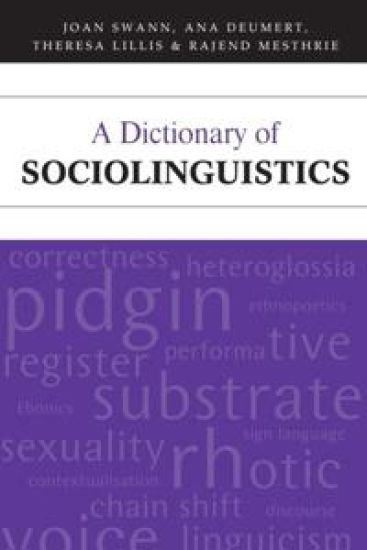
A Dictionary of Sociolinguistics

A Dictionary of Sociolinguistics

Joan Swann; Ana Deumert; Theresa Lillis; Rajend Mesthrie

Edinburgh University Press
2004
sidottu
The first comprehensive dictionary of the field of sociolinguistics, this is a valuable reference book for students and teachers of sociolinguistics, others concerned with the socially-oriented study of language and those with a professional interest in language. Entries are concise, the style is reader-friendly and numerous cross-references enable readers to follow up links to related terms and concepts. Sociolinguistics is characterised by increasing heterogeneity, and students are faced with a proliferation of theories, concepts and terminology. This is sometimes a minefield, with similar terms used rather differently within different academic traditions. The dictionary provides a broad coverage of sociolinguistics, including macro- and micro-sociolinguistics and a range of approaches within variationist, interactional, critical and applied traditions. In explaining sociolinguistic terminology, the dictionary is able to map out the traditions and approaches that comprise sociolinguistics and will thus help readers find their way around this fascinating but complex subject. The authors have taught and researched widely across different areas of sociolinguistics.They also draw on their experience of working in different geographical areas, including the USA, UK and Europe, Australia, southern Africa and the Indian subcontinent. Features: *Covers topics relevant to a broad range of disciplines, including anthropology, psychology, sociology and education as well as linguistics *Organised alphabetically with terms explained in a non-technical way *Includes an extensive bibliography.
A Dictionary of Sociolinguistics

A Dictionary of Sociolinguistics

Joan Swann; Ana Deumert; Theresa Lillis; Rajend Mesthrie

Edinburgh University Press
2004
nidottu
The first comprehensive dictionary of the field of sociolinguistics, this is a valuable reference book for students and teachers of sociolinguistics, others concerned with the socially-oriented study of language and those with a professional interest in language. Entries are concise, the style is reader-friendly and numerous cross-references enable readers to follow up links to related terms and concepts.Sociolinguistics is characterised by increasing heterogeneity, and students are faced with a proliferation of theories, concepts and terminology. This is sometimes a minefield, with similar terms used rather differently within different academic traditions. The dictionary provides a broad coverage of sociolinguistics, including macro- and micro-sociolinguistics and a range of approaches within variationist, interactional, critical and applied traditions. In explaining sociolinguistic terminology, the dictionary is able to map out the traditions and approaches that comprise sociolinguistics and will thus help readers find their way around this fascinating but complex subject. The authors have taught and researched widely across different areas of sociolinguistics. They also draw on their experience of working in different geographical areas, including the USA, UK and Europe, Australia, southern Africa and the Indian subcontinent.Features:*Covers topics relevant to a broad range of disciplines, including anthropology, psychology, sociology and education as well as linguistics*Organised alphabetically with terms explained in a non-technical way*Includes an extensive bibliography.