

Kirjailija
Anatol Rapoport
Kirjat ja teokset yhdessä paikassa: 10 kirjaa, julkaisuja vuosilta 1965-2023, suosituimpien joukossa History and Precedent in Environmental Design. Vertaile teosten hintoja ja tarkista saatavuus suomalaisista kirjakaupoista.
10 kirjaa
Kirjojen julkaisuhaarukka 1965-2023.
Response Models for Detection of Change
Anatol Rapoport; W. Stein; G. Burkheimer
Springer
2013
nidottu
This book reports our research on detection of change processes that underlie psychophysical, learning, medical diagnosis, military, and pro duction control situations, and share three major features. First, the states of the process are not directly observable but become gradually known with the sequential acquisition of fallible information over time. Second, the mechanism that generates the fallible information is not stationary; rather, it is subjected to a sudden and irrevocable change. Thirdly, in complete, probabilistic information about the time of change is available when the process commences. The purpose of the book is to characterize this class of detection of change processes, to derive the optimal policy that minimizes total expected loss, and, most importantly, to develop testable response models, based on simple decision rules, for describing detection of change behavior. The book is theoretical in the sense that it offers mathematical models of multi-stage decision behavior and solutions to optimization problems. However, it is not anti-empirical, as it aims to stimulate new experimental research and to generate applications. Throughout the book, questions of experimental verification are briefly considered, and existing data from two studies are brought to bear on the validity of the models. The work is not complete; it only provides a starting point for investigating how people detect a change in an uncertain environment, balancing between the cost of delay in detecting the change and the cost of making an incor rect terminal decision.
N-person game theory analyzes contests in which there are more than two sets of conflicting interests, from a hand of poker to wide-scale warfare. In this sequel to "Two-Person Game Theory, "the author introduces the necessary mathematical notation (mainly set theory), presents basic concepts, discusses a variety of models, and provides applications to social situations. 1970 edition.

The Journal of Conflict Resolution: A Quarterly for Research Related to War and Peace, V1, No. 3, September, 1957
Anatol Rapoport
Literary Licensing, LLC
2012
nidottu
This book presents the content of a year's course in decision processes for third and fourth year students given at the University of Toronto. A principal theme of the book is the relationship between normative and descriptive decision theory. The distinction between the two approaches is not clear to everyone, yet it is of great importance. Normative decision theory addresses itself to the question of how people ought to make decisions in various types of situations, if they wish to be regarded (or to regard themselves) as 'rational'. Descriptive decision theory purports to describe how people actually make decisions in a variety of situations. Normative decision theory is much more formalized than descriptive theory. Especially in its advanced branches, normative theory makes use of mathematicallanguage, mode of discourse, and concepts. For this reason, the definitions of terms encountered in normative decision theory are precise, and its deductions are rigorous. Like the terms and assertions of other branches of mathematics, those of mathematically formalized decision theory need not refer to anything in the 'real', i. e. the observable, world. The terms and assertions can be interpreted in the context of models of real li fe situations, but the verisimilitude of the models is not important. They are meant to capture only the essentials of adecision situation, which in reallife may be obscured by complex details and ambiguities. It is these details and ambiguities, however, that may be crucial in determining the outcomes of the decisions.

History and Precedent in Environmental Design
Anatol Rapoport
Kluwer Academic/Plenum Publishers
1990
nidottu
This book is about a new and different way of approaching and studying the history of the built environment and the use of historical precedents in design. However, although what I am proposing is new for what is currently called architectural history, both my approach and even my conclusions are not that new in other fields, as I discovered when I attempted to find supporting evidence. * In fact, of all the disciplines dealing with various aspects of the study of the past, architectural history seems to have changed least in the ways I am advocating. There is currently a revival of interest in the history of architecture and urban form; a similar interest applies to theory, vernacular design, and culture-environment relations. After years of neglect, the study of history and the use of historical precedent are again becoming important. However, that interest has not led to new approaches to the subject, nor have its bases been examined. This I try to do. In so doing, I discuss a more rigorous and, I would argue, a more valid way of looking at historical data and hence of using such data in a theory of the built environment and as precedent in environmental design. Underlying this is my view of Environment-Behavior Studies CEBS) as an emerging theory rather than as data to help design based on current "theory. " Although this will be the subject of another book, a summary statement of this position may be useful.

This book presents the content of a year's course in decision processes for third and fourth year students given at the University of Toronto. A principal theme of the book is the relationship between normative and descriptive decision theory. The distinction between the two approaches is not clear to everyone, yet it is of great importance. Normative decision theory addresses itself to the question of how people ought to make decisions in various types of situations, if they wish to be regarded (or to regard themselves) as 'rational'. Descriptive decision theory purports to describe how people actually make decisions in a variety of situations. Normative decision theory is much more formalized than descriptive theory. Especially in its advanced branches, normative theory makes use of mathematicallanguage, mode of discourse, and concepts. For this reason, the definitions of terms encountered in normative decision theory are precise, and its deductions are rigorous. Like the terms and assertions of other branches of mathematics, those of mathematically formalized decision theory need not refer to anything in the 'real', i. e. the observable, world. The terms and assertions can be interpreted in the context of models of real li fe situations, but the verisimilitude of the models is not important. They are meant to capture only the essentials of adecision situation, which in reallife may be obscured by complex details and ambiguities. It is these details and ambiguities, however, that may be crucial in determining the outcomes of the decisions.

A scientifically grounded method by which we can understand human conflict in all its forms
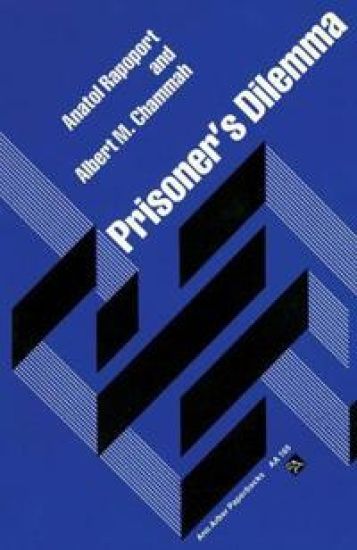
The term "Prisoner's Dilemma" comes from the original anecdote used to illustrate this game of strategy. Two prisoners, held incommunicado, are charged with the same crime. They can be convicted only if either confesses. If both prisoners confess, their payoff is minus one. If neither confesses, it is plus one. If only one confesses, he is set free for having turned state's evidence and is given a reward of plus two to boot. The prisoner who holds out is convicted on the strength of the other's testimony and is given a more severe sentence than if he had confessed. His payoff is minus two. It is in the interest of each to confess no matter what the other does, but it is in their collective interest to hold out. There is no satisfactory solution to the paradox of this game. Its simplicity is misleading. What seems rational from your own point of view, turns out to be detrimental in the end. This book is an account of many experiments in which Prisoner's Dilemma was played. Analyzing the results, one can learn how people are motivated to trust or distrust their partners, to keep faith or to betray, to be guided by joint or selfish interest. The method represents an important step toward building a bridge between psychology which is based on hard data and reproducible experiments and psychology which is concerned with internal conflict.