Kirjojen hintavertailu. Mukana 12 595 353 kirjaa ja 12 kauppaa.

Kirjailija

Andreas Freytag

Kirjat ja teokset yhdessä paikassa: 5 kirjaa, julkaisuja vuosilta 1996-2024, suosituimpien joukossa Success and Failure in Monetary Reform. Vertaile teosten hintoja ja tarkista saatavuus suomalaisista kirjakaupoista.

5 kirjaa

Kirjojen julkaisuhaarukka 1996-2024.

Reconsidering Central Bank Independence

Reconsidering Central Bank Independence

Stan Du Plessis; Andreas Freytag; Dawie van Lill

Cambridge University Press
2024
sidottu
Central bank independence has become one of the most widely accepted tenets of modern monetary policy. According to this view, the main role of independent central banks is to maintain price stability through the adjustment of short-term interest rates. Reconsidering Central Bank Independence argues that the global financial crisis has undermined confidence in this view as central banks increasingly have to address concerns other than price stability, such as financial stability, the need for output recovery and other broader policy goals. Large balance-sheet expansion by central banks followed the global financial crisis, which overlapped considerably with the financial policy of their respective governments. Exploring the consequences of this shift to a more diverse set of policy challenges, this book calls for a return to the consensus role for central banks and analyses what this might mean for their future independence.

Securing the Global Economy

Securing the Global Economy

Andreas Freytag; Paolo Savona

Routledge
2016
nidottu
Securing the Global Economy explores how and why the G8 and other institutions of global governance deal with increasingly comprehensive and complex economic-security connections. These connections are explored from an interdisciplinary perspective, with economists, political scientists and those in the policy world bringing their insights to bear. Moreover, this volume explores this economic-security connection from a constitutional or institutional perspective. In a classical liberal spirit, it is concerned with the organizing principles of a liberal international economic order and the framework of rules that enables it to survive and flourish. Security issues, national trade policies, the multilateral trade system and the detailed technical issues they subsume are analysed from this higher vantage point. This is thus a work about global governance as a whole and at its core, rather than a problem-solving manual for a few of the issues now at centre stage. Furthermore, it applies this larger vision to the current G8 and global economic-security agenda to generate a set of policy recommendations about how the global community, through and outside the G8, can better cope with the complex interconnected challenges it now confronts. Its innovative policy recommendations are especially timely when the recent global financial crisis, economic recession and fragile recovery place great strains on the liberal economic order, while new challenges from Iran, ongoing terrorist threats and corruption make this security-economic connection critically important.
Securing the Global Economy

Securing the Global Economy

Andreas Freytag; Paolo Savona

Ashgate Publishing Limited
2011
sidottu
Securing the Global Economy explores how and why the G8 and other institutions of global governance deal with increasingly comprehensive and complex economic-security connections. These connections are explored from an interdisciplinary perspective, with economists, political scientists and those in the policy world bringing their insights to bear. Moreover, this volume explores this economic-security connection from a constitutional or institutional perspective. In a classical liberal spirit, it is concerned with the organizing principles of a liberal international economic order and the framework of rules that enables it to survive and flourish. Security issues, national trade policies, the multilateral trade system and the detailed technical issues they subsume are analysed from this higher vantage point. This is thus a work about global governance as a whole and at its core, rather than a problem-solving manual for a few of the issues now at centre stage. Furthermore, it applies this larger vision to the current G8 and global economic-security agenda to generate a set of policy recommendations about how the global community, through and outside the G8, can better cope with the complex interconnected challenges it now confronts. Its innovative policy recommendations are especially timely when the recent global financial crisis, economic recession and fragile recovery place great strains on the liberal economic order, while new challenges from Iran, ongoing terrorist threats and corruption make this security-economic connection critically important.
Success and Failure in Monetary Reform

Success and Failure in Monetary Reform

Andreas Freytag

Edward Elgar Publishing Ltd
2002
sidottu
This innovative book uses mainstream theoretical analysis to explain the successes and failures of monetary reforms. Andreas Freytag argues that there is a systematic economic relationship between the success of a reform, the degree of monetary commitment and the institutional setting in a particular country. The book begins with a theoretical discussion of this relationship, and a formalisation of the theory of monetary reform. It goes on to offer an empirical assessment of the theory, using cross-section methods and case studies, before finally presenting economic policy options for countries facing monetary problems.Success and Failure in Monetary Reform will be of unique interest to economists and central banks. Scholars and students of monetary economics all over the world, in particular in developing countries, will also find this book invaluable.
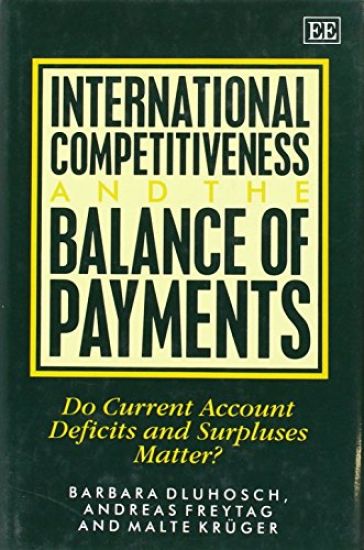
International Competitiveness and the Balance of Payments

International Competitiveness and the Balance of Payments

Barbara Dluhosch; Andreas Freytag; Malte Krüger

Edward Elgar Publishing Ltd
1996
sidottu
How can the notion of competitiveness be reasonably applied to an economy? What relation does high or low competitiveness have to the current account? Do huge and persistent imbalances really reflect competitive positions of local firms or are they merely due to a misalignment of exchange rates or even outright protectionism, as the US-Japan trade conflict suggests?All these questions are rigorously addressed in International Competitiveness and the Balance of Payments. In examining the determinants of current account balances the conventional competitiveness approach - in which deficits are assumed to indicate low competitiveness - is contrasted with an intertemporal view of the balance of payments. By emphasizing locational quality as the decisive factor in international competitiveness, the authors are able to offer fundamentally different conclusions about the determinants of current account debates.As well as theoretical evidence advocating the intertemporal view, the authors present four case studies in support of this approach: Germany before and after unification, Spain before joining the EMS, the United States since the early 1980s, and Japan's persistent current account surpluses.