Kirjojen hintavertailu. Mukana 12 595 353 kirjaa ja 12 kauppaa.

Kirjailija

Andreas Knauf

Kirjat ja teokset yhdessä paikassa: 4 kirjaa, julkaisuja vuosilta 1997-2018, suosituimpien joukossa Mathematische Physik: Klassische Mechanik. Vertaile teosten hintoja ja tarkista saatavuus suomalaisista kirjakaupoista.

4 kirjaa

Kirjojen julkaisuhaarukka 1997-2018.

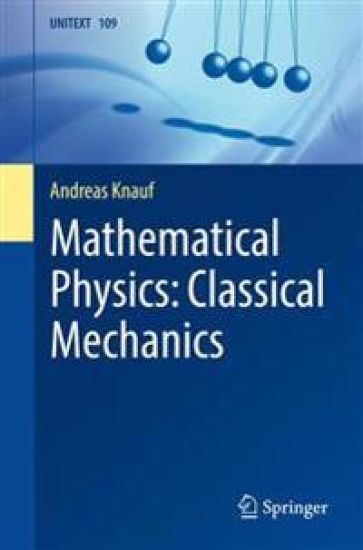
Mathematical Physics: Classical Mechanics

Mathematical Physics: Classical Mechanics

Andreas Knauf

Springer-Verlag Berlin and Heidelberg GmbH Co. K
2018
nidottu
As a limit theory of quantum mechanics, classical dynamics comprises a large variety of phenomena, from computable (integrable) to chaotic (mixing) behavior. This book presents the KAM (Kolmogorov-Arnold-Moser) theory and asymptotic completeness in classical scattering. Including a wealth of fascinating examples in physics, it offers not only an excellent selection of basic topics, but also an introduction to a number of current areas of research in the field of classical mechanics. Thanks to the didactic structure and concise appendices, the presentation is self-contained and requires only knowledge of the basic courses in mathematics.The book addresses the needs of graduate and senior undergraduate students in mathematics and physics, and of researchers interested in approaching classical mechanics from a modern point of view.
Mathematische Physik: Klassische Mechanik

Mathematische Physik: Klassische Mechanik

Andreas Knauf

Springer Fachmedien Wiesbaden
2017
nidottu
Ausgehend von interessanten Beispielen aus der Physik bietet dieses Buch auch in der zweiten Auflage nicht nur eine gelungene Auswahl grundlegender Ergebnisse der klassischen Mechanik, sondern auch einen Einstieg in aktuelle Forschungsgebiete aus diesem Bereich. Hierbei reicht das Themenspektrum von dynamischen Systemen bis hin zur Störungstheorie und zeigt den großen Formenreichtum des Gebiets auf, vom gut berechenbaren (integrablen) bis zum chaotischen (mischenden) Verhalten. Höhepunkte des Buches sind die Darstellung der KAM-Theorie (Kolmogorov-Arnold-Moser-Theorie) und ein Beweis der asymptotischen Vollständigkeit in der klassischen Streutheorie. Mit einer klaren inhaltlichen Struktur und konzentrierten Anhängen ist die Darstellung in sich geschlossen und setzt lediglich Kenntnisse der Grundvorlesungen in Mathematik voraus.
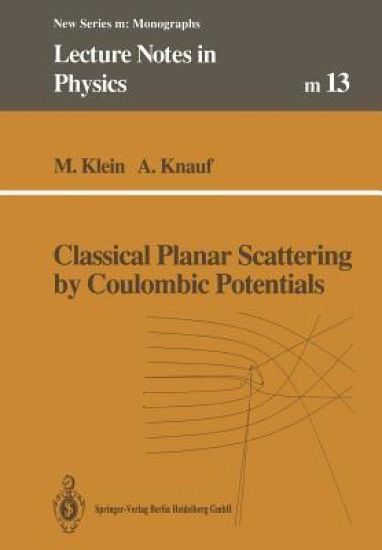
Classical Planar Scattering by Coulombic Potentials

Classical Planar Scattering by Coulombic Potentials

Markus Klein; Andreas Knauf

Springer-Verlag Berlin and Heidelberg GmbH Co. K
2014
nidottu
Astronomy as well as molecular physics describe non-relativistic motion by an interaction of the same form: By Newton's respectively by Coulomb's potential. But whereas the fundamental laws of motion thus have a simple form, the n-body problem withstood (for n > 2) all attempts of an explicit solution. Indeed, the studies of Poincare at the end of the last century lead to the conclusion that such an explicit solution should be impossible. Poincare himselfopened a new epoch for rational mechanics by asking qual­ itative questions like the one about the stability of the solar system. To a largeextent, his work, which was critical for the formation of differential geometry and topology, was motivated by problems arising in the analysis of the n-body problem ([38], p. 183). As it turned out, even by confining oneselfto questions ofqualitativenature, the general n-body problem could not be solved. Rather, simplified models were treated, like planar motion or the restricted 3-body problem, where the motion of a test particle did not influence the other two bodies.
Classical Nonintegrability, Quantum Chaos

Classical Nonintegrability, Quantum Chaos

Andreas Knauf; Yakov G. Sinai

Birkhauser Verlag AG
1997
nidottu
Our DMV Seminar on 'Classical Nonintegrability, Quantum Chaos' intended to introduce students and beginning researchers to the techniques applied in nonin­ tegrable classical and quantum dynamics. Several of these lectures are collected in this volume. The basic phenomenon of nonlinear dynamics is mixing in phase space, lead­ ing to a positive dynamical entropy and a loss of information about the initial state. The nonlinear motion in phase space gives rise to a linear action on phase space functions which in the case of iterated maps is given by a so-called transfer operator. Good mixing rates lead to a spectral gap for this operator. Similar to the use made of the Riemann zeta function in the investigation of the prime numbers, dynamical zeta functions are now being applied in nonlinear dynamics. In Chapter 2 V. Baladi first introduces dynamical zeta functions and transfer operators, illustrating and motivating these notions with a simple one-dimensional dynamical system. Then she presents a commented list of useful references, helping the newcomer to enter smoothly into this fast-developing field of research. Chapter 3 on irregular scattering and Chapter 4 on quantum chaos by A. Knauf deal with solutions of the Hamilton and the Schr6dinger equation. Scatter­ ing by a potential force tends to be irregular if three or more scattering centres are present, and a typical phenomenon is the occurrence of a Cantor set of bounded orbits. The presence of this set influences those scattering orbits which come close.