Kirjojen hintavertailu. Mukana 12 390 323 kirjaa ja 12 kauppaa.

Kirjailija

Andreas Kokkinis

Kirjat ja teokset yhdessä paikassa: 6 kirjaa, julkaisuja vuosilta 2017-2024, suosituimpien joukossa Great Debates in Company Law. Vertaile teosten hintoja ja tarkista saatavuus suomalaisista kirjakaupoista.

6 kirjaa

Kirjojen julkaisuhaarukka 2017-2024.

Great Debates in Company Law

Great Debates in Company Law

Lorraine Talbot; Andreas Kokkinis

BLOOMSBURY PUBLISHING PLC
2024
sidottu
A thoroughly updated new edition of this successful and influential text, it helps students gain a critical understanding of the key debates shaping the field of company law. The new edition has been updated to include many substantial developments in company law, specifically the area of board diversity, corporate social responsibility, shareholder control, director remuneration and human rights.

Great Debates in Company Law

Great Debates in Company Law

Lorraine Talbot; Andreas Kokkinis

BLOOMSBURY PUBLISHING PLC
2024
nidottu
A thoroughly updated new edition of this successful and influential text, it helps students gain a critical understanding of the key debates shaping the field of company law.The new edition has been updated to include many substantial developments in company law, specifically the area of board diversity, corporate social responsibility, shareholder control, director remuneration and human rights.

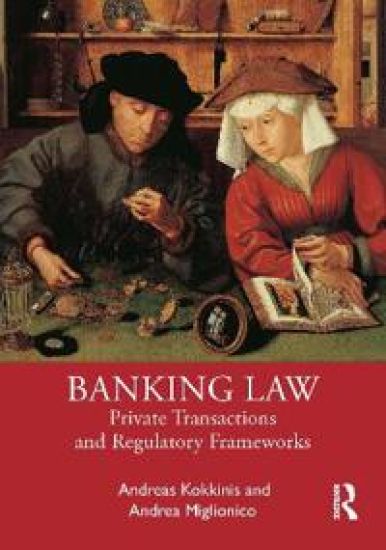
Banking Law

Banking Law

Andreas Kokkinis; Andrea Miglionico

Routledge
2021
sidottu
Banking regulation and the private law governing the bank-customer relationship came under the spotlight as a result of the global financial crisis of 2007–2009. More than a decade later UK, EU and international regulatory initiatives have transformed the structure, business practices, financing models and governance of the banking sector. This authoritative text offers an in-depth analysis of modern banking law and regulation, while providing an assessment of its effectiveness and normative underpinnings. Its main focus is on UK law and practice, but where necessary it delves into EU law and institutions, such as the European Banking Union and supervisory role of the European Central Bank. The book also covers the regulation of bank corporate governance and executive remuneration, the promises and perils of FinTech and RegTech, and the impact of Brexit on UK financial services. Although detailed, the text remains easy to read and reasonably short; pedagogic features such as a glossary of terms and practice questions for each chapter are intended to facilitate learning. It is a useful resource for students and scholars of banking law and regulation, as well as for regulators and other professionals who are interested in reading a precise and evaluative account of this evolving area of law.
Banking Law

Banking Law

Andreas Kokkinis; Andrea Miglionico

Routledge
2021
nidottu
Banking regulation and the private law governing the bank-customer relationship came under the spotlight as a result of the global financial crisis of 2007–2009. More than a decade later UK, EU and international regulatory initiatives have transformed the structure, business practices, financing models and governance of the banking sector. This authoritative text offers an in-depth analysis of modern banking law and regulation, while providing an assessment of its effectiveness and normative underpinnings. Its main focus is on UK law and practice, but where necessary it delves into EU law and institutions, such as the European Banking Union and supervisory role of the European Central Bank. The book also covers the regulation of bank corporate governance and executive remuneration, the promises and perils of FinTech and RegTech, and the impact of Brexit on UK financial services. Although detailed, the text remains easy to read and reasonably short; pedagogic features such as a glossary of terms and practice questions for each chapter are intended to facilitate learning. It is a useful resource for students and scholars of banking law and regulation, as well as for regulators and other professionals who are interested in reading a precise and evaluative account of this evolving area of law.
Corporate Law and Financial Instability
Virtually all large banks and other financial institutions in the UK and internationally are public limited liability companies whose shares are listed on one or several stock exchanges. As such, their corporate governance and, in particular, the incentives faced by their directors and senior managers are to a significant extent determined by corporate and securities law rules such as directors’ duties, directors’ liability in insolvency, takeover regulation, disclosure obligations, shareholder rights and rules on executive remuneration. At the same time, systemically important financial institutions in the UK are licensed, regulated and supervised by the Prudential Regulation Authority (PRA).This book explores the relationship between, on the one hand, the broader corporate law, corporate governance and securities law framework and, on the other, the prudential regulatory framework. Although the book’s main focus is on UK law, much of the policy argumentation is relevant globally and therefore appropriate international comparisons are drawn, and analysis of EU law and regulation is included. The book argues that the corporate law regime, which focuses on shareholder empowerment and profit maximisation, operates as an antithesis to prudential regulatory objectives thus undermining the safety and soundness of banks and other financial institutions by encouraging risky behaviour that may be in the best interests of their shareholders, but is clearly not in the public interest.
Corporate Law and Financial Instability
Virtually all large banks and other financial institutions in the UK and internationally are public limited liability companies whose shares are listed on one or several stock exchanges. As such, their corporate governance and, in particular, the incentives faced by their directors and senior managers are to a significant extent determined by corporate and securities law rules such as directors’ duties, directors’ liability in insolvency, takeover regulation, disclosure obligations, shareholder rights and rules on executive remuneration. At the same time, systemically important financial institutions in the UK are licensed, regulated and supervised by the Prudential Regulation Authority (PRA).This book explores the relationship between, on the one hand, the broader corporate law, corporate governance and securities law framework and, on the other, the prudential regulatory framework. Although the book’s main focus is on UK law, much of the policy argumentation is relevant globally and therefore appropriate international comparisons are drawn, and analysis of EU law and regulation is included. The book argues that the corporate law regime, which focuses on shareholder empowerment and profit maximisation, operates as an antithesis to prudential regulatory objectives thus undermining the safety and soundness of banks and other financial institutions by encouraging risky behaviour that may be in the best interests of their shareholders, but is clearly not in the public interest.