Kirjojen hintavertailu. Mukana 12 595 353 kirjaa ja 12 kauppaa.

Kirjailija

Andreas Koschella

Kirjat ja teokset yhdessä paikassa: 4 kirjaa, julkaisuja vuosilta 2006-2019, suosituimpien joukossa Cellulose Derivatives. Vertaile teosten hintoja ja tarkista saatavuus suomalaisista kirjakaupoista.

4 kirjaa

Kirjojen julkaisuhaarukka 2006-2019.

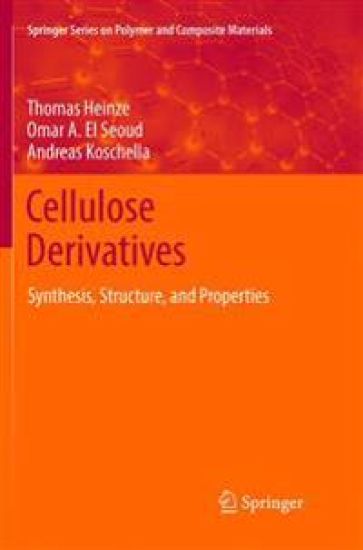
Cellulose Derivatives

Cellulose Derivatives

Thomas Heinze; Omar A. El Seoud; Andreas Koschella

Springer International Publishing AG
2019
nidottu
This book summarizes recent progress in cellulose chemistry. The last 10 years have witnessed important developments, because sustainability is a major concern. Biodegradable cellulose derivatives, in particular esters and ethers, are employed on a large scale. The recent developments in cellulose chemistry include unconventional methods for the synthesis of derivatives, introduction of novel solvents, e.g. ionic liquids, novel approaches to regioselective derivatization of cellulose, preparation of nano-particles and nano-composites for specific applications. These new developments are discussed comprehensively. This book is aimed at researchers and professionals working on cellulose and its derivatives. It fills an important gap in teaching, because most organic chemistry textbooks concentrate on the relatively simple chemistry of mono- and disaccharides. The chemistry and, more importantly, the applications of cellulose are only concisely mentioned.
Cellulose Derivatives

Cellulose Derivatives

Thomas Heinze; Omar A. El Seoud; Andreas Koschella

Springer International Publishing AG
2018
sidottu
This book summarizes recent progress in cellulose chemistry. The last 10 years have witnessed important developments, because sustainability is a major concern. Biodegradable cellulose derivatives, in particular esters and ethers, are employed on a large scale. The recent developments in cellulose chemistry include unconventional methods for the synthesis of derivatives, introduction of novel solvents, e.g. ionic liquids, novel approaches to regioselective derivatization of cellulose, preparation of nano-particles and nano-composites for specific applications. These new developments are discussed comprehensively. This book is aimed at researchers and professionals working on cellulose and its derivatives. It fills an important gap in teaching, because most organic chemistry textbooks concentrate on the relatively simple chemistry of mono- and disaccharides. The chemistry and, more importantly, the applications of cellulose are only concisely mentioned.
Esterification of Polysaccharides

Esterification of Polysaccharides

Thomas Heinze; Tim Liebert; Andreas Koschella

Springer-Verlag Berlin and Heidelberg GmbH Co. K
2014
nidottu
Polysaccharide esters (e.g. cellulose and starch) are among the first polymeric materials applied commercially. The way of producing these technically relevant derivatives, mainly the carboxylic acid esters of C2 to C4 acids, have not been changed significantly during their history of manufacture. The investigation of new acylation methods and strategies of analysis was revived during the last decade by the search for tailored, biocompatible material for specific fields of application, e.g., biotechnology, sensor technique and medicine. Unconventional solvents were developed for completely homogeneous acylation reaction applying state of the art techniques of modern organic chemistry for polysaccharide modification. This book will provide a first comprehensive summary of acylation methods in a very practical manner.Detailed structure analysis is indispensable for the evaluation of structure-property-relationships. Spectroscopic methods in particular FTIR- and NMR spectroscopy including two dimensional methods are of increasing importance.
Esterification of Polysaccharides

Esterification of Polysaccharides

Thomas Heinze; Tim Liebert; Andreas Koschella

Springer-Verlag Berlin and Heidelberg GmbH Co. K
2006
muu
Polysaccharide esters (e.g. cellulose and starch) are among the first polymeric materials applied commercially. The way of producing these technically relevant derivatives, mainly the carboxylic acid esters of C2 to C4 acids, have not been changed significantly during their history of manufacture. The investigation of new acylation methods and strategies of analysis was revived during the last decade by the search for tailored, biocompatible material for specific fields of application, e.g., biotechnology, sensor technique and medicine. Unconventional solvents were developed for completely homogeneous acylation reaction applying state of the art techniques of modern organic chemistry for polysaccharide modification. This book will provide a first comprehensive summary of acylation methods in a very practical manner.Detailed structure analysis is indispensable for the evaluation of structure-property-relationships. Spectroscopic methods in particular FTIR- and NMR spectroscopy including two dimensional methods are of increasing importance.