Kirjojen hintavertailu. Mukana 12 595 353 kirjaa ja 12 kauppaa.

Kirjailija

Andreas Philippopoulos-Mihalopoulos

Kirjat ja teokset yhdessä paikassa: 10 kirjaa, julkaisuja vuosilta 2007-2025, suosituimpien joukossa Niklas Luhmann: Law, Justice, Society. Vertaile teosten hintoja ja tarkista saatavuus suomalaisista kirjakaupoista.

10 kirjaa

Kirjojen julkaisuhaarukka 2007-2025.

Niklas Luhmann: Law, Justice, Society

Niklas Luhmann: Law, Justice, Society

Andreas Philippopoulos-Mihalopoulos

Routledge
2009
sidottu
Niklas Luhmann: Law, Justice, Society presents the work of sociologist Niklas Luhmann in a radical new light. Luhmann’s theory is here introduced both in terms of society at large and the legal system specifically, and for the first time, Luhmann’s texts are systematically read together with theoretical insights from post-structuralism, deconstruction, phenomenology, radical ethics, feminism and post-ecologism. In his far-reaching book, Andreas Philippopoulos-Mihalopoulos distances Luhmann’s theory from its misrepresentations as conservative, rigorously positivist and disconnected from empirical reality, and firmly locates it in a sphere of post-ideological jurisprudence.The book operates both as a detailed explanation of the theory’s concepts and as the locus of a critique which brings forth Luhmann’s radical credentials. The focal points are Luhmann’s concept of society and the law’s paradoxical connection to justice. However, these concepts are also transgressed in order to show how the law deals with the illusion of its identity, and more broadly how the theory itself deals with its limitations. This is illustrated by examples drawn from human rights, constitutional theory and ecological thinking. On the whole, Niklas Luhmann: Law, Justice, Society serves both as an introductory text and as a critical response to Luhmann’s theory, and is recommended reading for students and researchers in sociology, law, social sciences, politics and whoever is interested in seeing the influential work of Niklas Luhmann from a critical new perspective.
Hydrojustice

Hydrojustice

Andreas Philippopoulos-Mihalopoulos

JOHN WILEY AND SONS LTD
2025
sidottu
This is a book about justice, but not as we know it. Andreas Philippopoulos-Mihalopoulos argues that justice is always hydrojustice – that is, always defined in relation to water, the element that constitutes and unites all bodies, human and nonhuman. Hence justice is not an ideal state reached through merely human procedures (legal, political, economic, etc.) but also a planetary one, always conjoined with the element of water that both constitutes and transcends the boundaries of the human. In short, hydrojustice is the just confluence of all bodies, human and nonhuman.For the first time, this book brings questions of justice into line with the current literature on water. Up to now, justice has been understood as an anthropocentric affair, with most existing theories accepting and reinforcing the division between human and nonhuman. This book builds on feminism, ecology, posthumanism and the current Blue Turn in the humanities and social sciences, and puts questions of justice at their core.What the book proposes, however, is not simply an ecological concept of justice. Rather, through examples taken from current affairs, science and the art world, it attempts a radical recalibration of what justice is. The book argues that hydrojustice is already here, part of our planetary condition, but it requires unearthing, in the double sense of revealing what is hidden and allowing earth to cede priority to the aquatic.
Hydrojustice

Hydrojustice

Andreas Philippopoulos-Mihalopoulos

JOHN WILEY AND SONS LTD
2025
nidottu
This is a book about justice, but not as we know it. Andreas Philippopoulos-Mihalopoulos argues that justice is always hydrojustice – that is, always defined in relation to water, the element that constitutes and unites all bodies, human and nonhuman. Hence justice is not an ideal state reached through merely human procedures (legal, political, economic, etc.) but also a planetary one, always conjoined with the element of water that both constitutes and transcends the boundaries of the human. In short, hydrojustice is the just confluence of all bodies, human and nonhuman.For the first time, this book brings questions of justice into line with the current literature on water. Up to now, justice has been understood as an anthropocentric affair, with most existing theories accepting and reinforcing the division between human and nonhuman. This book builds on feminism, ecology, posthumanism and the current Blue Turn in the humanities and social sciences, and puts questions of justice at their core.What the book proposes, however, is not simply an ecological concept of justice. Rather, through examples taken from current affairs, science and the art world, it attempts a radical recalibration of what justice is. The book argues that hydrojustice is already here, part of our planetary condition, but it requires unearthing, in the double sense of revealing what is hidden and allowing earth to cede priority to the aquatic.
Our Distance Became Water

Our Distance Became Water

Andreas Philippopoulos-Mihalopoulos

Eris
2024
nidottu
“We knew very little with any certainty. One thing, though, was confirmed by everyone: that we were not the only ones flooded. For all we knew, every city across the globe had suffered a comparable fate”.As an unnamed city finds itself partially submerged below water, a small community of friends and lovers is forced to adapt to a world that has been radically transformed. An arresting vision of the wages of ecological disaster, Our Distance Became Water is at once lyrical, moving, and psychologically acute. Endlessly inventive in both its style and its substance, this is a singularly powerful literary response to environmental change. Our Distance Became Water is the debut novel of Andreas Philippopoulos-Mihalopoulos, author of the acclaimed short story collection Book of Water.
Book of Water

Book of Water

Andreas Philippopoulos-Mihalopoulos

Eris
2022
nidottu
Andreas Philippopoulos-Mihalopoulos's Book of Water is a collection of short stories about desire, fear, life, care, and ecological anxiety, all narrated through the physical and metaphysical presence of water. This water is not the open, bucolic water of the romantic imagination. It is the claustrophobic water of the deep seabed, the flooded cities, the womb. It is a water that brings oblivion, serenity, and salvation. At first impression, the stories are narrated by a multiplicity of voices preoccupied with everyday psychological situations. At some point, however, the quotidian withdraws and gives way to surreal and disorienting moments of ethical, political, psychoanalytical, ecological, and personal challenges. The book is a literary response to the current geological epoch of the Anthropocene, where the effect of the human presence on the planet and its various elements seems by now irreversible. The bodies in this collection are not limited to the human-nonhuman and inhuman alike centre in the stories. The protagonist, however, remains the body of water.
Spatial Justice

Spatial Justice

Andreas Philippopoulos-Mihalopoulos

Routledge
2015
nidottu
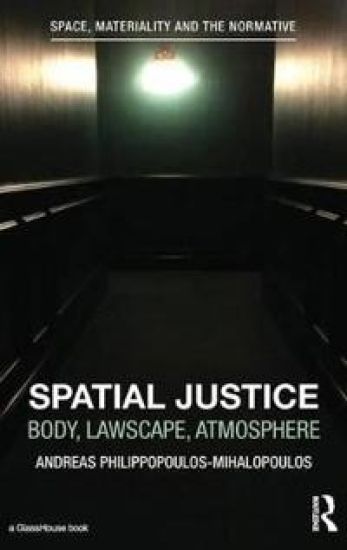
There can be no justice that is not spatial. Against a recent tendency to despatialise law, matter, bodies and even space itself, this book insists on spatialising them, arguing that there can be neither law nor justice that are not articulated through and in space.Spatial Justice presents a new theory and a radical application of the material connection between space – in the geographical as well as sociological and philosophical sense – and the law – in the broadest sense that includes written and oral law, but also embodied social and political norms. More specifically, it argues that spatial justice is the struggle of various bodies – human, natural, non-organic, technological – to occupy a certain space at a certain time. Seen in this way, spatial justice is the most radical offspring of the spatial turn, since, as this book demonstrates, spatial justice can be found in the core of most contemporary legal and political issues – issues such as geopolitical conflicts, environmental issues, animality, colonisation, droning, the cyberspace and so on. In order to ague this, the book employs the lawscape, as the tautology between law and space, and the concept of atmosphere in its geological, political, aesthetic, legal and biological dimension.Written by a leading theorist in the area, Spatial Justice: Body, Lawscape, Atmosphere forges a new interdisciplinary understanding of space and law, while offering a fresh approach to current geopolitical, spatiolegal and ecological issues.
Spatial Justice

Spatial Justice

Andreas Philippopoulos-Mihalopoulos

Routledge
2014
sidottu
There can be no justice that is not spatial. Against a recent tendency to despatialise law, matter, bodies and even space itself, this book insists on spatialising them, arguing that there can be neither law nor justice that are not articulated through and in space.Spatial Justice presents a new theory and a radical application of the material connection between space – in the geographical as well as sociological and philosophical sense – and the law – in the broadest sense that includes written and oral law, but also embodied social and political norms. More specifically, it argues that spatial justice is the struggle of various bodies – human, natural, non-organic, technological – to occupy a certain space at a certain time. Seen in this way, spatial justice is the most radical offspring of the spatial turn, since, as this book demonstrates, spatial justice can be found in the core of most contemporary legal and political issues – issues such as geopolitical conflicts, environmental issues, animality, colonisation, droning, the cyberspace and so on. In order to ague this, the book employs the lawscape, as the tautology between law and space, and the concept of atmosphere in its geological, political, aesthetic, legal and biological dimension.Written by a leading theorist in the area, Spatial Justice: Body, Lawscape, Atmosphere forges a new interdisciplinary understanding of space and law, while offering a fresh approach to current geopolitical, spatiolegal and ecological issues.
Niklas Luhmann: Law, Justice, Society

Niklas Luhmann: Law, Justice, Society

Andreas Philippopoulos-Mihalopoulos

Routledge
2011
nidottu
Niklas Luhmann: Law, Justice, Society presents the work of sociologist Niklas Luhmann in a radical new light. Luhmann’s theory is here introduced both in terms of society at large and the legal system specifically, and for the first time, Luhmann’s texts are systematically read together with theoretical insights from post-structuralism, deconstruction, phenomenology, radical ethics, feminism and post-ecologism. In his far-reaching book, Andreas Philippopoulos-Mihalopoulos distances Luhmann’s theory from its misrepresentations as conservative, rigorously positivist and disconnected from empirical reality, and firmly locates it in a sphere of post-ideological jurisprudence.The book operates both as a detailed explanation of the theory’s concepts and as the locus of a critique which brings forth Luhmann’s radical credentials. The focal points are Luhmann’s concept of society and the law’s paradoxical connection to justice. However, these concepts are also transgressed in order to show how the law deals with the illusion of its identity, and more broadly how the theory itself deals with its limitations. This is illustrated by examples drawn from human rights, constitutional theory and ecological thinking. On the whole, Niklas Luhmann: Law, Justice, Society serves both as an introductory text and as a critical response to Luhmann’s theory, and is recommended reading for students and researchers in sociology, law, social sciences, politics and whoever is interested in seeing the influential work of Niklas Luhmann from a critical new perspective.
Absent Environments

Absent Environments

Andreas Philippopoulos-Mihalopoulos

Routledge Cavendish
2009
nidottu
Offering a novel, transdisciplinary approach to environmental law, its principles, mechanics and context, as tested in its application to the urban environment, this book traces the conceptual and material absence of communication between the human and the natural and controversially includes such an absence within a system of law and a system of geography which effectively remain closed to environmental considerations.The book looks at Niklas Luhmann's theory of autopoiesis. Introducing the key concepts and operations, contextualizing them and opening them up to critical analysis. Indeed, in contrast to most discussions on autopoiesis, it proposes a radically different reading of the theory, in line with critical legal, political, sociological, urban and ecological theories, while drawing from writings by Husserl and Derrida, as well as Latour, Blanchot, Haraway, Agamben and Nancy.It explores a range of topics in the areas of environmental law and urban geography, including:environmental risk, environmental rights, the precautionary principle, intergenerational equity and urban wastediscourses on community, nature, science and identity. The author redefines the traditional foundations of environmental law and urban geography and suggests a radical way of dealing with scientific ignorance, cultural differences and environmental degradation within the perceived need for legal delivery of certainty.
Absent Environments

Absent Environments

Andreas Philippopoulos-Mihalopoulos

Routledge Cavendish
2007
sidottu
Offering a novel, transdisciplinary approach to environmental law, its principles, mechanics and context, as tested in its application to the urban environment, this book traces the conceptual and material absence of communication between the human and the natural and controversially includes such an absence within a system of law and a system of geography which effectively remain closed to environmental considerations.The book looks at Niklas Luhmann's theory of autopoiesis. Introducing the key concepts and operations, contextualizing them and opening them up to critical analysis. Indeed, in contrast to most discussions on autopoiesis, it proposes a radically different reading of the theory, in line with critical legal, political, sociological, urban and ecological theories, while drawing from writings by Husserl and Derrida, as well as Latour, Blanchot, Haraway, Agamben and Nancy.It explores a range of topics in the areas of environmental law and urban geography, including:environmental risk, environmental rights, the precautionary principle, intergenerational equity and urban wastediscourses on community, nature, science and identity. The author redefines the traditional foundations of environmental law and urban geography and suggests a radical way of dealing with scientific ignorance, cultural differences and environmental degradation within the perceived need for legal delivery of certainty.