Kirjojen hintavertailu. Mukana 12 595 353 kirjaa ja 12 kauppaa.

Kirjailija

Andrew Altman

Kirjat ja teokset yhdessä paikassa: 7 kirjaa, julkaisuja vuosilta 1993-2021, suosituimpien joukossa Civil Rights. Vertaile teosten hintoja ja tarkista saatavuus suomalaisista kirjakaupoista.

7 kirjaa

Kirjojen julkaisuhaarukka 1993-2021.

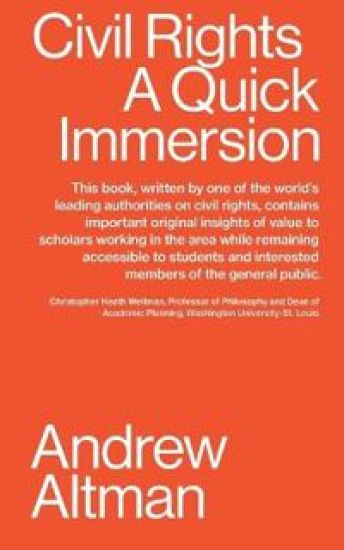
Civil Rights

Civil Rights

Andrew Altman

Tibidabo Publishing, Inc.
2021
pokkari
The idea of civil rights has animated the actions of countless persons and groups around the globe over the past several centuries. But what are civil rights? Why has the idea played such an important role in the history of the modern world? Is the idea a valuable one for addressing issues faced by societies in the early decades of the 21st century? This book addresses those questions from philosophical as well as historical perspectives. It explains the idea of civil rights by looking at its use over the centuries in major legal and political controversies over who gets to be a full member of society and what that membership entails. Three historic civil rights movements are prominent in the discussion: the Civil Rights Movement of Black Americans, the emancipation of European Jews, and the international women's movements of the 19th and 20th centuries. Drawing lessons from the similarities and differences among those movements, the book also examines 21st century civil rights issues involving matters of sexual orientation, religion, and race. ENDORSEMENTS: Civil Rights by Andrew Altman breaks new ground on important questions about rights in modern society. After providing an account of civil rights' connections to human, moral, natural, and legal rights, Altman looks unflinchingly at the history of several civil rights movements, focusing particularly on political struggles of Black Americans and European Jews. Civil Rights dramatically illustrates the treacherous see-saw of legal reform's gains and losses, hard-won successes and heartbreaking defeats, where certain civil rights have been denied, then legally established, later rescinded by judicial rulings and convention, later still recognized, again diminished, and so forth. Altman raises a suggestion that this relentless back and forth, gaining, then losing political recognition, may be endemic to legal reform itself, thus limiting its ability to ensure civil rights. Is this what inspires Altman to make the provocative yet promising claim that there are two senses of civil rights, and that "In a crucial sense, the rights with which we are concerned in this book cannot be granted or revoked, but they can be recognized, protected, or violated"? Read this tantalizing sometimes chilling yet user-friendly Civil Rights guide to find out. Sandra Dwyer, Principal Senior Lecturer, Department of Philosophy, Georgia State University. This book, written by one of the world's leading authorities on civil rights, contains important original insights of value to scholars working in the area while remaining accessible to students and interested members of the general public. Civil Rights: A Quick Immersion sets the standard for scholarship on this important subject. Christopher Heath Wellman, Professor of Philosophy and Dean of Academic Planning, Washington University-St. Louis.
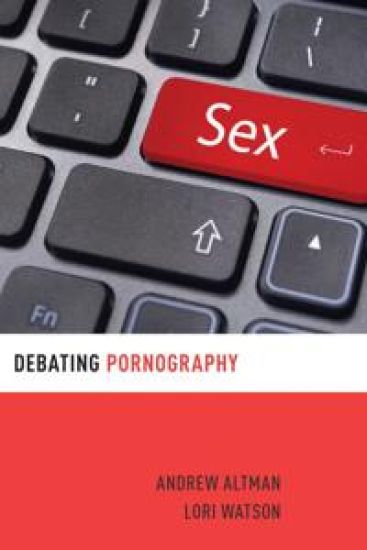
Debating Pornography

Debating Pornography

Andrew Altman; Lori Watson

Oxford University Press Inc
2019
sidottu
Since the sexual revolution of the 1960s, debates over pornography have raged, and the explosive spread in recent years of sexually explicit images across the Internet has only added more urgency to these disagreements. Politicians, judges, clergy, citizen activists, and academics have weighed in on the issues for decades, complicating notions about what precisely is at stake, and who stands to benefit or be harmed by pornography. This volume takes an unusual but radical approach by analyzing pornography philosophically. Philosophers Andrew Altman and Lori Watson recalibrate debates by viewing pornography from distinctly ethical platforms -- namely, does a person's right to produce and consume pornography supersede a person's right to protect herself from something often violent and deeply misogynistic? In a for-and-against format, Altman first argues that there is an individual right to create and view pornographic images, rooted in a basic right to sexual autonomy. Watson counteracts Altman's position by arguing that pornography inherently undermines women's equal status. Central to their disagreement is the question of whether pornography truly harms women enough to justify laws aimed at restricting the production and circulation of such material. Through this debate, the authors address key questions that have dogged both those who support and oppose pornography: What is pornography? What is the difference between the material widely perceived as objectionable and material that is merely erotic or suggestive? Do people have a right to sexual arousal? Does pornography, or some types of it, cause violence against women? How should rights be weighed against consequentialist considerations in deciding what laws and policies ought to be adopted? Bolstered by insights from philosophy and law, the two authors engage in a reasoned examination of questions that cannot be ignored by anyone who takes seriously the values of freedom and equality.
Debating Pornography

Debating Pornography

Andrew Altman; Lori Watson

Oxford University Press Inc
2018
nidottu
Since the sexual revolution of the 1960s, debates over pornography have raged, and the explosive spread in recent years of sexually explicit images across the Internet has only added more urgency to these disagreements. Politicians, judges, clergy, citizen activists, and academics have weighed in on the issues for decades, complicating notions about what precisely is at stake, and who stands to benefit or be harmed by pornography. This volume takes an unusual but radical approach by analyzing pornography philosophically. Philosophers Andrew Altman and Lori Watson recalibrate debates by viewing pornography from distinctly ethical platforms -- namely, does a person's right to produce and consume pornography supersede a person's right to protect herself from something often violent and deeply misogynistic? In a for-and-against format, Altman first argues that there is an individual right to create and view pornographic images, rooted in a basic right to sexual autonomy. Watson counteracts Altman's position by arguing that pornography inherently undermines women's equal status. Central to their disagreement is the question of whether pornography truly harms women enough to justify laws aimed at restricting the production and circulation of such material. Through this debate, the authors address key questions that have dogged both those who support and oppose pornography: What is pornography? What is the difference between the material widely perceived as objectionable and material that is merely erotic or suggestive? Do people have a right to sexual arousal? Does pornography, or some types of it, cause violence against women? How should rights be weighed against consequentialist considerations in deciding what laws and policies ought to be adopted? Bolstered by insights from philosophy and law, the two authors engage in a reasoned examination of questions that cannot be ignored by anyone who takes seriously the values of freedom and equality.
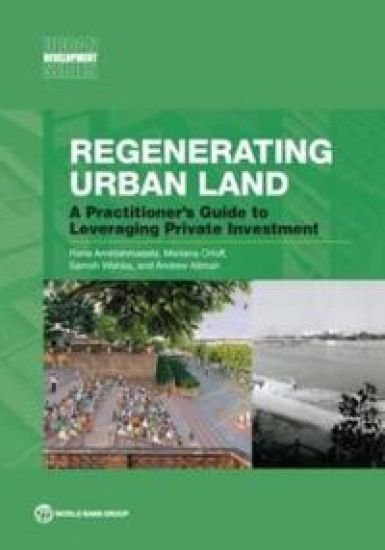
Regenerating Urban Land

Regenerating Urban Land

Rana Amirtahmasebi; Mariana Orloff; Andrew Altman; Sameh Wahba

World Bank Publications
2016
nidottu
Regenerating Urban Land draws on the experience of eight case studies from around the world. The case studies outline various policy and financial instruments to attract private sector investment in urban regeneration of underutilized and unutilized areas and the requisite infrastructure improvements. In particular, each case study details the project cycle, from the scoping phase and determination of the initial amount of public sector investment, to implementation and subsequent leveraged private-sector funds. This manual analyzes rates of return on the investments and long-term financial sustainability. Regenerating Urban Land guides local governments to systematically identify the sequence of steps and tasks needed to develop a regeneration policy framework, with the participation of the private sector. The manual also formulates specific policies and instruments for expanding private sector participation; structuring effective administrative and legal frameworks; utilizing land readjustment/assembly methods; determining duration of contracts, adequate phasing, and timeline; and balancing the distribution of risk and sustainability measures.
A Liberal Theory of International Justice

A Liberal Theory of International Justice

Andrew Altman; Christopher Heath Wellman

Oxford University Press
2011
nidottu
A Liberal Theory of International Justice advances a novel theory of international justice that combines the orthodox liberal notion that the lives of individuals are what ultimately matter morally with the putatively antiliberal idea of an irreducibly collective right of self-governance. The individual and her rights are placed at center stage insofar as political states are judged legitimate if they adequately protect the human rights of their constituents and respect the rights of all others. Yet, the book argues that legitimate states have a moral right to self-determination and that this right is inherently collective, irreducible to the individual rights of the persons who constitute them. Exploring the implications of these ideas, the book addresses issues pertaining to democracy, secession, international criminal law, armed intervention, political assassination, global distributive justice, and immigration. A number of the positions taken in the book run against the grain of current academic opinion: there is no human right to democracy; separatist groups can be morally entitled to secede from legitimate states; the fact that it is a matter of brute luck whether one is born in a wealthy state or a poorer one does not mean that economic inequalities across states must be minimized or even kept within certain limits; most existing states have no right against armed intervention; and it is morally permissible for a legitimate state to exclude all would-be immigrants.
A Liberal Theory of International Justice

A Liberal Theory of International Justice

Andrew Altman; Christopher Heath Wellman

Oxford University Press
2009
sidottu
This book advances a novel theory of international justice that combines the orthodox liberal notion that the lives of individuals are what ultimately matter morally with the putatively antiliberal idea of an irreducibly collective right of self-governance. The individual and her rights are placed at center stage insofar as political states are judged legitimate if they adequately protect the human rights of their constituents and respect the rights of all others. Yet, the book argues that legitimate states have a moral right to self-determination and that this right is inherently collective, irreducible to the individual rights of the persons who constitute them. Exploring the implications of these ideas, the book addresses issues pertaining to democracy, secession, international criminal law, armed intervention, political assassination, global distributive justice, and immigration. A number of the positions taken in the book run against the grain of current academic opinion: there is no human right to democracy; separatist groups can be morally entitled to secede from legitimate states; the fact that it is a matter of brute luck whether one is born in a wealthy state or a poorer one does not mean that economic inequalities across states must be minimized or even kept within certain limits; most existing states have no right against armed intervention; and it is morally permissible for a legitimate state to exclude all would-be immigrants.
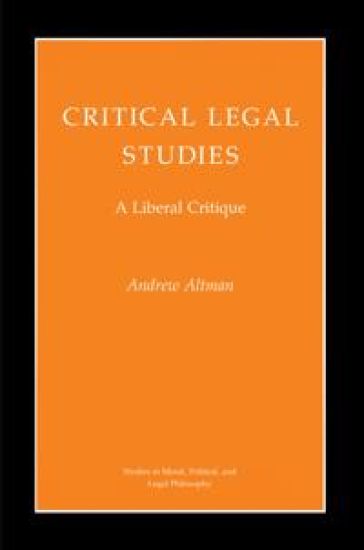
Critical Legal Studies

Critical Legal Studies

Andrew Altman

Princeton University Press
1993
pokkari
Scholars in the "Critical Legal Studies" movement have challenged some of the most cherished ideals of modern Western legal and political thought. CLS thinkers claim that the rule of law is a myth and that its defense by liberal thinkers is riddled with inconsistencies. This first book-length liberal reply to CLS systematically examines the philosophical underpinnings of the CLS movement and exposes the deficiencies in the major lines of CLS argument against liberalism.