Kirjojen hintavertailu. Mukana 12 235 567 kirjaa ja 12 kauppaa.

Kirjailija

Andrew Benjamin

Kirjat ja teokset yhdessä paikassa: 33 kirjaa, julkaisuja vuosilta 1991-2026, suosituimpien joukossa Pornification. Vertaile teosten hintoja ja tarkista saatavuus suomalaisista kirjakaupoista.

33 kirjaa

Kirjojen julkaisuhaarukka 1991-2026.

The Art of Gesture

The Art of Gesture

Andrew Benjamin

EDINBURGH UNIVERSITY PRESS
2026
sidottu
Andrew Benjamin approaches the relationship between philosophy and art history through the concept of gesture. Critically engaging with Walter Benjamin, Aby Warburg and Giorgio Agamben, by focusing on gesture he offers a novel philosophical intervention into the classical problem of ‘meaning’ in art, as well as addressing the new perspectives brought by political theology into art theory. Benjamin uses gesture to function as the continual point of orientation, allowing works of art and their detail to be central. Original interpretations of Domenico Ghirlandaio, Rosso Fiorentino and Piero dell Francesca show how Christian political theology has an operative presence within the works of art examined. A key theme running through the book is the question of time in the work of art, alongside the question of how art history, and the representation of history in art, are to be understood philosophically.
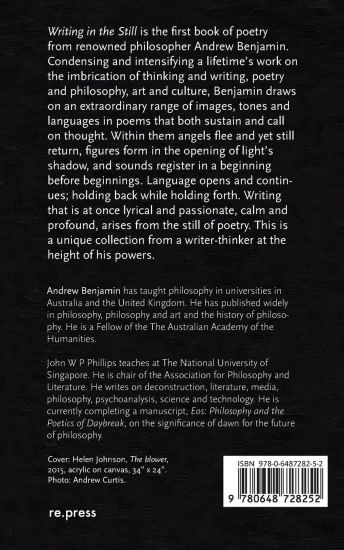
Writing in the Still

Writing in the Still

Andrew Benjamin

Re.Press
2023
pokkari
This haunting opening poem, which through eight sections situates its reader in the aftermath of a spectral memory, does not immediately suggest a place so much as the allusive echo of a choir of departed angels. The scene-historic in Walter Benjamin's sense of accumulated ruin-gives voice to such questions and recollections, "singing there in the instant," a still voice that patently inhabits discrete moments of silence. The seventh section, "That Angel should with Angel war," expands on a baffling instance where Milton's Angel Raphael recalls two armies lined up one against the other. The allusion sees the Angel Michael wielding a sword hewn in God's armoury, using Satan's body as his target, while steeling himself to land a blow that will not need repeating. With a downward stroke he slices Satan's sword in two and in the returning cycle sheers the now fallen Angel almost in half. The reader's incredulous supposition, even before the ethereal substance sutures the evaporating wound, leaving the angel humbled by the memory of pain for the first time, is that this must be poetic spectacle, a staging of epic excess.
Looking Through Images

Looking Through Images

Emmanuel Alloa; Daniel Herwitz; Andrew Benjamin

Columbia University Press
2021
pokkari
Images have always stirred ambivalent reactions. Yet whether eliciting fascinated gazes or iconoclastic repulsion from their beholders, they have hardly ever been seen as true sources of knowledge. They were long viewed as mere appearances, placeholders for the things themselves or deceptive illusions. Today, the traditional critique of the spectacle has given way to an unconditional embrace of the visual. However, we still lack a persuasive theoretical account of how images work.Emmanuel Alloa retraces the history of Western attitudes toward the visual to propose a major rethinking of images as irreplaceable agents of our everyday engagement with the world. He examines how ideas of images and their powers have been constructed in Western humanities, art theory, and philosophy, developing a novel genealogy of both visual studies and the concept of the medium. Alloa reconstructs the earliest Western media theory—Aristotle’s concept of the diaphanous milieu of vision—and the significance of its subsequent erasure in the history of science. Ultimately, he argues for a historically informed phenomenology of images and visual media that explains why images are not simply referential depictions, windows onto the world. Instead, images constantly reactivate the power of appearing. As media of visualization, they allow things to appear that could not be visible except in and through these very material devices.
Looking Through Images

Looking Through Images

Emmanuel Alloa; Daniel Herwitz; Andrew Benjamin

Columbia University Press
2021
sidottu
Images have always stirred ambivalent reactions. Yet whether eliciting fascinated gazes or iconoclastic repulsion from their beholders, they have hardly ever been seen as true sources of knowledge. They were long viewed as mere appearances, placeholders for the things themselves or deceptive illusions. Today, the traditional critique of the spectacle has given way to an unconditional embrace of the visual. However, we still lack a persuasive theoretical account of how images work.Emmanuel Alloa retraces the history of Western attitudes toward the visual to propose a major rethinking of images as irreplaceable agents of our everyday engagement with the world. He examines how ideas of images and their powers have been constructed in Western humanities, art theory, and philosophy, developing a novel genealogy of both visual studies and the concept of the medium. Alloa reconstructs the earliest Western media theory—Aristotle’s concept of the diaphanous milieu of vision—and the significance of its subsequent erasure in the history of science. Ultimately, he argues for a historically informed phenomenology of images and visual media that explains why images are not simply referential depictions, windows onto the world. Instead, images constantly reactivate the power of appearing. As media of visualization, they allow things to appear that could not be visible except in and through these very material devices.
Virtue in Being

Virtue in Being

Andrew Benjamin

State University of New York Press
2017
pokkari
A radical rethinking of ethics set within the development of a philosophical anthropology. In his last book, Towards a Relational Ontology, Andrew Benjamin provided a philosophical account of what he terms anoriginal relationality, demonstrating how this concept can be seen to be at work throughout the history of philosophy. In Virtue in Being, he builds on that project to argue for a new way of understanding the relationship between ontology and ethics through insightful readings of texts by Immanuel Kant, Hannah Arendt, and Jacques Derrida. Structuring the book around the themes of violence, evil, and pardon, Benjamin builds a convincing case for the connections he draws between thinkers not commonly associated with one another.
Virtue in Being

Virtue in Being

Andrew Benjamin

State University of New York Press
2016
sidottu
A radical rethinking of ethics set within the development of a philosophical anthropology.In his last book, Towards a Relational Ontology, Andrew Benjamin provided a philosophical account of what he terms anoriginal relationality, demonstrating how this concept can be seen to be at work throughout the history of philosophy. In Virtue in Being, he builds on that project to argue for a new way of understanding the relationship between ontology and ethics through insightful readings of texts by Immanuel Kant, Hannah Arendt, and Jacques Derrida. Structuring the book around the themes of violence, evil, and pardon, Benjamin builds a convincing case for the connections he draws between thinkers not commonly associated with one another.
Towards a Relational Ontology

Towards a Relational Ontology

Andrew Benjamin

State University of New York Press
2016
pokkari
An original philosophical account of relational ontology drawing on the work of Descartes, Kant, Fichte, Hegel, and Heidegger.In this original work of philosophy, Andrew Benjamin calls for a new understanding of relationality, one inaugurating a philosophical mode of thought that takes relations among people and events as primary, over and above conceptions of simple particularity or abstraction. Drawing on the work of Descartes, Kant, Fichte, Hegel, and Heidegger, Benjamin shows that a relational ontology has always been at work within the history of philosophy even though philosophy has been reluctant to affirm its presence. Arguing for what he calls anoriginal relationality, he demonstrates that the already present status of a relational ontology is philosophy's other possibility. Touching on a range of topics including community, human-animal relations, and intimacy, Benjamin's thoughtful and penetrating distillation of ancient, modern, and twentieth-century philosophical ideas, and his judicious attention to art and literature make this book a model for original philosophical thinking and writing.
Translation and the Nature of Philosophy (Routledge Revivals)
This engrossing study, first published in 1989, explores the basic mutuality between philosophy and translation. By studying the conceptions of translation in Plato, Seneca, Davidson, Walter Benjamin and Freud, Andrew Benjamin reveals the interplay between the two disciplines not only in their relationship to language, but also at a deeper, cognitive level.Benjamin engages throughout with the central tenets of post-structuralism: the concept of a constant yet illusive ‘true’ meaning has lost authority, but remains a problem. The fact of translation seems to defy the notion that ‘meaning’ is reducible to its component words; yet, to say that the ‘truth’ is more than the sum of its parts, we are challenging the very foundations of what it is to communicate, to understand, and to know. In Translation and the Nature of Philosophy, the author sets out his own theory of language in light of these issues.
Art's Philosophical Work

Art's Philosophical Work

Andrew Benjamin

Rowman Littlefield International
2015
sidottu
What is the work of art? How does art work as art? Andrew Benjamin contends that the only way to address these questions is by developing a radically new materialist philosophy of art, and by rethinking the history of art from within that perspective. A materialist philosophy of art starts with the contention that meaning is only ever the after effect of the way in which materials work. Starting with the relation between history, materials and work (art’s work), this book opens up a highly original reconfiguration of the philosophy of art. Benjamin undertakes a major project that seeks to develop a set of complex interarticulations between art history and an approach to art’s work that emphasizes art’s material presence. A philosophy of art emerges from the limitations of aesthetics.
Art's Philosophical Work

Art's Philosophical Work

Andrew Benjamin

Rowman Littlefield International
2015
nidottu
What is the work of art? How does art work as art? Andrew Benjamin contends that the only way to address these questions is by developing a radically new materialist philosophy of art, and by rethinking the history of art from within that perspective. A materialist philosophy of art starts with the contention that meaning is only ever the after effect of the way in which materials work. Starting with the relation between history, materials and work (art’s work), this book opens up a highly original reconfiguration of the philosophy of art. Benjamin undertakes a major project that seeks to develop a set of complex interarticulations between art history and an approach to art’s work that emphasizes art’s material presence. A philosophy of art emerges from the limitations of aesthetics.
Here We Go Again....: They Always Tell The Truth....Even When They Lie!

Here We Go Again....: They Always Tell The Truth....Even When They Lie!

Andrew Benjamin

Createspace Independent Publishing Platform
2014
nidottu
To thine own self to be true, but this is never the case when we have high expectations of love. We see everything and comprehend nothing that's going on in a relationship. All the "Red Flags" that warn us of loss of interest, disrespect and infidelity are often ignored because we don't want to acknowledge it. Realizing the happenstance would be to admit our desires will go unfulfilled. So the average person keeps their eyes closed until the inevitable separation occurs. Only then do we wake up and see reality for what it really was. Due to the fact that around the world, someone, somewhere, is in a relationship trying to either make it work or trying to end it. This self-help manual through comparison with the author's "experience" (the name men give to their mistakes) will assist you in acknowledging the nonsense you tolerate in your own affairs. "Red flags" are discussed for most dating situations such as: "If you were able to have sex with someone on the first night, odds are they will sleep with someone else on the first night before and after you too". While reading this book, you will see yourself in many cases as the author shares his experience with ratchet people; the jokes and the drama created by them. You will relate to so much that you will find yourself getting upset with the characters as if it were happening to you; and fighting with yourself to put the book down or get annoyed whenever someone interrupts your intense evaluation. After you read this book by the Luv_Doctor, you would be much wiser in the future and be ahead of the game when it comes to dating and marriage. WARNING]: This book is written with the opinions of "The Truth", written with strong language by various individuals other than the author. The truth for most will be offensive because the truth hurts. This book is not for the sensitive. Relationship breakups can be raw and nasty; and should be discussed in the same intensity.
Translation and the Nature of Philosophy (Routledge Revivals)
This engrossing study, first published in 1989, explores the basic mutuality between philosophy and translation. By studying the conceptions of translation in Plato, Seneca, Davidson, Walter Benjamin and Freud, Andrew Benjamin reveals the interplay between the two disciplines not only in their relationship to language, but also at a deeper, cognitive level.Benjamin engages throughout with the central tenets of post-structuralism: the concept of a constant yet illusive ‘true’ meaning has lost authority, but remains a problem. The fact of translation seems to defy the notion that ‘meaning’ is reducible to its component words; yet, to say that the ‘truth’ is more than the sum of its parts, we are challenging the very foundations of what it is to communicate, to understand, and to know. In Translation and the Nature of Philosophy, the author sets out his own theory of language in light of these issues.
Pocahontas: And Her Incredible Journey

Pocahontas: And Her Incredible Journey

Andrew Benjamin

Cavendish Square Publishing
2014
nidottu
Pocahontas, the seventeenth-century Native American Indian princess, was instrumental in creating peace between the English colonists and Native Americans. In this book, Andrew Benjamin exposes the historic story of Pocahontas and her way of life in two very different cultures. This book contains original artwork, historical context of the story, recounts folktales from diverse cultures and defines words unique to the story.
Working with Walter Benjamin

Working with Walter Benjamin

Andrew Benjamin

Edinburgh University Press
2013
nidottu
This book provides a highly original approach to the writings of the twentieth-century German philosopher Walter Benjamin by one of his most distinguished readers. It develops the idea of 'working with' Benjamin, seeking both to read his corpus and to put it to work - to show how a reading of Benjamin can open up issues that may not themselves be immediately at stake in his texts. The defining elements in Benjamin's writings that Andrew Benjamin isolates - history, experience, translation, technical reproducibility and politics - are put to work; that is, their utility is established in engaging the works of others. The question is how utility is understood. As Andrew Benjamin argues, utility involves demonstrating the different ways in which Benjamin is a central thinker within the project of understanding the nature of modernity. This is best achieved by noting connections and points of differentiation between his work and the writings of Adorno and Heidegger. However, the more demanding project is that 'working with' Benjamin necessitates deploying the implicit assumptions within his writings as well as demanding of his formulations more than is provided by their initial presentation. What is at stake is not the application of Benjamin's thought. Rather what counts is its use.Working with Benjamin engages with the themes central to Benjamin's work with deftness, daring and critical insight while at the same time situating those themes within current academic and cultural debates.
Working with Walter Benjamin

Working with Walter Benjamin

Andrew Benjamin

Edinburgh University Press
2013
sidottu
This book provides a highly original approach to the writings of the twentieth-century German philosopher Walter Benjamin by one of his most distinguished readers. It develops the idea of 'working with' Benjamin, seeking both to read his corpus and to put it to work - to show how a reading of Benjamin can open up issues that may not themselves be immediately at stake in his texts. The defining elements in Benjamin's writings that Andrew Benjamin isolates - history, experience, translation, technical reproducibility and politics - are put to work; that is, their utility is established in engaging the works of others. The question is how utility is understood. As Andrew Benjamin argues, utility involves demonstrating the different ways in which Benjamin is a central thinker within the project of understanding the nature of modernity. This is best achieved by noting connections and points of differentiation between his work and the writings of Adorno and Heidegger. However, the more demanding project is that 'working with' Benjamin necessitates deploying the implicit assumptions within his writings as well as demanding of his formulations more than is provided by their initial presentation. What is at stake is not the application of Benjamin's thought. Rather what counts is its use. Working with Benjamin engages with the themes central to Benjamin's work with deftness, daring and critical insight while at the same time situating those themes within current academic and cultural debates.
Of Jews And Animals

Of Jews And Animals

Andrew Benjamin

Edinburgh University Press
2011
nidottu
By developing his own conception of the 'figure' Andrew Benjamin has written an innovative and provocative study of the complex relationship between philosophy, the history of painting and their presentation of both Jews and animals. As Benjamin makes clear the 'Other' is never abstract. He underscores the means by which the ethical imperative, arising from the way the history of philosophy and the history of art are constructed, shows us how to respond to an already identified, even if unacknowledged, determinant other.
Place, Commonality and Judgment

Place, Commonality and Judgment

Andrew Benjamin

CONTINUUM PUBLISHING CORPORATION
2011
sidottu
In this important and highly original book, place, commonality and judgment provide the framework within which works central to the Greek philosophical and literary tradition are usefully located and reinterpreted. Greek life, it can be argued, was defined by the interconnection of place, commonality and judgment. Similarly within the Continental philosophical tradition topics such as place, judgment, law and commonality have had a pervasive centrality. Works by Jacques Derrida and Giorgio Agamben amongst others attest to the current exigency of these topics. Yet the ways in which they are interrelated has been barely discussed within the context of Ancient Philosophy. The conjecture of this book is that not only are these terms of genuine philosophical importance in their own right, but they are also central to Ancient Philosophy. Andrew Benjamin ultimately therefore aims to underscore the relevance of Ancient Philosophy for contemporary debates in Continental Philosophy.
Of Jews And Animals

Of Jews And Animals

Andrew Benjamin

Edinburgh University Press
2010
sidottu
By developing his own conception of the 'figure' Andrew Benjamin has written an innovative and provocative study of the complex relationship between philosophy, the history of painting and their presentation of both Jews and animals. As Benjamin makes clear the 'Other' is never abstract. He underscores the means by which the ethical imperative, arising from the way the history of philosophy and the history of art are constructed, shows us how to respond to an already identified, even if unacknowledged, determinant other.