Kirjojen hintavertailu. Mukana 12 390 323 kirjaa ja 12 kauppaa.

Kirjailija

Andrew C. Wenaus

Kirjat ja teokset yhdessä paikassa: 5 kirjaa, julkaisuja vuosilta 2021-2024, suosituimpien joukossa Jeff Noon's "Vurt". Vertaile teosten hintoja ja tarkista saatavuus suomalaisista kirjakaupoista.

Mukana myös kirjoitusasut: Andrew C Wenaus

5 kirjaa

Kirjojen julkaisuhaarukka 2021-2024.

Zipf Maneuvers

Zipf Maneuvers

Andrew C Wenaus; Germán Sierra

Erratum Press
2024
pokkari
Zipf Maneuvers: On Non-Reprintable Materials is a work of conceptual protest that challenges the commodification of knowledge in academic publishing, using mathematical and algorithmic techniques to resist institutional control over intellectual labour. In response to the exorbitant fee imposed by corporate publishers to reprint their own work, neuroscientist Germ n Sierra and literary theorist Andrew C. Wenaus devise a radical strategy to bypass the neoliberal logic of access and ownership. As cultural critic and philosopher Steven Shaviro remarks in the introduction to this volume, the project orbits around Zipf's Law, a statistical principle that ranks words by frequency. Sierra and Wenaus deploy a Python algorithm to reorganize their original articles according to Zipfian distributions, alphabetizing and numerically indexing every word. This reorganization produces a fragmented, non-linear data set that resists conventional reading. Each word is assigned a number corresponding to its original position in the text, creating a disjointed, catalogue-like structure. The result is a protest against the corporate financialization of knowledge and a critique of intellectual property laws that restrict access. By transforming their essays into algorithmically rearranged data, Zipf Maneuvers enacts a singular form of resistance, exposing the absurdity of a system that hinders the free circulation of ideas.
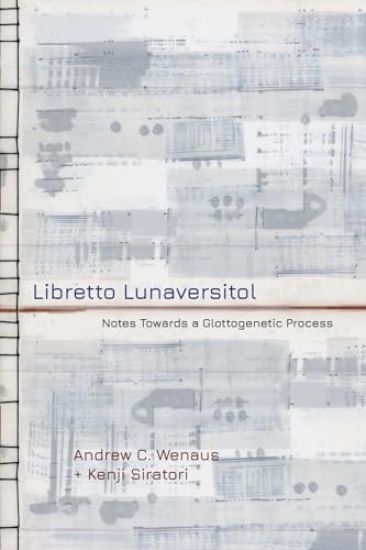
Libretto Lunaversitol

Libretto Lunaversitol

Kenji Siratori; Andrew C Wenaus

Calamari Archive
2024
pokkari
TBDIt is a book that uses Zaum language written in patamathematical prose (the characters used are international phonetic alphabet and can technically be pronounced), each page is designed independently (by me), and includes about 18 images of biomorphic figures by Japanese artist Kenji Siratori (all writing and design, however, is mine).The guiding idea behind the book is that hidden away amidst the frequency signals of information technologies, a novel undecipherable universal language (a kind of techno-Zaum inspired by Cubo-Futurists Velimir Khlebnikov and Aleksei Kruchenykh) is autonomously and autopoietically taking shape outside the experience, knowledge, or access of humans. In this sense, the book isn't asemic; instead, it can be thought of as an extended analogue to the ways autonomous informational processes optimize themselves in ways that we no longer fully understand - it is like a window into the black box of info and communications tech. In a way, it could be considered a conceptual graphic novel or a work of visual poetry.
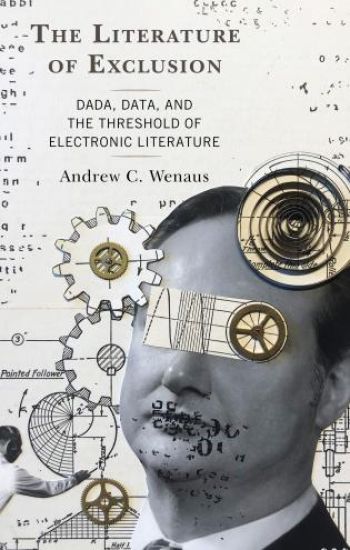
The Literature of Exclusion

The Literature of Exclusion

Andrew C. Wenaus

BLOOMSBURY PUBLISHING PLC
2023
nidottu
In the early twentieth century, the Dadaists protested against art, nationalism, the individual subject, and technologized war. With their automatic anti-art and cultural disruptiveness, Dadaists sought to “signify no thing.” Today, data also operates autonomously. However, rather than dismantling tradition, data organizes, selects, combines, quantifies, and simplifies the complexity of actuality. Like Dada, data also signifies nothing. While Dadaists protest with purpose, data proceeds without intention. The individual in the early twentieth century agonizes over the alienation from daily life and the fear of being converted into a cog in a machine. Today, however, the individual in twenty-first-century supermodernity merges, not with large industrial machinery, but with the processual and procedural logic of programming with innocuous ease. Both exclude human agency from self-narration but to differing degrees of abstraction. Examining the work of B.R. Yeager, Samuel Beckett, Jeff Noon, Kenji Siratori, Mike Bonsall, Allison Parrish, and narratives written by artificial intelligence, Wenaus considers the threshold of sensible narration and the effects that the shift from a culture of language to a culture of digital code has on lived experience. While data offers a closed system, Dadaist literature of exclusion, he suggests, promises a future of open, hyper-contingent, unprescribed alternatives for self-narration.
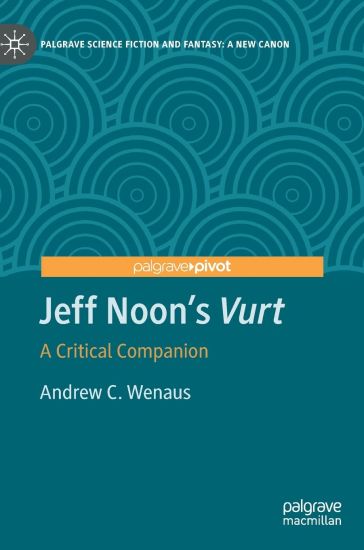
Jeff Noon's "Vurt"

Jeff Noon's "Vurt"

Andrew C. Wenaus

Springer International Publishing AG
2022
sidottu
This book offers an examination of Jeff Noon’s iconoclastic debut novel, Vurt (1993). In this first book-length study of the novel, which includes an extended interview with Noon, Wenaus considers how Vurt complicates the process of literary canonization, its constructivist relationship to genre, its violent and oneiric setting of Manchester, its use of the Orphic myth as an archetype for the practice of literary collage and musical remix, and how the structural paradoxes of chaos and fractal geometry inform the novel’s content, form, and theme. Finally, Wenaus makes the case for Vurt’s ongoing relevance in the 21st century, an era increasingly characterized by neuro-totalitarianism, psychopolitics, and digital surveillance. With Vurt, Noon begins his project of rupturing feedback loops of control by breaking narrative habits and embracing the contingent and unpredictable. An inventive, energetic, and heartbreaking novel, Vurt is also anoptimistic and heartfelt call for artists to actively create open futures.
The Literature of Exclusion

The Literature of Exclusion

Andrew C. Wenaus

Lexington Books
2021
sidottu
In the early twentieth century, the Dadaists protested against art, nationalism, the individual subject, and technologized war. With their automatic anti-art and cultural disruptiveness, Dadaists sought to “signify no thing.” Today, data also operates autonomously. However, rather than dismantling tradition, data organizes, selects, combines, quantifies, and simplifies the complexity of actuality. Like Dada, data also signifies nothing. While Dadaists protest with purpose, data proceeds without intention. The individual in the early twentieth century agonizes over the alienation from daily life and the fear of being converted into a cog in a machine. Today, however, the individual in twenty-first-century supermodernity merges, not with large industrial machinery, but with the processual and procedural logic of programming with innocuous ease. Both exclude human agency from self-narration but to differing degrees of abstraction. Examining the work of B.R. Yeager, Samuel Beckett, Jeff Noon, Kenji Siratori, Mike Bonsall, Allison Parrish, and narratives written by artificial intelligence, Wenaus considers the threshold of sensible narration and the effects that the shift from a culture of language to a culture of digital code has on lived experience. While data offers a closed system, Dadaist literature of exclusion, he suggests, promises a future of open, hyper-contingent, unprescribed alternatives for self-narration.