Kirjojen hintavertailu. Mukana 12 595 353 kirjaa ja 12 kauppaa.

Kirjailija

Andrew Cliff

Kirjat ja teokset yhdessä paikassa: 6 kirjaa, julkaisuja vuosilta 1998-2017, suosituimpien joukossa Atlas of refugees, displaced populations, and epidemic diseases. Vertaile teosten hintoja ja tarkista saatavuus suomalaisista kirjakaupoista.

6 kirjaa

Kirjojen julkaisuhaarukka 1998-2017.

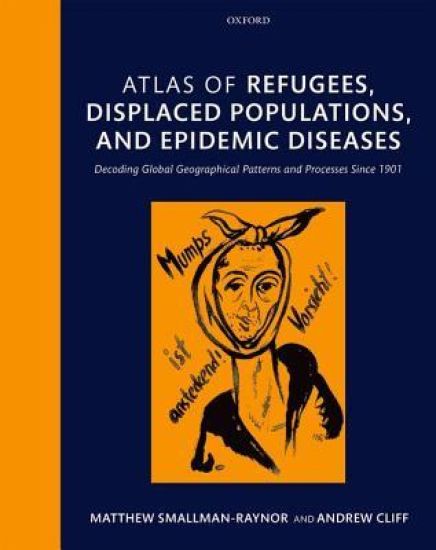
Atlas of refugees, displaced populations, and epidemic diseases

Atlas of refugees, displaced populations, and epidemic diseases

Matthew Smallman-Raynor; Andrew Cliff

Oxford University Press
2017
sidottu
Refugees and displaced populations are a highly relevant, controversial topic of the modern socio-political landscape, with images of people fleeing conflicts and natural disasters a regular occurrence in the media. They flee to perceived safe havens, but are often accompanied by sickness, starvation, poor sanitation, close contact and reduced healthcare. Infection frequently spreads among camps, and sometimes, onwards into the local population. Epidemics develop. What are these diseases, and can they be controlled? What are the health consequences for the migrating and resident populations? What might the demographic impact be? The Atlas of refugees, displaced populations, and epidemic diseases examines the globally changing geographical patterns of communicable diseases among refugees and other displaced persons - in flight, in camps, and resettled in local communities - since the beginning of the twentieth century. The book explores historical and contemporary case studies, including the First World War and its aftermath, the impact of genocides across the twentieth and early twenty-first centuries, Mozambican refugees traversing Central Africa in the late 1980's, the 2010 Haiti earthquake, and the 2014 Ebola virus crisis. The book integrates theory, qualitative and quantitative data, and spatial analysis, locating examples in the context of global demographics and summarising information in an approachable way. Illustrated with over 400 maps and diagrams, case studies are presented in regional and thematic contexts to guide the reader through the displaced populations and communicable diseases over the last 116 years. The discussion covers epidemiological determinants of outbreaks, including overviews of social and political factors that motivate displacement of populations. Important information on epidemic control and the results of these actions is also provided. The Atlas of refugees, displaced populations, and epidemic diseases is an essential resource for all those interested in public health, epidemiology, demography, ecology, economic history, and the history of medicine. This rich and detailed text is ideal for both specialists and students to deepen their understanding of the topic.

Oxford Textbook of Infectious Disease Control

Oxford Textbook of Infectious Disease Control

Andrew Cliff; Matthew Smallman-Raynor

Oxford University Press
2013
sidottu
The Oxford Textbook of Infectious Disease Control: A Geographical Analysis from Medieval Quarantine to Global Eradication is a comprehensive analysis of spatial theory and the practical methods used to prevent the geographical spread of communicable diseases in humans. Drawing on current and historical examples spanning seven centuries from across the globe, this indispensable volume demonstrates how to mitigate the public health impact of infections in disease hotspots and prevent the propagation of infection from such hotspots into other geographical locations. Containing case studies of longstanding global killers such as influenza, measles and poliomyelitis, through to newly emerged diseases like SARS and highly pathogenic avian influenza in humans, this book integrates theory, data and spatial analysis and locates these quantitative analyses in the context of global demographic and health policy change. Beautifully illustrated with over 100 original maps and diagrams to aid understanding and assimilation, in six sections the authors examine surveillance, quarantine, vaccination, and forecasting for disease control. The discussion covers theoretical approaches, techniques and systems central to mitigating disease spread, and methods that deliver practical disease control. Essential information is also provided on the geographical eradication of diseases, including the design of early warning systems that detect the geographical spread of epidemics, enabling students and practitioners to design spatially-targeted control strategies. Despite the early hope of eradication of many communicable diseases after the global eradication of smallpox by 1979, the world is still working at the control and elimination of the spatial spread of newly-emerging and resurgent infectious diseases. Learning from past examples and incorporating modern surveillance and reporting techniques that are used to design value-for-money spatially-targeted interventions to protect public health, the Oxford Textbook of Infectious Disease Control is an essential resource for all those working in, or studying ways to control the spread of communicable diseases between humans in a timely and cost-effective manner. It is ideal for specialists and students in infectious disease control as well as those in the medical sciences, epidemiology, demography, public health, geography, and medical history.
War Epidemics

War Epidemics

Matthew Smallman-Raynor; Andrew Cliff

Oxford University Press
2004
sidottu
Down the ages, war epidemics have decimated the fighting strength of armies, caused the suspension and cancellation of military operations, and have brought havoc to the civil populations of belligerent and non-belligerent states alike. This book examines the historical occurrence and geographical spread of infectious diseases in association with past wars. It addresses an intrinsically geographical question: how are the spatial dynamics of epidemics influenced by military operations and the directives of war? The term historical geography in the title indicates the authors' primary concern with qualitative analyses of archival source materials over a 150-year time period from 1850, and this is combined with quantitative analyses less frequently associated with historical studies. Written from the viewpoints of historical geography, epidemiology, and spatial analysis, this book examines in four parts the historical occurrence and geographical spread of infectious diseases in association with wars. Part I: War and Disease, surveys war-disease associations from early times to 1850. Part II: Temporal Trends studies time trends since 1850. Part III: A Regional Pattern of War Epidemics, examines grand themes in the war-disease complex. Part IV: Prospects, considers a series of war-related issues of epidemiological significance in the twenty-first century.
Island Epidemics

Island Epidemics

Andrew Cliff; Peter Haggett; Matthew Smallman-Raynor

Oxford University Press
2000
sidottu
Ever since Charles Darwin landed on the Galápagos islands in September 1835, small islands have had a special place in scientific history. In Island epidemics, the authors show that the complex warfare of invasion and extinction observed by Darwin for plants and animals applies today with equal force to the micro-organisms which lie behind many human diseases. Growing from their earlier studies of Iceland and the Fijian islands, they provide a broad world picture of diseases which range from the familiar (influenza and German measles) to the exotic (kuru and tsutsugamushi), and islands which range in remoteness from the nearby Faroes and Scillies to the inaccessible Tristan da Cunha and Easter island. A constant theme in the book is the way in which technical developments over the last 150 years, notably in vaccination and transport, are fundamentally affecting the ways in which waves of epidemic diseases circle around the globe. As Darwin argued, islands form natural laboratories in which processes can be observed which are too complex to track in the fast-interacting city worlds, which dominate the crowded continents. The arrival of Ross River virus in the Cook islands or the decline of motor-neurone diseases on Guam can be followed with a precision, which owes much to an islands small size and limited accessibility. The revolution in molecular biology at the end of this century is emphasising how an islands genome, with peoples less mixed than in mainland communities, can provide unique genetic insights into diseases and heredity; the book reports on several examples including the interest in Icelands DNA bank.
Deciphering Global Epidemics

Deciphering Global Epidemics

Andrew Cliff; Peter Haggett; Matthew Smallman-Raynor

Cambridge University Press
1998
sidottu
Using data collected for 350 cities from around the world, the authors use a variety of analytical methods to provide a global picture of what was happening to infectious epidemic diseases at a critical period in urban evolution on the international stage. The diseases considered are diphtheria, enteric fever, measles, scarlet fever, tuberculosis, and whooping cough. To place the results in a wider time context, other data are used to look both backwards and forwards for nearly a century on either side of the twenty-five-year time window. The book presents a number of results that may be interpreted in the context of debates on the causes of long-term mortality decline from these infectious diseases. It will be of interest to students of demography, history of medicine, and economic history as well as to researchers already active in these fields.
Deciphering Global Epidemics

Deciphering Global Epidemics

Andrew Cliff; Peter Haggett; Matthew Smallman-Raynor

Cambridge University Press
1998
pokkari
Using data collected for 350 cities from around the world, the authors use a variety of analytical methods to provide a global picture of what was happening to infectious epidemic diseases at a critical period in urban evolution on the international stage. The diseases considered are diphtheria, enteric fever, measles, scarlet fever, tuberculosis, and whooping cough. To place the results in a wider time context, other data are used to look both backwards and forwards for nearly a century on either side of the twenty-five-year time window. The book presents a number of results that may be interpreted in the context of current debates on the causes of long-term mortality decline from these infectious diseases. It will be of interest to students of demography, history of medicine, and economic history as well as to researchers already active in these fields.