Kirjojen hintavertailu. Mukana 12 595 353 kirjaa ja 12 kauppaa.

Kirjailija

Andrew Duncan

Kirjat ja teokset yhdessä paikassa: 42 kirjaa, julkaisuja vuosilta 2002-2025, suosituimpien joukossa Heads of Lectures On the Theory and Practice of Medicine. Vertaile teosten hintoja ja tarkista saatavuus suomalaisista kirjakaupoista.

42 kirjaa

Kirjojen julkaisuhaarukka 2002-2025.

On the Margins of Great Housing Estates

On the Margins of Great Housing Estates

Andrew Duncan

Shearsman Books
2025
nidottu
This follows a 12-year year halt, and the first product of the new phase was With Feathers on Glass (2023). 'A history of shopping' was started around 2003 and falls on both sides of the gap. That series deals with exchange and retailing, as a successor to a prolonged interest in manufacturing and production. "The Goths as inventors of tourism", deals with the legend of wealth and culture as the motive which leads barbarians from the world-periphery to surge towards the Mediterranean as if to a shopping mall. The flow of goods lifts people off their feet, is like a river of dreams. 'One absolutely perfect cultural object' describes perfection as what you can't have and which still motivates the life cultural. A poem deals with William Hallam Pegg, a Nottingham lace designer and communist who, during the Depression, produced a monumental design for an allegory of Want and Plenty, as a pattern to be realised in Jacquard lace. In central place is the long poem 'Calendar Rite', an autobiographical sequence constructed in a double line like two banks of a river; the poem is strung out along a V where there is a hinge and poems along each arm repeat each other's themes in an altered or defective symmetry. The speaker is faced with a cold river and has to shed every possession to get across it without being swept under. He remembers everything which must be lost, which stored heat and which generated heat. Scenes of unresolved conflict play out in a dream landscape. The rival journeys of several hundred poets are recounted as a race between so many ships, in which almost all are wrecked, their anatomies altered by terminal stresses. Past performances are recalled along with past poems, realised as chains of irrational and compulsive images. Irrational motives for symbolic action are re-voiced as the mineralisation of cherished objects, a personal museum of impassioned seizures which are models for verbal objects, moving from inside to out and surrounding the speaker. The choices infallibly leading to rejection of collective and imposed imagery make for a history of dissidence, symbolised in a tiny 5th century papyrus codex, written at millimetric scale to be easily hidden during police raids, and read with the help of a convex lens. The hidden is boundless and space vanishes into the cracks.

Beautiful Feelings of Sensitive People

Beautiful Feelings of Sensitive People

Andrew Duncan

Shearsman Books
2024
nidottu
Beautiful feelings of sensitive people is just a five-word way of explaining to someone who never reads poetry what we are hoping to find in a book of poems. It is the most unifying (and featureless?) description I could find. It is not there to exclude political poetry - to have beautiful feelings and not wish for a beautiful world would be like lying on a beach for eight hours and not noticing that there is an ocean just in front of you. In fact, wanting to be Greta Thunberg is a beautiful feeling in itself. It describes a wide range of 21st century poetry but perhaps not the majority. The figures suggest that there is a public verdict on the poetry of the past, so of the period say 1970 to 2000, which is utterly favourable - people have an image of Being a Poet and they want to go and inhabit that image. It is a Yes vote. Maybe all those struggles were not in vain. But, that wish to be a poet does not necessarily mean you have much interest in the work of other poets.
With Feathers on Glass

With Feathers on Glass

Andrew Duncan

Shearsman Books
2023
nidottu
This new poetry is saturated in folklore and myth. The glass paintings are a distribution of cultured art motifs to rural households, patterns copied onto glass with feathers or brushes made of marten-hair. They are an expression of humility towards the illiterate. The idea of cultural difference being the effect of distribution technology was illustrated by the pedlars who carried the glass panes around the villages of central Europe. The interest in shopping follows a previous and prolonged interest in manufacturing and production, completing the sequence. Reminiscences of childhood and the wreck of the great High Street department stores around 2020 combine in a personal mythology of grand motifs and elaborate ruins. This volume is a new start after a long period of silence and begins with an inventory of concrete facts around the poet, in his home in Nottingham, close to where he grew up. One theme is defeaturing, the recreation of court and metropolitan art forms in a simpler manner. Radiant messages broken up by distance. Comments on 'On the Margins of Great Empires' (2018): "For the last 30 years, Andrew Duncan has patiently traced alternative wavelengths, to and from the unevocable, irreconcilable and the impossible." (Kevin Nolan) "Andrew Duncan [is] a writer whose poetry, criticism and magazine editing must make him one of the most vital and questing of today's authors." (David Hackbridge Johnson, The High Window) "Andrew Duncan's selected poems from 1978 to 2003 [is] an excited, hugely wide-ranging poetry soaring from the star and jewel riches of the Asian margins down to the brick offices in which are fates are problematized. Quite cryptic but never shirking the open and articulate cry." (Peter Riley, Fortnightly Review)
Nothing is being suppressed

Nothing is being suppressed

Andrew Duncan

Shearsman Books
2022
nidottu
"There are several reasons for writing about the Seventies at this point. One is a reading of a recent collection of memories of the decade by participants. My impression was that they couldn't remember the period - too much time had gone by. They had lost all sense of differentiation and were writing about 1975 as if it was 2015. It is also possible that any attitudes of the previous time which didn't chime with current positions were being written out, consciously or unconsciously. The extent of the mismatch is of great importance, I think. This suggested that there was a real problem with memory, justifying an account based on contemporary documents. The other problem with memory is that we are living in a splinter dictatorship, a cultural phase where the forces of convergence have stacked arms and opinions are split up into small groups. How can there be a collective memory when there is no single point on which all factions agree? so how can I record collective memory? in what sense is any statement about poetry true? But this argues even more for putting facts down and increasing the area free from malicious invention. We need to think about the divergence as a phenomenon in itself, a kind of cultural gravity that guides all the watercourses. The splintering allows local freedom at most locations - what it does not allow is unifying literary opinion." -Andrew Duncan
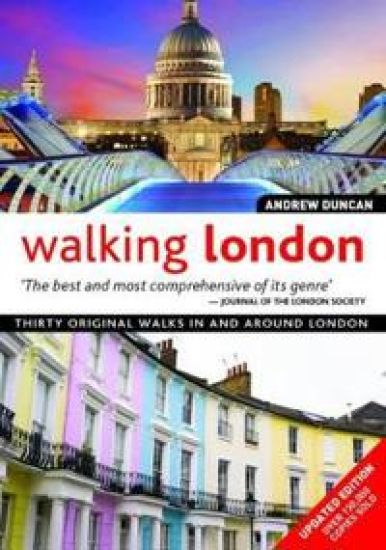
Walking London

Walking London

Andrew Duncan

FOX CHAPEL PUBLISHING
2022
nidottu
Walking London is the essential companion for any urban explorer—visitor or native—committed to discovering the true heart of one of the world's greatest capital cities. In 30 original walks, distinguished historian Andrew Duncan reveals miles of London's endlessly surprising landscape. From wild heathland to formal gardens, cobbled mews to elegant squares and arcades, bustling markets to tranquil villages—Duncan reveals the pick of the famous sights, but also steers walkers off the tourist track and into the city's hidden corners. Handsomely illustrated with specially commissioned color photographs and complete route maps, the book provides full details of addresses, opening times and the best bars and restaurants to visit en route.
Unto the Uttermost

Unto the Uttermost

Andrew Duncan

Lulu.com
2020
pokkari
A science fiction novel. With action and adventure. Has a spiritual context. For older teen/ adults. Synopsis: Myles Carver, theology student, is troubled by a recurring dream in which he sees a crashed aircraft with the passengers and crew scrambling out.He is convinced the dream carries a supernatural message. He makes a startling discovery that 5 decades before that plane had mysteriously vanished linked to an awesome mystery kept hidden in secret government files; and to the disappearance of a team of scientists secretly testing a device capable of reaching the stars.Could his destiny be somehow entwined with theirs? Perplexed, Carver probes further. Believing that with God anything is possible, he begins by faith a seemingly impossible mission....
Fulfilling the Silent Rules

Fulfilling the Silent Rules

Andrew Duncan

Shearsman Books
2018
nidottu
Why "silent rules"? Poetry is made of sound, in the form of speech, but is governed by rules which are not stated explicitly. As a help to readers, we try to tease out and make plain these silent rules. You have to perceive the structure of a work in order to read it. The subtitle is "inside and out" and becoming an insider involves knowing what the silent rules are. So much of the staging of modern poetry has operated a kind of "stereo blindness", in which whatever is visible to observer A is invisible to observer B, and vice versa. Annulling territoriality and blocks on visibility, we try to disengage a "cultural field", a low-resolution set of gradients which on mapping displays the cultural space inside which every literary move takes place. If you populate all the squares, eventually you have the map. By setting things in their true relations, much that had been suppressed or denied emerges in the light of day. The "hero of the piece" is the entire landscape, the awe-inspiring span from one end of the poetry world to the other. This completes the "heptagonal vortex", a set of seven volumes about British poetry in the period 1960 to 1997. The message is that poetic merit is scattered over the landscape and that loyalty to a faction is not compatible with full aesthetic principles and a thorough approach to collecting primary evidence.
On the Margins of Great Empires

On the Margins of Great Empires

Andrew Duncan

Shearsman Books
2018
nidottu
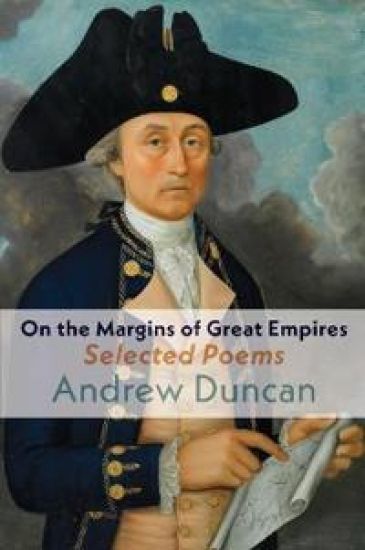
At this point in time Andrew Duncan is better known as a critic of contemporary poetry - and an entertaining, waspish, and unusual critic at that. His own poetic work has been under-recognised and several previous collections - barring those from Shearsman - are out of print. This Selected edition gives the poetry-reading pubic a valuable chance to re-engage with a very original voice. Certainly no experimentalist, but also not a mainstream writer by any stretch of the imagination, he engages with narrative and history in a way that has become unusual in contemporary British poetry.
Emberoks

Emberoks

Andrew Duncan

Lulu.com
2017
sidottu
Wide eyed and breathless, he watched as the stone surfaces changed to flowing garments and unfurled to reveal six humanoid creatures of various sizes cloaked in hooded capes. Six pairs of ember eyes glowed yellow at him with the light from his flashlight. "Emberoks!" He whispered. "A man!" two astonished voices replied. "See, I told you!" said another. "Men are not just in stories." He reached out to touch Kristofer who instinctively drew back, "A real man." "A human, to be sure." The strange creature stood at Kristofer's height. He wore a dull cloak having the appearance of weathered rock. His probing, penetrating eyes glowing yellow from the flashlight seemed to search every dark corner of Kristofer's soul. Only the peace, the soothing calm of his voice made his gaze bearable. "A man? Perhaps." Kristofer's embarrassment frowned at the Emberok's judgment. He liked these creatures better in Grandpa's stories.
Centre and Periphery in Modern British Poetry
Does what is true depend on where you are? or, can we speak of a British culture which varies gradually over the 600 miles from one end of the island to the other, with currents gradually mutating and turning into their opposites as they cross such a distance? Any account of the matter must rapidly disclose the fact that where group A proclaims idea X, group B swiftly proclaims X to be untrue. Assimilation and dissimilation are the exuberant flows which make the mill of culture turn. The unbalanced local energies which gave birth to the central horror of possessive individualism, the Empire, and the State as war-machine, do not sound their triumphalist self-praises without conjuring up a reaction in favour of collective values, pacifism, equity, and the languages of the periphery. Poetry has to offer more than the illusion of being in the few rooms where a metropolitan elite solemnly engages in the circularity of authentication. A polemic tour of Scotland, Wales, and the North of England exposes the possibility that the finest poets of the last 50 years have lived in the outlands, not networking and neglecting to acquire linguistic signs of status. We contemplate the sublime through the works of Sorley Maclean, Glyn Jones, Colin Simms, and Michael Haslam. But a second look at poetry in the South jettisons the shallow tricks favoured by High Street cultural managers to reveal a hidden stratum of intellectually sophisticated poets, even in Babylon.
The Failure of Conservatism in Modern British Poetry
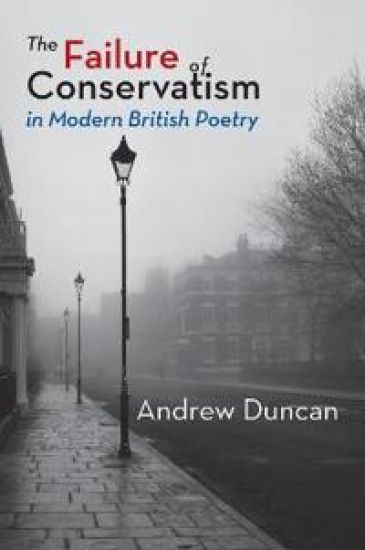
This volume starts from the key misrepresentation of orthodox poetry criticism, that the conservative is also the new, and sets out to define the whole British complex of refusing to innovate. In the attempt to set up publicly accountable criteria for what counts as new, the book goes through the whole period from the 1950s to the mid-1990s, identifying what the stylistic innovations were at each point. Naturally, in such a culturally rich era, not every significant poet or work can be mentioned. We present the 1950s as an era of conservative reaction and occupation of the institutions by a new stratum, whose self-regard is locked up with verbal gestures as "status objects". We go on to the 1960s as a moment where a certain fear of the past brought immediacy, hedonism, simultaneity, immersion, spontaneity, montage, direct address. Then, in the late 60s, Utopian project: When the faint star does take/ us into the deeper parts of the night. The imaginary space engulfing all poetic space, between divination and navigation. In the 1970s, there is the classic era of modern poetry, as the innovations are made to work. Then in the 1980s we see how a restorative taste sealed off the penetration of the new. The next chapter attempts to define the whole phenomenon of poetic conservatism, the feeling that only old and familiar things offer wholeness, and that ideas utterly prevent pleasure. A final chapter stumbles into the field of what isn't clear yet, and what hasn't even happened yet, in order to flourish the names of poets to whom the future may belong.
Walking London, Updated Edition

Walking London, Updated Edition

Andrew Duncan

IMM Lifestyle Books
2016
pokkari
"Walking London" is the essential companion for any urban explorer visitor or native committed to discovering the true heart of one of the world's greatest capital cities. In 30 original walks, distinguished historian Andrew Duncan reveals miles of London's endlessly surprising landscape. From wild heathland to formal gardens, cobbled mews to elegant squares and arcades, bustling markets to tranquil villages Duncan reveals the pick of the famous sights, but also steers walkers off the tourist track and into the city's hidden corners. Handsomely illustrated with specially commissioned color photographs and complete route maps, the book provides full details of addresses, opening times and the best bars and restaurants to visit en route."
A Poetry Boom 1990-2010

A Poetry Boom 1990-2010

Andrew Duncan

Shearsman Books
2015
nidottu
The figures we have tell that the number of new books of poetry published each year nearly doubled between 1976 and 1993 and then nearly doubled again by 2000, then staying at this level. In the years 1999-2001 roughly as many books of poetry were published as in the whole of the 1970s. This is a poetry boom. We seem to have a situation where there are 100,000 Eng Lit graduates and 10,000 write a book of poems and succeed in getting it published. This is the outcome of large-scale benign processes. You aren't going to take to the streets and chant Less choice. Less access. Now! A knock-on is that I can't survey the period; all I can do is make notes on the regions I've been to. We're on the beach and the marks in the sand get wiped away everynight. Maybe 12,000 people have published at least one book of poetry. (Maybe it's only 10,000 - oh, that's so much easier. Am I an expert on all ten thousand? What do you think? "'I love you all' he lied and left the room.") People like what poetry has to offer. It is more plausible to describe the things people like than to describe some other cultural system which would be more free of flaws.Not all poems work. However much you dislike theory, the sound of an emotional-symbolic structure slipping, snapping its pegs, teetering, and collapsing into cultural rubble is all-pervasive: the sound of Now. We have to listen very closely to that sound. I have included a number of chapters on critique, the thing poets dislike most. Some poets think that equity means that whatever I say is true. It seems to support the statement, whatever other people say about me is true, but in fact the rule changes at that point. The idea of softening the boundary between the self and the world does not abolish the outside world. It may be that the gift of the poet is to internalise parts of the outside world, to soften the boundary between the self and the world. The critic is trying to bring the processes of the self outside, into the light where they can be objectively examined. That is the reverse process, pretty much. At present the statement, 'justice means Me getting exactly what I want' seems to be socially acceptable. I want to reform this to say that 'people who actually wrote and finished numerous poems of high quality and who didn't get good reviews, circulation, etc. are examples of Injustice'. Prose has to be founded on equity.
Secret London, Updated Edition

Secret London, Updated Edition

Andrew Duncan

IMM Lifestyle Books
2015
pokkari
Aimed at visitors and Londoners alike, this fully updated new edition of Secret London unlocks the city's most fascinating secrets - both above and below ground. Celebrated historian Andrew Duncan strips away bricks, mortar and tarmac to uncover parts of the capital that even born and bred Londoners may never have seen.Below ground, he guides readers through an extraordinary honeycomb of structures - from the government's vast system of offices and tunnels under Whitehall and through abandoned Underground stations to Clerkenwell's amazing network of subterranean prison cells.Above ground, he leads the way through narrow alleyways and cobbled mews, revealing unexpected treasures and describing rarely seen interiors and special collections. Opening times and addresses, detailed route maps and evocative photographs complement a fascinating text that is sure to delight all urban explorers.
Threads of Iron

Threads of Iron

Andrew Duncan

Shearsman Books
2013
pokkari
Threads of Iron is Duncan's lost debut volume: not because it was never published, but because it never appeared as intended. Instead, the original was split into two and was published in two parts by Reality Street (in 1991) and by Shearsman Books (in 2000). A further part of the manuscript was cut and became Sound Surface (see In Five Eyes, published simultaneously with this volume).