Kirjojen hintavertailu. Mukana 12 657 676 kirjaa ja 12 kauppaa.

Kirjailija

Andrew E. Skodol

Kirjat ja teokset yhdessä paikassa: 6 kirjaa, julkaisuja vuosilta 2016-2025, suosituimpien joukossa Learning DSM-5® by Case Example. Vertaile teosten hintoja ja tarkista saatavuus suomalaisista kirjakaupoista.

6 kirjaa

Kirjojen julkaisuhaarukka 2016-2025.

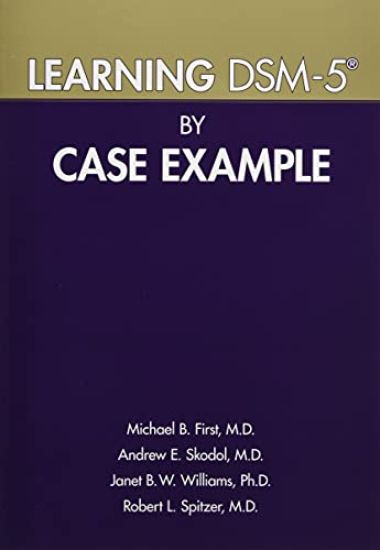
Learning DSM-5® by Case Example

Learning DSM-5® by Case Example

Michael B. First; Andrew E. Skodol; Janet B. W. Williams; Robert L. Spitzer

American Psychiatric Association Publishing
2016
pokkari
With at least one case presentation for each of the mental disorders catalogued in DSM-5—and multiple cases for nearly half of the disorders—Learning DSM-5 by Case Example has been meticulously designed to aid practitioners and students of all levels in psychology, psychiatry, social work, counseling, and psychiatric nursing develop internalized prototypes of DSM-5 disorders by first describing each disorder in relatable terms and subsequently illustrating how these symptom constellations manifest in real-life settings using clinical case material. The nearly 200 cases featured in this guide are drawn from the clinical experience of well over 100 clinicians, many of whom are well-known experts in particular areas of diagnosis and treatment. Sensitive to the fact that one of the hallmarks of mental disorders is the wide range of presentations that are encountered in a real-world setting, many of the disorders described include multiple cases that vary in symptom presentation, gender, age, clinical course, associated impairment in psychosocial functioning, and developmental factors, thus giving readers an appreciation for the heterogeneity typical of these disorders. Each case is complemented by a discussion that elaborates the ways in which the case conforms to the DSM-5 prototype or highlights those features of the case that illustrate the heterogeneity. With definitions of potentially unfamiliar medical and psychiatric terms, Learning DSM-5 by Case Example is an accessible resource for readers of all disciplines. And because it guides the reader through the organizational structure of DSM-5, it is also an ideal reference for courses on psychopathology or abnormal psychology.
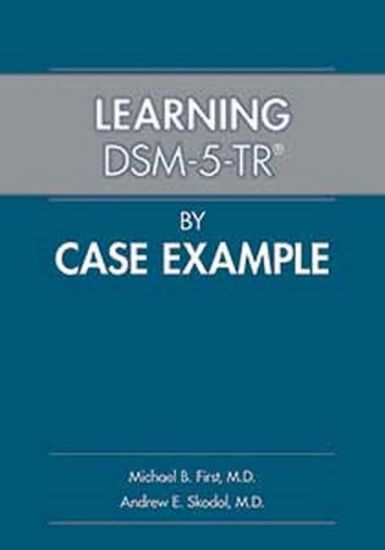
Learning DSM-5-TR® by Case Example

Learning DSM-5-TR® by Case Example

Michael B. First; Andrew E. Skodol

American Psychiatric Association Publishing
2025
pokkari
Engaging case studies drawn from the real-world practice of a diverse group of experts bring DSM-5-TR to life in this exhaustive new volume. Designed to familiarize undergraduate, graduate, and postgraduate students in psychology, psychiatry, social work, counseling, and psychiatric nursing with the diagnosis of psychopathology, this guide is equally useful for experienced clinicians seeking to improve their understanding of the new concepts and terminology in DSM-5-TR. Organized according to the order of the 19 diagnostic groupings as they appear in DSM-5-TR, this book includes at least one case for each mental disorder listed in DSM-5-TR. In each richly detailed chapter, readers will find:An overview of the manifestation of the various diagnoses in the corresponding disorder class.A table summarizing key characteristics of each individual disorder.Comprehensive sections on the individual diagnoses that describe hallmark features, prevalence data, clinical course, and common comorbidities, among other topics.Where specific factors—including severity, course, and symptom presentation—affect the manifestation of a disorder, the book includes multiple cases that illustrate that diagnostic heterogeneity. Unique to this edition are four new, cutting-edge cases: two that are included in the Conditions for Further Study section in DSM-5-TR and an additional two included in the current edition of the World Health Organization’s International Classification of Diseases, 11th revision. The book concludes with an alphabetical index of case names and a comprehensive index of diagnoses with their related cases for ease of reference. Unmatched in its scope and detail, Learning DSM-5-TR by Case Example is an essential resource for all those looking to translate the latest diagnostic criteria to real world practice.
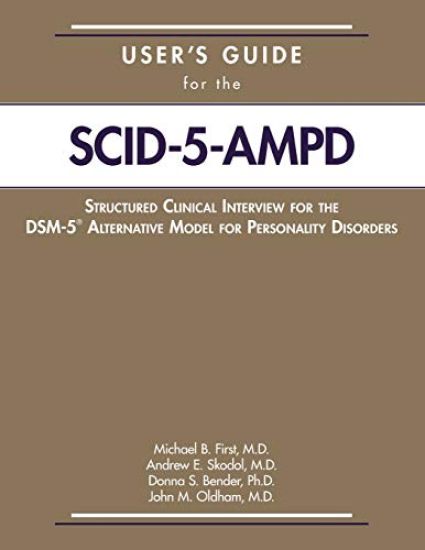
User's Guide for the Structured Clinical Interview for the DSM-5® Alternative Model for Personality Disorders (SCID-5-AMPD)

User's Guide for the Structured Clinical Interview for the DSM-5® Alternative Model for Personality Disorders (SCID-5-AMPD)

Michael B. First; Andrew E. Skodol; Donna S. Bender; John M. Oldham

American Psychiatric Association Publishing
2018
pokkari
Expertly designed, the Structured Clinical Interview for the DSM-5 Alternative Model for Personality Disorders (SCID-5-AMPD) is a semistructured diagnostic interview that guides clear assessment of the defining components of personality pathology as presented in the DSM-5 Alternative Model. The paramount tool for the use of SCID-5-AMPD, the User's Guide for the SCID-5-AMPD provides readers with an essential manual to effectively understand and use any SCID-5-AMPD module. Integrating an overview of the DSM-5 Alternative Model, this companion guide provides instructions for every SCID-5-AMPD module and features completed samples of all modules in full, with corresponding sample patient cases and commentary. The modular format of the SCID-5-AMPD allows the researcher or clinician to focus on those aspects of the Alternative Model of most interest. The User's Guide for the SCID-5-AMPD fully explicates each module—available individually or in customized sets: • Module I is devoted to the dimensional assessment of self and interpersonal functioning using the Level of Personality Functioning Scale.• Module II focuses on the dimensional assessment of the five pathological personality trait domains and corresponding 25 trait facets. • Module III is a comprehensive assessment of each of the six specific personality disorders of the DSM-5 Alternative Model, as well as Personality Disorder–Trait-Specified, and includes a global assessment of the level of personality functioning. Trained clinicians with a basic knowledge of the concepts of personality and personality psychopathology will find the SCID-5-AMPD a valuable tool in the assessment and study of personality disorders.
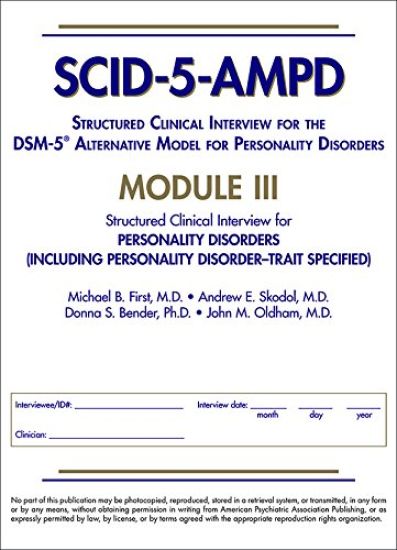
Structured Clinical Interview for the DSM-5® Alternative Model for Personality Disorders (SCID-5-AMPD) Module III

Structured Clinical Interview for the DSM-5® Alternative Model for Personality Disorders (SCID-5-AMPD) Module III

Michael B. First; Andrew E. Skodol; Donna S. Bender; John M. Oldham

American Psychiatric Association Publishing
2017
nidottu
Expertly designed, the Structured Clinical Interview for the DSM-5 Alternative Model for Personality Disorders (SCID-5-AMPD) is a semistructured diagnostic interview that guides clear assessment of the defining components of personality pathology as presented in the DSM-5 Alternative Model. The modular format of the SCID-5-AMPD allows the researcher or clinician to focus on those aspects of the Alternative Model of most interest.Module III: Structured Clinical Interview for Personality Disorders (Including Personality Disorder–Trait Specified) provides a comprehensive assessment of each of the six specific personality disorders of the Alternative Model. It features clear guidance through the new diagnosis of Personality Disorder–Trait-Specified and elucidates when this diagnosis is applicable. The module concludes with a global assessment of the level of personality functioning and includes a survey of all the personality disorder diagnoses in the module.Module III can be used independently or in combination with any of the following SCID-5-AMPD modules:• Module I dimensionally assesses self and interpersonal functioning using the Level of Personality Functioning Scale.• Module II dimensionally assesses the five pathological personality trait domains and their corresponding 25 trait facets. Also available is the User’s Guide for the SCID-5-AMPD: the essential tool for the effective use of any SCID-5-AMPD module. This companion guide provides instructions for each SCID-5-AMPD module and features completed samples of all modules in full, with corresponding sample patient cases and commentary.Trained clinicians with a basic knowledge of the concepts of personality and personality psychopathology will benefit from the myriad applications and insights offered by the SCID-5-AMPD.
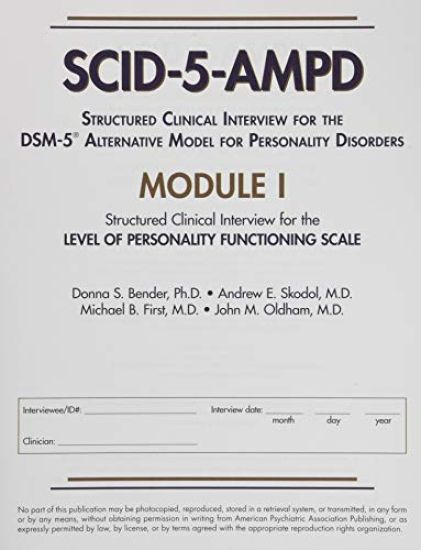
Structured Clinical Interview for the DSM-5® Alternative Model for Personality Disorders (SCID-5-AMPD) Module I

Structured Clinical Interview for the DSM-5® Alternative Model for Personality Disorders (SCID-5-AMPD) Module I

Donna S. Bender; Andrew E. Skodol; Michael B. First; John M. Oldham

American Psychiatric Association Publishing
2017
nidottu
Expertly designed, the Structured Clinical Interview for the DSM-5 Alternative Model for Personality Disorders (SCID-5-AMPD) is a semistructured diagnostic interview that guides clear assessment of the defining components of personality pathology as presented in the DSM-5 Alternative Model. The modular format of the SCID-5-AMPD allows the researcher or clinician to focus on those aspects of the Alternative Model of most interest.Module I: Structured Clinical Interview for the Level of Personality Functioning Scale is devoted to the linchpin of dimensional assessment—self and interpersonal functioning—using the Level of Personality Functioning Scale. Module I provides both a global functioning score and an innovative, detailed assessment of all four domains of functioning (Identity, Self-Direction, Empathy, and Intimacy) and their corresponding subdomains.Module I can be used independently or in combination with any of the following SCID-5-AMPD modules:• Module II dimensionally assesses the five pathological personality trait domains and their corresponding 25 trait facets. • Module III comprehensively assesses each of the six specific personality disorders of the Alternative Model, as well as Personality Disorder–Trait-Specified.Also available is the User’s Guide for the SCID-5-AMPD: the essential tool for the effective use of any SCID-5-AMPD module. This companion guide provides instructions for each SCID-5-AMPD module and features completed samples of all modules in full, with corresponding sample patient cases and commentary.Trained clinicians with a basic knowledge of the concepts of personality and personality psychopathology will benefit from the myriad applications and insights offered by the SCID-5-AMPD.
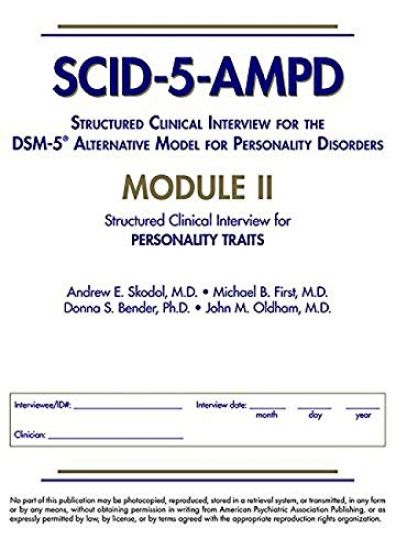
Structured Clinical Interview for the DSM-5® Alternative Model for Personality Disorders (SCID-5-AMPD) Module II

Structured Clinical Interview for the DSM-5® Alternative Model for Personality Disorders (SCID-5-AMPD) Module II

Andrew E. Skodol; Michael B. First; Donna S. Bender; John M. Oldham

American Psychiatric Association Publishing
2017
nidottu
Expertly designed, the Structured Clinical Interview for the DSM-5 Alternative Model for Personality Disorders (SCID-5-AMPD) is a semistructured diagnostic interview that guides clear assessment of the defining components of personality pathology as presented in the DSM-5 Alternative Model. The modular format of the SCID-5-AMPD allows the researcher or clinician to focus on those aspects of the Alternative Model of most interest.Module II: Structured Clinical Interview for Personality Traits focuses on the dimensional assessment of the five pathological personality trait domains in the Alternative Model and their corresponding 25 trait facets. This comprehensive review of the trait domains (Negative Affectivity, Detachment, Antagonism, Disinhibition, and Psychoticism) identifies multiple areas of personality variation and provides a visual profile of trait facets across the trait domains.Module II can be used independently or in combination with any of the following SCID-5-AMPD modules:• Module I dimensionally assesses self and interpersonal functioning using the Level of Personality Functioning Scale.• Module III comprehensively assesses each of the six specific personality disorders of the Alternative Model, as well as Personality Disorder–Trait-Specified.Also available is the User’s Guide for the SCID-5-AMPD: the essential tool for the effective use of any SCID-5-AMPD module. This companion guide provides instructions for each SCID-5-AMPD module and features completed samples of all modules in full, with corresponding sample patient cases and commentary.Trained clinicians with a basic knowledge of the concepts of personality and personality psychopathology will benefit from the myriad applications and insights offered by the SCID-5-AMPD.