Kirjojen hintavertailu. Mukana 12 390 323 kirjaa ja 12 kauppaa.
Kirjailija
Andrew Gelman
Kirjat ja teokset yhdessä paikassa: 10 kirjaa, julkaisuja vuosilta 2006-2026, suosituimpien joukossa Bayesian Workflow. Vertaile teosten hintoja ja tarkista saatavuus suomalaisista kirjakaupoista.
Andrew Gelman; Aki Vehtari; Richard McElreath; Daniel Simpson; Charles C. Margossian; Yuling Yao; Lauren Kennedy; Jonah Gabry; Paul-Christian Bürkner; Martin Modrák; Vianey Leos Barajas
Bayesian statistics and statistical practice have evolved over the years, driven by advancements in theory, methods, and computational tools. This book explores the intricate workflows of applied Bayesian statistics, aiming to uncover the tacit knowledge often overlooked in published papers and textbooks. By systematizing the process of Bayesian model development, the book seeks to improve applied analyses and inspire future innovations in theory, methods, and software. It emphasizes the importance of iterative model building, model checking, computational troubleshooting, and simulated-data experimentation, offering a comprehensive perspective on statistical analysis. Through detailed examples and practical guidance, the book bridges the gap between theory and application, empowering practitioners and researchers to navigate the complexities of Bayesian inference. It is not a checklist or cookbook but a flexible framework for understanding and resolving challenges in statistical modeling and decision-making under uncertainty. Features: Covers all aspects of Bayesian statistical workflow, including model building, inference, validation, troubleshooting, and understanding Demonstrates iterative model development and computational problem-solving through real-world case studies Explores computational challenges, calibration checking, and connections between modeling and computation Highlights the importance of checking models under diverse conditions to understand their limitations and improve their robustness Discusses how Bayesian principles apply to non-Bayesian methods in statistics and machine learning Includes code snippets, exercises, and links to full datasets and code in R and Stan, with applicability to other programming environments like Python and Julia This book is designed for practitioners of applied Bayesian statistics, particularly users of probabilistic programming languages such as Stan, as well as developers of methods and software tailored to these users. It also targets researchers in Bayesian theory and methods, offering insights into understudied aspects of statistical workflows. Instructors and students will find adaptable exercises and case studies to enhance their learning experience. Beyond Bayesian inference, the book’s principles are relevant to users of non-Bayesian methods, making it a valuable resource for statisticians, data scientists, and machine learning professionals seeking to improve their modeling and decision-making processes.
This book provides statistics instructors and students with complete classroom material for a one- or two-semester course on applied regression and causal inference. It is built around 52 stories, 52 class-participation activities, 52 hands-on computer demonstrations, and 52 discussion problems that allow instructors and students to explore in a fun way the real-world complexity of the subject. The book fosters an engaging 'flipped classroom' environment with a focus on visualization and understanding. The book provides instructors with frameworks for self-study or for structuring the course, along with tips for maintaining student engagement at all levels, and practice exam questions to help guide learning. Designed to accompany the authors' previous textbook Regression and Other Stories, its modular nature and wealth of material allow this book to be adapted to different courses and texts or be used by learners as a hands-on workbook.
Most textbooks on regression focus on theory and the simplest of examples. Real statistical problems, however, are complex and subtle. This is not a book about the theory of regression. It is about using regression to solve real problems of comparison, estimation, prediction, and causal inference. Unlike other books, it focuses on practical issues such as sample size and missing data and a wide range of goals and techniques. It jumps right in to methods and computer code you can use immediately. Real examples, real stories from the authors' experience demonstrate what regression can do and its limitations, with practical advice for understanding assumptions and implementing methods for experiments and observational studies. They make a smooth transition to logistic regression and GLM. The emphasis is on computation in R and Stan rather than derivations, with code available online. Graphics and presentation aid understanding of the models and model fitting.
Students in the sciences, economics, social sciences, and medicine take an introductory statistics course. And yet statistics can be notoriously difficult for instructors to teach and for students to learn. To help overcome these challenges, Gelman and Nolan have put together this fascinating and thought-provoking book. Based on years of teaching experience the book provides a wealth of demonstrations, activities, examples, and projects that involve active student participation. Part I of the book presents a large selection of activities for introductory statistics courses and has chapters such as 'First week of class'-- with exercises to break the ice and get students talking; then descriptive statistics, graphics, linear regression, data collection (sampling and experimentation), probability, inference, and statistical communication. Part II gives tips on what works and what doesn't, how to set up effective demonstrations, how to encourage students to participate in class and to work effectively in group projects. Course plans for introductory statistics, statistics for social scientists, and communication and graphics are provided. Part III presents material for more advanced courses on topics such as decision theory, Bayesian statistics, sampling, and data science.
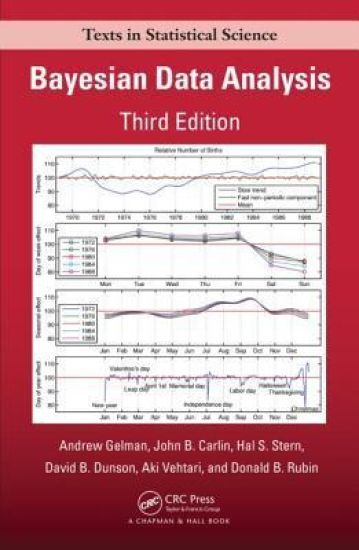
Winner of the 2016 De Groot Prize from the International Society for Bayesian AnalysisNow in its third edition, this classic book is widely considered the leading text on Bayesian methods, lauded for its accessible, practical approach to analyzing data and solving research problems. Bayesian Data Analysis, Third Edition continues to take an applied approach to analysis using up-to-date Bayesian methods. The authors—all leaders in the statistics community—introduce basic concepts from a data-analytic perspective before presenting advanced methods. Throughout the text, numerous worked examples drawn from real applications and research emphasize the use of Bayesian inference in practice.New to the Third Edition Four new chapters on nonparametric modelingCoverage of weakly informative priors and boundary-avoiding priorsUpdated discussion of cross-validation and predictive information criteriaImproved convergence monitoring and effective sample size calculations for iterative simulationPresentations of Hamiltonian Monte Carlo, variational Bayes, and expectation propagationNew and revised software codeThe book can be used in three different ways. For undergraduate students, it introduces Bayesian inference starting from first principles. For graduate students, the text presents effective current approaches to Bayesian modeling and computation in statistics and related fields. For researchers, it provides an assortment of Bayesian methods in applied statistics. Additional materials, including data sets used in the examples, solutions to selected exercises, and software instructions, are available on the book’s web page.
On the night of the 2000 presidential election, Americans watched on television as polling results divided the nation's map into red and blue states. Since then the color divide has become symbolic of a culture war that thrives on stereotypes--pickup-driving red-state Republicans who vote based on God, guns, and gays; and elitist blue-state Democrats woefully out of touch with heartland values. With wit and prodigious number crunching, Andrew Gelman debunks these and other political myths. This expanded edition includes new data and easy-to-read graphics explaining the 2008 election. Red State, Blue State, Rich State, Poor State is a must-read for anyone seeking to make sense of today's fractured political landscape.
Data Analysis Using Regression and Multilevel/Hierarchical Models, first published in 2007, is a comprehensive manual for the applied researcher who wants to perform data analysis using linear and nonlinear regression and multilevel models. The book introduces a wide variety of models, whilst at the same time instructing the reader in how to fit these models using available software packages. The book illustrates the concepts by working through scores of real data examples that have arisen from the authors' own applied research, with programming codes provided for each one. Topics covered include causal inference, including regression, poststratification, matching, regression discontinuity, and instrumental variables, as well as multilevel logistic regression and missing-data imputation. Practical tips regarding building, fitting, and understanding are provided throughout.