Kirjojen hintavertailu. Mukana 12 595 353 kirjaa ja 12 kauppaa.

Kirjailija

Andrew McMeekin

Kirjat ja teokset yhdessä paikassa: 3 kirjaa, julkaisuja vuosilta 2007-2011, suosituimpien joukossa Innovation by Demand. Vertaile teosten hintoja ja tarkista saatavuus suomalaisista kirjakaupoista.

3 kirjaa

Kirjojen julkaisuhaarukka 2007-2011.

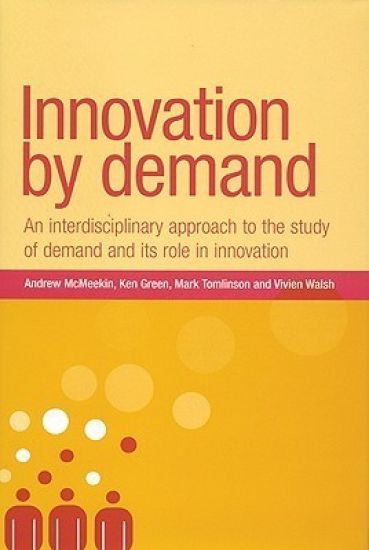
Innovation by Demand

Innovation by Demand

Andrew McMeekin; Mark Tomlinson; Ken Green; Vivien Walsh

Manchester University Press
2011
nidottu
The structure and regulation of consumption and demand has recently become of great interest to sociologists and economists alike, and at the same time there is growing interest in trying to understand the patterns and drivers of technological innovation. This book, newly available in paperback, brings together a range of sociologists and economists to study the role of demand and consumption in the innovative process.The book starts with a broad conceptual overview of ways that the sociological and economics literatures address issues of innovation, demand and consumption. It goes on to offer different approaches to the economics of demand and innovation through an evolutionary framework, before reviewing how consumption fits into evolutionary models of economic development. Food consumption is then looked at as an example of innovation by demand, including an examination of the dynamic nature of socially-constituted consumption routines.The book includes a number of illuminating case studies, including an analysis of how black Americans use consumption to express collective identity, and a number of demand–innovation relationships within matrices or chains of producers and users or other actors, including service industries such as security, and the environmental performance of companies. The involvement of consumers in innovation is looked at, including an analysis of how consumer needs may be incorporated in the design of high-tech products. The final chapter argues for the need to build an economic sociology of demand that goes from micro-individual through to macro-structural features.This book is relevant to United Nations Sustainable Development Goal 9, Industry, innovation and infrastructure.An electronic edition of this book is freely available under a Creative Commons (CC BY-NC-ND) licence.

Public or Private Economies of Knowledge?

Public or Private Economies of Knowledge?

Mark Harvey; Andrew McMeekin

Edward Elgar Publishing Ltd
2009
nidottu
The 'great divide' between public and private knowledge in capitalism is an unstable frontier at the core of contemporary economic transformations. Based on research in the USA, Europe and Brazil into the cutting edge of biological science and technology, this book presents a novel framework for understanding this historically shifting fault-line.Over the last quarter of a century, major controversies have accompanied the dramatic developments in biological science and technology. At critical points, leading commercial companies were poised to take ownership over the human genome and much new post-genomic knowledge. The software tools for analysing the deluge of data also appeared, as did expanding new markets for private enterprise. At the same time, huge new public programmes of biological research were accompanied by radical innovation in the institutions and organisation of public knowledge. Would private marketable knowledge dominate over the new public domain or vice versa? Surprisingly, the dynamism and expansion of the public domain, and new forms of differentiation and interdependence between public and private economies of knowledge, now characterise the landscape. This book presents an analytical framework for understanding the shifting 'great divide' in capitalist economies of knowledge. The authors develop a novel economic sociology of innovation, based on the 'instituted economic process' approach. By focusing on economies of knowledge, they seek to demonstrate that capitalism is multi-modal at its core, with interdependent growth of market and non-market modes of production, distribution, exchange and use.Public or Private Economies of Knowledge? will appeal to those with an interest in innovation studies, economic sociology and economic theory.
Public or Private Economies of Knowledge?

Public or Private Economies of Knowledge?

Mark Harvey; Andrew McMeekin

Edward Elgar Publishing Ltd
2007
sidottu
The 'great divide' between public and private knowledge in capitalism is an unstable frontier at the core of contemporary economic transformations. Based on research in the USA, Europe and Brazil into the cutting edge of biological science and technology, this book presents a novel framework for understanding this historically shifting fault-line.Over the last quarter of a century, major controversies have accompanied the dramatic developments in biological science and technology. At critical points, leading commercial companies were poised to take ownership over the human genome and much new post-genomic knowledge. The software tools for analysing the deluge of data also appeared, as did expanding new markets for private enterprise. At the same time, huge new public programmes of biological research were accompanied by radical innovation in the institutions and organisation of public knowledge. Would private marketable knowledge dominate over the new public domain or vice versa? Surprisingly, the dynamism and expansion of the public domain, and new forms of differentiation and interdependence between public and private economies of knowledge, now characterise the landscape. This book presents an analytical framework for understanding the shifting 'great divide' in capitalist economies of knowledge. The authors develop a novel economic sociology of innovation, based on the 'instituted economic process' approach. By focusing on economies of knowledge, they seek to demonstrate that capitalism is multi-modal at its core, with interdependent growth of market and non-market modes of production, distribution, exchange and use.Public or Private Economies of Knowledge? will appeal to those with an interest in innovation studies, economic sociology and economic theory.