Kirjojen hintavertailu. Mukana 12 595 353 kirjaa ja 12 kauppaa.

Kirjailija

Andrew Radin

Kirjat ja teokset yhdessä paikassa: 22 kirjaa, julkaisuja vuosilta 2008-2025, suosituimpien joukossa Security Sector Reform in Ukraine. Vertaile teosten hintoja ja tarkista saatavuus suomalaisista kirjakaupoista.

22 kirjaa

Kirjojen julkaisuhaarukka 2008-2025.

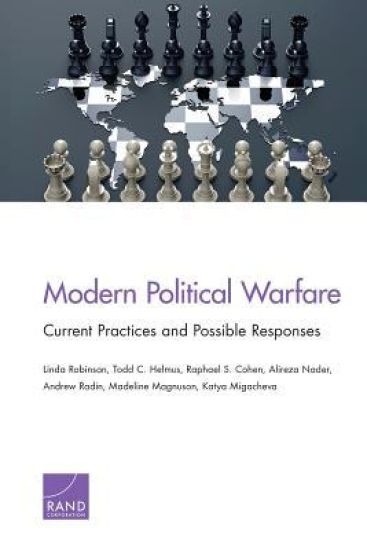
Modern Political Warfare

Modern Political Warfare

Linda Robinson; Todd C Helmus; Raphael S Cohen; Alireza Nader; Andrew Radin; Madeline Magnuson; Katya Migacheva

RAND
2018
nidottu
This report analyzes political warfare as it is practiced today by both state and nonstate actors, and provides detailed recommendations regarding the most effective ways that the U.S. government, along with its allies and partners, can respond to or engage in this type of conflict to achieve U.S. ends and protect U.S. interests.
Understanding the Current International Order

Understanding the Current International Order

Michael J. Mazarr; Miranda Priebe; Andrew Radin; Astrid Stuth Cevallos

RAND
2016
pokkari
In the first report of a series on the emerging international order, RAND researchers examine the liberal order in effect since World War II, including the mechanisms by which the order affects state behavior, the engines that drive states to participate, and the U.S. approach to the order since 1945.
Lessons from the War in Ukraine for Space

Lessons from the War in Ukraine for Space

Andrew Radin; Khrystyna Holynska; Cheyenne Tretter

RAND Corporation
2025
pokkari
The role of space-based services in the war in Ukraine offers important lessons for how the United States must prepare for events in the space domain in potential future conflicts. RAND researchers recount space activities throughout the war and extract relevant lessons for the national security community. They use publicly available information to examine the mission areas that were most significant in shaping the war.
Space Strategic Stability

Space Strategic Stability

Alexandra T Evans; Andrew Radin; Katie Feistel

RAND Corporation
2024
pokkari
Improvements in Russian and Chinese counterspace capabilities could endanger the space-based capabilities that the United States relies on for a broad array of military and economic functions. In this report, the authors examine the conventional wisdom on escalation in the space domain to offer recommendations for how the U.S. Space Force and other stakeholders can better prepare to deter and manage escalation.
Deterring Russia and Iran

Deterring Russia and Iran

Jeffrey Martini; Andrew Radin; Alyssa Demus; Krystyna Marcinek; Dara Massicot; Katherine Pfrommer; Ashley L Rhoades; Chandler Sachs; Karen M Sudkamp; David E Thaler; David Woodworth; Sean M Zeigler

RAND Corporation
2023
pokkari
To support defense planners in crafting effective deterrence strategies for Europe and the Middle East, RAND researchers conducted a multimethod analysis--consisting of a literature review, roundtables with subject-matter experts, quantitative analysis, and a case study of Ukraine--to assess the effectiveness of U.S. forward presence, exercises and short-term deployments, and security cooperation for deterring Russian and Iranian aggression.
China-Russia Cooperation

China-Russia Cooperation

Andrew Radin; Andrew Scobell; Elina Treyger

RAND
2021
nidottu
Since 2014, China and Russia have strengthened their relationship, increasing political, military, and economic cooperation. In this report, the authors seek to understand the history of cooperation between Beijing and Moscow, the drivers of and constraints on the relationship, the potential future of cooperation between China and Russia, the impact of the Chinese-Russian relationship on the United States, and implications for future U.S. policy.
Institution Building in Weak States

Institution Building in Weak States

Andrew Radin

Georgetown University Press
2020
pokkari
The effort to improve state institutions in post-conflict societies is a complicated business. Even when foreign intervention is carried out with the best of intentions and the greatest resources, it often fails. What can account for this failure? In Institution Building in Weak States, Andrew Radin argues that the international community’s approach to building state institutions needs its own reform. This innovative book proposes a new strategy, rooted in a rigorous analysis of recent missions.In contrast to the common strategy of foreign interveners—imposing models drawn from Western countries—Radin shows how pursuing incremental change that accommodates local political interests is more likely to produce effective, accountable, and law-abiding institutions. Drawing on extensive field research and original interviews, Radin examines efforts to reform the central government, military, and police in post-conflict Bosnia and Herzegovina, Kosovo, Iraq, and Timor-Leste. Based on his own experience in defense reform in Ukraine after 2014, Radin also draws parallels with efforts to improve state institutions outside of post-conflict societies.Institution Building in Weak States introduces a domestic opposition theory that better explains why institution building fails and what is required to make it work. With actionable recommendations for smarter policy, the book offers an important corrective for scholars and practitioners of post-conflict missions, international development, peacebuilding, and security cooperation.
Institution Building in Weak States

Institution Building in Weak States

Andrew Radin

Georgetown University Press
2020
sidottu
The effort to improve state institutions in post-conflict societies is a complicated business. Even when foreign intervention is carried out with the best of intentions and the greatest resources, it often fails. What can account for this failure? In Institution Building in Weak States, Andrew Radin argues that the international community’s approach to building state institutions needs its own reform. This innovative book proposes a new strategy, rooted in a rigorous analysis of recent missions.In contrast to the common strategy of foreign interveners—imposing models drawn from Western countries—Radin shows how pursuing incremental change that accommodates local political interests is more likely to produce effective, accountable, and law-abiding institutions. Drawing on extensive field research and original interviews, Radin examines efforts to reform the central government, military, and police in post-conflict Bosnia and Herzegovina, Kosovo, Iraq, and Timor-Leste. Based on his own experience in defense reform in Ukraine after 2014, Radin also draws parallels with efforts to improve state institutions outside of post-conflict societies.Institution Building in Weak States introduces a domestic opposition theory that better explains why institution building fails and what is required to make it work. With actionable recommendations for smarter policy, the book offers an important corrective for scholars and practitioners of post-conflict missions, international development, peacebuilding, and security cooperation.
Russia's Hostile Measures

Russia's Hostile Measures

Ben Connable; Stephanie Young; Stephanie Pezard; Andrew Radin; Raphael S Cohen; Katya Migacheva; James Sladden

RAND
2020
nidottu
Russia has historically succeeded in using various hostile measures to sow disorder, weaken democratic institutions, and undermine Western alliances. However, it also has a long track record of strategic shortfalls and even ineptitude. Exploring opportunities to deter, prevent, and counter Russian hostile behavior will benefit NATO and other Western powers in the so-called gray zone short of war, as well as in a conventional warfare scenario.
The Future of the Russian Military

The Future of the Russian Military

Andrew Radin; Lynn E Davis; Edward Geist

RAND
2019
nidottu
Since 2008 Russia's military forces have improved, enabling Russian military operations in Crimea, eastern Ukraine, and Syria. Researchers analyze the societal, political, economic, and demographic factors that undergird Russian military power. Based on these factors, they analyze how Russian ground combat capabilities will evolve. The challenge for the U.S. military will be to compete in different regions without provoking escalation.
Countering Russian Social Media Influence

Countering Russian Social Media Influence

Elizabeth Bodine-Baron; Todd C Helmus; Andrew Radin; Elina Treyger

RAND
2019
nidottu
With the rise of social media, it has become clear that the Russian government and its proxies have found new and useful outlets in which to sow disinformation and confusion among various populations, including within the United States. This report draws on expert recommendations from academia, think tanks, and the private sector to formulate specific and actionable approaches for countering Russian social media influence.
Russian Social Media Influence

Russian Social Media Influence

Todd C Helmus; Elizabeth Bodine-Baron; Andrew Radin; Madeline Magnuson; Joshua Mendelsohn; William Marcellino; Andriy Bega; Zev Winkelman

RAND
2018
nidottu
Russia employs a sophisticated social media campaign against former Soviet states that includes news tweets, nonattributed comments on web pages, troll and bot social media accounts, and fake hashtag and Twitter campaigns. Nowhere is this threat more tangible than in Ukraine. Researchers analyzed social media data and conducted interviews with regional and security experts to understand the critical ingredients to countering this campaign.
Measuring the Health of the Liberal International Order

Measuring the Health of the Liberal International Order

Michael J Mazarr; Astrid Stuth Cevallos; Miranda Priebe; Andrew Radin; Kathleen Reedy; Alexander D Rothenberg; Julia A Thompson; Jordan Willcox

RAND
2017
nidottu
As part of a larger study on the future of the post-World War II liberal international order, RAND researchers analyze the health of the existing order and offer implications for future U.S. policy. The study's overall conclusion is that the postwar order continues to enjoy many elements of stability but is increasingly threatened by major geopolitical and domestic socioeconomic trends that call into question the order's fundamental assumptions.
Alternative Options for U.S. Policy Toward the International Order

Alternative Options for U.S. Policy Toward the International Order

Michael J Mazarr; Miranda Priebe; Andrew Radin; Astrid Stuth Cevallos

RAND
2017
nidottu
Since 1945, the United States has pursued its global interests through creating and maintaining international economic institutions, bilateral and regional security organizations, and liberal political norms; these ordering mechanisms are often collectively referred to as the international order. This report examines options for future U.S. policies with respect to the order.
Russian Views of the International Order

Russian Views of the International Order

Andrew Radin; Clint Reach

RAND
2017
nidottu
In this report, RAND researchers analyze Russian core interests and views of the international order. The authors find that Russia sees the current international order as dominated by the United States and as a threat to some of Russia's interests. For several areas, U.S. and Russian interests overlap and cooperation is feasible. In other areas, U.S. and Russian interests conflict, and this report offers options for U.S. policy going forward.
European Relations with Russia

European Relations with Russia

Stephanie Pezard; Andrew Radin; Thomas S Szayna; F Stephen Larrabee

RAND
2017
nidottu
Russia's 2014 annexation of Crimea has challenged the integrity of Europe's territorial borders and had a broader negative impact on the European security environment. This report analyzes how Europeans perceive the Russian threat--whether European states regard Russia's policy in eastern and northern Europe as a security priority, how they have responded to Russian behavior, and how officials see the future of Russo-European relations.
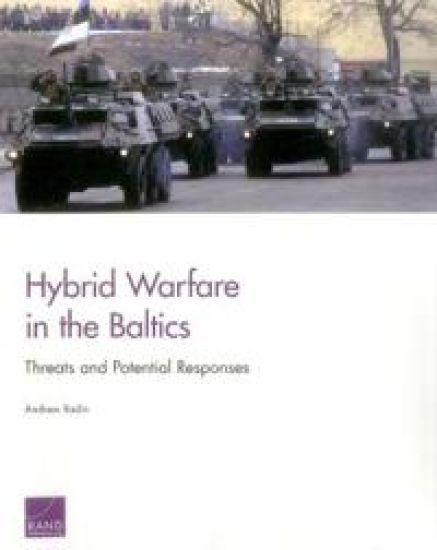
Hybrid Warfare in the Baltics
There is significant concern about Russian use of "hybrid warfare" in the Baltics. To understand this threat, the author of this report analyzes three potential scenarios--nonviolent subversion, covert violent action, and conventional aggression supported by political subversion. The author finds that, given the growing integration of Russian speakers and high capacity of the Baltic states, the greatest threat comes from conventional aggression.