Kirjojen hintavertailu. Mukana 12 657 676 kirjaa ja 12 kauppaa.

Kirjailija

Aneesh Sreevallabh Chivukula

Kirjat ja teokset yhdessä paikassa: 4 kirjaa, julkaisuja vuosilta 2019-2024, suosituimpien joukossa Adversarial Machine Learning. Vertaile teosten hintoja ja tarkista saatavuus suomalaisista kirjakaupoista.

4 kirjaa

Kirjojen julkaisuhaarukka 2019-2024.

Adversarial Machine Learning

Adversarial Machine Learning

Aneesh Sreevallabh Chivukula; Xinghao Yang; Bo Liu; Wei Liu; Wanlei Zhou

Springer Nature Switzerland AG
2024
nidottu
A critical challenge in deep learning is the vulnerability of deep learning networks to security attacks from intelligent cyber adversaries. Even innocuous perturbations to the training data can be used to manipulate the behaviour of deep networks in unintended ways. In this book, we review the latest developments in adversarial attack technologies in computer vision; natural language processing; and cybersecurity with regard to multidimensional, textual and image data, sequence data, and temporal data. In turn, we assess the robustness properties of deep learning networks to produce a taxonomy of adversarial examples that characterises the security of learning systems using game theoretical adversarial deep learning algorithms. The state-of-the-art in adversarial perturbation-based privacy protection mechanisms is also reviewed. We propose new adversary types for game theoretical objectives in non-stationary computational learning environments. Proper quantificationof the hypothesis set in the decision problems of our research leads to various functional problems, oracular problems, sampling tasks, and optimization problems. We also address the defence mechanisms currently available for deep learning models deployed in real-world environments. The learning theories used in these defence mechanisms concern data representations, feature manipulations, misclassifications costs, sensitivity landscapes, distributional robustness, and complexity classes of the adversarial deep learning algorithms and their applications. In closing, we propose future research directions in adversarial deep learning applications for resilient learning system design and review formalized learning assumptions concerning the attack surfaces and robustness characteristics of artificial intelligence applications so as to deconstruct the contemporary adversarial deep learning designs. Given its scope, the book will be of interest to Adversarial Machine Learning practitioners and Adversarial Artificial Intelligence researchers whose work involves the design and application of Adversarial Deep Learning.
Adversarial Machine Learning

Adversarial Machine Learning

Aneesh Sreevallabh Chivukula; Xinghao Yang; Bo Liu; Wei Liu; Wanlei Zhou

Springer Nature Switzerland AG
2023
sidottu
A critical challenge in deep learning is the vulnerability of deep learning networks to security attacks from intelligent cyber adversaries. Even innocuous perturbations to the training data can be used to manipulate the behaviour of deep networks in unintended ways. In this book, we review the latest developments in adversarial attack technologies in computer vision; natural language processing; and cybersecurity with regard to multidimensional, textual and image data, sequence data, and temporal data. In turn, we assess the robustness properties of deep learning networks to produce a taxonomy of adversarial examples that characterises the security of learning systems using game theoretical adversarial deep learning algorithms. The state-of-the-art in adversarial perturbation-based privacy protection mechanisms is also reviewed. We propose new adversary types for game theoretical objectives in non-stationary computational learning environments. Proper quantificationof the hypothesis set in the decision problems of our research leads to various functional problems, oracular problems, sampling tasks, and optimization problems. We also address the defence mechanisms currently available for deep learning models deployed in real-world environments. The learning theories used in these defence mechanisms concern data representations, feature manipulations, misclassifications costs, sensitivity landscapes, distributional robustness, and complexity classes of the adversarial deep learning algorithms and their applications. In closing, we propose future research directions in adversarial deep learning applications for resilient learning system design and review formalized learning assumptions concerning the attack surfaces and robustness characteristics of artificial intelligence applications so as to deconstruct the contemporary adversarial deep learning designs. Given its scope, the book will be of interest to Adversarial Machine Learning practitioners and Adversarial Artificial Intelligence researchers whose work involves the design and application of Adversarial Deep Learning.
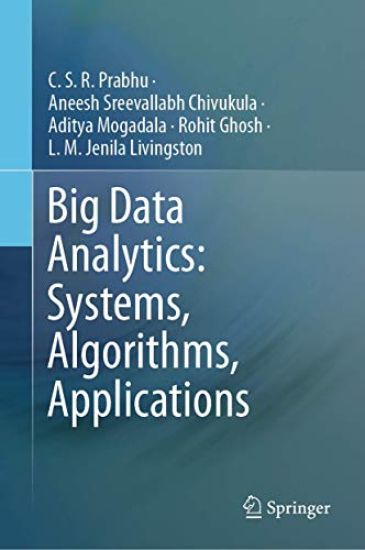
Big Data Analytics: Systems, Algorithms, Applications

Big Data Analytics: Systems, Algorithms, Applications

C.S.R. Prabhu; Aneesh Sreevallabh Chivukula; Aditya Mogadala; Rohit Ghosh; L.M. Jenila Livingston

Springer Verlag, Singapore
2020
nidottu
This book provides a comprehensive survey of techniques, technologies and applications of Big Data and its analysis. The Big Data phenomenon is increasingly impacting all sectors of business and industry, producing an emerging new information ecosystem. On the applications front, the book offers detailed descriptions of various application areas for Big Data Analytics in the important domains of Social Semantic Web Mining, Banking and Financial Services, Capital Markets, Insurance, Advertisement, Recommendation Systems, Bio-Informatics, the IoT and Fog Computing, before delving into issues of security and privacy. With regard to machine learning techniques, the book presents all the standard algorithms for learning – including supervised, semi-supervised and unsupervised techniques such as clustering and reinforcement learning techniques to perform collective Deep Learning. Multi-layered and nonlinear learning for Big Data are also covered. In turn,the book highlights real-life case studies on successful implementations of Big Data Analytics at large IT companies such as Google, Facebook, LinkedIn and Microsoft. Multi-sectorial case studies on domain-based companies such as Deutsche Bank, the power provider Opower, Delta Airlines and a Chinese City Transportation application represent a valuable addition. Given its comprehensive coverage of Big Data Analytics, the book offers a unique resource for undergraduate and graduate students, researchers, educators and IT professionals alike.
Big Data Analytics: Systems, Algorithms, Applications

Big Data Analytics: Systems, Algorithms, Applications

C.S.R. Prabhu; Aneesh Sreevallabh Chivukula; Aditya Mogadala; Rohit Ghosh; L.M. Jenila Livingston

Springer Verlag, Singapore
2019
sidottu
This book provides a comprehensive survey of techniques, technologies and applications of Big Data and its analysis. The Big Data phenomenon is increasingly impacting all sectors of business and industry, producing an emerging new information ecosystem. On the applications front, the book offers detailed descriptions of various application areas for Big Data Analytics in the important domains of Social Semantic Web Mining, Banking and Financial Services, Capital Markets, Insurance, Advertisement, Recommendation Systems, Bio-Informatics, the IoT and Fog Computing, before delving into issues of security and privacy. With regard to machine learning techniques, the book presents all the standard algorithms for learning – including supervised, semi-supervised and unsupervised techniques such as clustering and reinforcement learning techniques to perform collective Deep Learning. Multi-layered and nonlinear learning for Big Data are also covered. In turn,the book highlights real-life case studies on successful implementations of Big Data Analytics at large IT companies such as Google, Facebook, LinkedIn and Microsoft. Multi-sectorial case studies on domain-based companies such as Deutsche Bank, the power provider Opower, Delta Airlines and a Chinese City Transportation application represent a valuable addition. Given its comprehensive coverage of Big Data Analytics, the book offers a unique resource for undergraduate and graduate students, researchers, educators and IT professionals alike.