Kirjojen hintavertailu. Mukana 12 361 541 kirjaa ja 12 kauppaa.

Kirjailija

Angel Rabasa

Kirjat ja teokset yhdessä paikassa: 24 kirjaa, julkaisuja vuosilta 2000-2017, suosituimpien joukossa The Muslim World After 9/11. Vertaile teosten hintoja ja tarkista saatavuus suomalaisista kirjakaupoista.

24 kirjaa

Kirjojen julkaisuhaarukka 2000-2017.

The Military and Democracy in Indonesia

The Military and Democracy in Indonesia

Angel Rabasa; John Haseman

RAND
2003
pokkari
The Indonesian military, with its tradition of secular nationalism, is one of the few institutions that cut across the divides of Indonesian society. But as it continues to play a critical part in determining Indonesia's future development, the military itself is undergoing profound change. The authors explore the role of the military in politics and society since the fall of President Suharto in 1998. They examine key research issues that are central to the strategic interests of the United States in Asia: Will the Indonesian military be a constructive force supporting democratic processes or will it opt for authoritarian solutions? What are some realistic goals for further progress on military reform? And how can the United States engage the Indonesian military most effectively to help bring about positive change? To answer these questions, the authors present several strategic scenarios for Indonesia, each of which has important implications for U.S.-Indonesian relations. They conclude by proposing goals for Indonesian military reform and elements of a U.S. engagement policy.
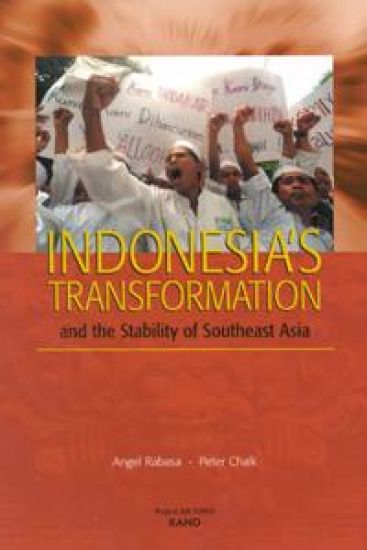
Indonesia's Transformation and the Stability of Southeast Asia
Indonesia, the world's fourth most populous country, is undergoing a profound transformation that could lead to a variety of outcomes, from the consolidation of democracy to return to authoritarianism or military rule, to radical Islamic rule, or to violent disintegration. The stakes are high, for Indonesia is the key to Southeast Asian security. The authors examine the trends and dynamics that are driving Indonesia's transformation, outline possible strategic futures and their implications for regional stability, and identify options the United States might pursue in the critical challenge of influencing Indonesia's future course. Steps the United States might take now include support for Indonesia's stability and territorial integrity, reestablishment of Indonesian-U.S. military cooperation and interaction, aid in rebuilding a constructive Indonesian role in regional security, and support for development of a regional crisis reaction force. A continued strong U.S. presence in the Asia-Pacific region will reinforce the U.S. role as regional balancer.
Colombian Labyrinth

Colombian Labyrinth

Angel Rabasa; Peter Chalk

RAND
2001
pokkari
U.S. policy toward Colombia has been driven to a large extent by counter-narcotics considerations, but the evolving situation in that South American country confronts the United States with as much of a national security as a drug policy problem.
The Role of Southeast Asia in U.S. Strategy Toward China

The Role of Southeast Asia in U.S. Strategy Toward China

Richard Sokolsky; Angel Rabasa; Carl Richard Neu

RAND
2000
pokkari
China's geopolitical ambitions and growing military capabilities and the Southeast Asian states1 perceptions of a "rising China" will play a crucial role in shaping the future of Southeast Asia and the U.S. military posture in the region. The authors examine the role of regional states in developing a hedge against the possible threat of an overly aggressive China. They find that rather than confronting a conventional attack, the United States and the Southeast Asian countries are likely to find a continuation of China's creeping irredentism and threats. Southeast Asia is likely to prove a critical testing ground for a "third way" of dealing with China's rising power called a policy of "congagement" international system while both deterring and preparing for a possible Chinese challenge. The report recommends that the United States adopt an incremental approach to this hedging strategy, focusing on peacetime military engagement with Southeast Asian states, development of a more robust and diversified network of access arrangements, and strengthened military ties with the Philippines, Singapore, Thailand, Malaysia, Indonesia, and Vietnam.