Kirjojen hintavertailu. Mukana 12 657 676 kirjaa ja 12 kauppaa.

Kirjailija

Angelika Fitz

Kirjat ja teokset yhdessä paikassa: 3 kirjaa, julkaisuja vuosilta 2020-2025, suosituimpien joukossa Yasmeen Lari. Vertaile teosten hintoja ja tarkista saatavuus suomalaisista kirjakaupoista.

3 kirjaa

Kirjojen julkaisuhaarukka 2020-2025.

Yasmeen Lari

Yasmeen Lari

Angelika Fitz; Elke Krasny

MIT PRESS LTD
2023
nidottu
A rich exploration of the extraordinary life and work of celebrated architect Yasmeen Lari, winner of the 2023 RIBA Royal Gold Medal.After more than three decades as a renowned global architect, Yasmeen Lari, the first woman to open her own architecture firm in Pakistan in 1964, developed Zero Carbon Architecture, which unites ecological and social justice. This volume, edited by Angelika Fitz, Elke Krasny, and Marvi Mazhar, presents Lari’s trajectory from exemplary modernist to zero carbon revolutionary, with a focus on her remarkable contributions to the global architectural movement to decarbonize and decolonize. The book includes extensive photographs, drawings, and plans from Lari’s archive, most of which have not previously been shown or published.Lari’s architectural thinking and activism have always gone beyond the quest for a singular built solution. Rather, she strategically plans systemic approaches and solutions, be it for housing, a heritage foundation, or zero-carbon shelters with communities at risk. Original essays from diverse international contributors contextualize Lari’s work; investigate architecture and the postimperial, postcolonial, and postpartition condition; and examine the intersections of architecture and human rights, climate change, decolonization, gender, care, activism, and vernacular innovation. More than a tribute to Yasmeen Lari’s extraordinary career, this volume brings her legacy forward and shows how to create change today.Contributors:Abira Ashfaq, Cassandra Cozza, Angelika Fitz, Runa Kahn, Anne Karpf, Elke Krasny, Marvi Mazhar, Chris Moffat, Anila Naeem, Raquel Rolnik, Helen Thomas, Rafia Zakaria

Abundance not Capital

Abundance not Capital

Angelika Fitz; Elke Krasny

MIT PRESS LTD
2025
nidottu
What if architecture were not an instrument of capital? How to imagine and build a non-extractivist and non-exploitative architecture. Capital s voracious appetite forces architecture into a regime of never enough. The current realities of building involve extraction and exploitation, which, in turn, cause climate breakdown, environmental ruin, alienated labor conditions, and the destruction of local construction knowledge. But what if we could do architecture differently? What does non-extractivist architecture look like? In this book, Angelika Fitz and Elke Krasny introduce the concept of abundance to call for a paradigm shift in architecture. Using as its example the exceptional work of architect Anupama Kundoo, this book shows that non-extractivist and non-exploitative architecture is undeniably possible. Kundoo, born in Pune, India, weaves together innovative technological experimentation and traditional crafts. With careful consideration of local resources, building skills, climate, and environment, she makes buildings that embody spatial beauty and graceful materiality. Abundance Not Capital is a manifesto for creating a future-forward, alternative architecture. Contributors: Shumi Bose, Jordan Carver, Peggy Deamer, Madhavi Desai, Angelika Fitz, Rupali Gupte, Ranjit Hoskote, Elke Krasny, Charlotte Malterre-Barthes, Shannon Mattern, and Laurie Parsons. Copublished with Architekturzentrum Wien.
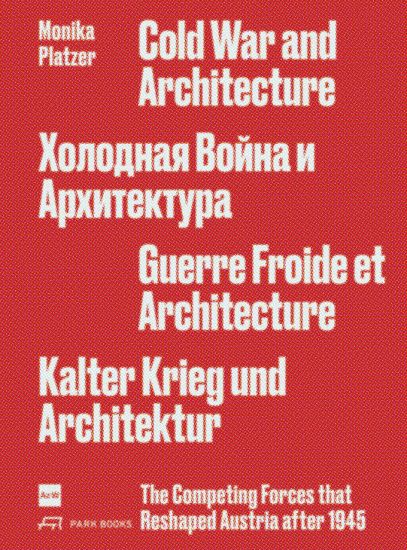
Cold War and Architecture

Cold War and Architecture

Monika Platzer; Angelika Fitz

Park Books
2020
nidottu
Following the liberation and subsequent occupation of Austria at the end of World War II in spring 1945 by the victorious powers Britain, France, the United States, and the Soviet Union, Vienna soon became a central stage for the quickly emerging Cold War. The struggle of differing political systems was also carried out in the field of architecture. Cold War and Architecture sheds new light on the building activity in postwar Austria and its main protagonists. For the first time, this book explores the lines of architectural debates of the time in the context of the global political and cultural conflict of East vs. West. With its transnational perspective, it changes our view of architectural history and postwar society. During the ten-year occupation period, Austria experienced a transition from authoritarian government to democratic consumer society. Each of the four Allied powers established its own extensive cultural program. Architectural exhibitions became important instruments of such educational schemes with the objective of a new social order. British, American, French, and Soviet cultural policies served as catalysts for ideological convictions.