Kirjojen hintavertailu. Mukana 12 390 323 kirjaa ja 12 kauppaa.

Kirjailija

Angie Debo

Kirjat ja teokset yhdessä paikassa: 11 kirjaa, julkaisuja vuosilta 1974-2022, suosituimpien joukossa The Road to Disappearance. Vertaile teosten hintoja ja tarkista saatavuus suomalaisista kirjakaupoista.

11 kirjaa

Kirjojen julkaisuhaarukka 1974-2022.

And Still the Waters Run

And Still the Waters Run

Angie Debo

PRINCETON UNIVERSITY PRESS
2022
pokkari
The classic book that exposed the scandal of the dispossession of native land by American settlersAnd Still the Waters Run tells the tragic story of the liquidation of the independent Indian republics of the Choctaws, Chickasaws, Cherokees, Creeks, and Seminoles, known as the Five Civilized Tribes. At the turn of the twentieth century, the tribes owned the eastern half of what is now Oklahoma, a territory immensely wealthy in farmland, forests, coal, and oil. Their political and economic status was guaranteed by the federal government—until American settlers arrived. Congress abrogated treaties that it had promised would last “as long as the waters run,” and within a generation, the tribes were systematically stripped of their holdings, and were rescued from starvation only through public charity. Called a “work of art” by writer Oliver La Farge, And Still the Waters Run was so controversial when it was first published that Angie Debo was banned from teaching in Oklahoma for many years. Now with an incisive foreword by Amanda Cobb-Greetham, here is the acclaimed book that first documented the scandalous founding of Oklahoma on native land.
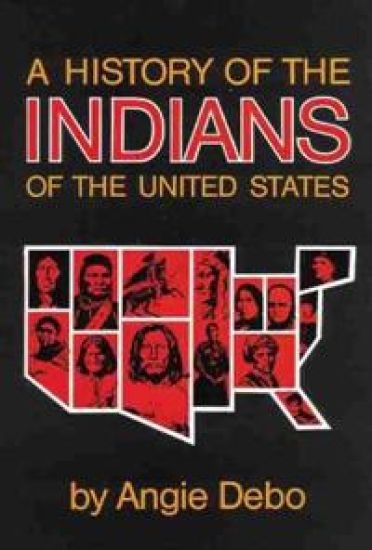
A History of the Indians of the United States, 106

A History of the Indians of the United States, 106

Angie Debo

UNIVERSITY OF OKLAHOMA PRESS
2021
nidottu
In 1906 when the Creek Indian Chitto Harjo was protesting the United States government's liquidation of his tribe's lands, he began his argument with an account of Indian history from the time of Columbus, "for, of course, a thing has to have a root before it can grow." Yet even today most intelligent non-Indian Americans have little knowledge of Indian history and affairs those lessons have not taken root.This book is an in-depth historical survey of the Indians of the United States, including the Eskimos and Aleuts of Alaska, which isolates and analyzes the problems which have beset these people since their first contacts with Europeans. Only in the light of this knowledge, the author points out, can an intelligent Indian policy be formulated.In the book are described the first meetings of Indians with explorers, the dispossession of the Indians by colonial expansion, their involvement in imperial rivalries, their beginning relations with the new American republic, and the ensuing century of war and encroachment.The most recent aspects of government Indian policy are also detailed the good and bad administrative practices and measures to which the Indians have been subjected and their present situation.Miss Debo's style is objective, and throughout the book the distinct social environment of the Indians is emphasized-an environment that is foreign to the experience of most white men. Through ignorance of that culture and life style the results of non-Indian policy toward Indians have been centuries of blundering and tragedy.In response to Indian history, an enlightened policy must be formulated: protection of Indian land, vocational and educational training, voluntary relocation, encouragement of tribal organization, recognition of Indians' social groupings, and reliance on Indians' abilities to direct their own lives.The result of this new policy would be a chance for Indians to live now, whether on their own land or as adjusted members of white society. Indian history is usually highly specialized and is never recorded in books of general history. This book unifies the many specialized volumes which have been written about their history and culture. It has been written not only for persons who work with Indians or for students of Indian culture, but for all Americans of good will.
Prairie City

Prairie City

Angie Debo

University of Oklahoma Press
1998
nidottu
Prairie City is the social history of a representative midwestern town - a composite of several Oklahoma small towns. Beginning with the one flashing moment of the 1889 land run, which opened the Oklahoma Lands for white settlement, Angie Debo depicts the struggles of the settlers on the vast prairie to build a community despite seasons of drought, prairie fire, and destitution. Solidly based on historical research, Prairie City chronicles the arrival of the railroad, the growth of political parties and educational institutions, KKK uprisings, the oil boom, the Depression and the New Deal, and the effects of two world wars on small-town America.
Half-Sun on the Columbia

Half-Sun on the Columbia

Robert H. Ruby; John A. Brown; Angie Debo

University of Oklahoma Press
1995
nidottu
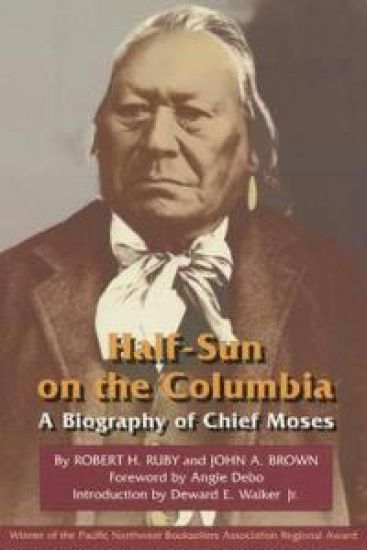
Chief Moses (Sulktalthscosum or Half-Sun) was chief of the Columbias, a Salish-speaking people of the mid-Columbia River area in what is now the state of Washington. This award-winning biography by Robert H. Ruby and John A. Brown situates Moses in the opening of the Northwest and subsequent Indian-white relations, between 1850 and 1898. Early in life Moses had won a name for himself battling whites, but with the maturity and responsibilities of chieftainship, he became a diplomat and held his united tribe at peace in spite of growing white encroachment. He resisted the call to arms of his friend Chief Joseph of the Nez Percés, whose heroic campaign ended in defeat and exile to Indian Territory. Yet their friendship persisted, and after Joseph's return to the Northwest, the two lived out their lives on the reservation, sharing their frustrations and uniting their voices in complaint.
Geronimo

Geronimo

Angie Debo

University of Oklahoma Press
1982
nidottu
On September 5, 1886, the entire nation rejoiced as the news flashed from the Southwest that the Apache war leader Geronimo had surrendered to Brigadier General Nelson A. Miles. With Geronimo, at the time of his surrender, were Chief Naiche (the son of the great Cochise), sixteen other warriors, fourteen women, and six children. It had taken a force of 5,000 regular army troops and a series of false promises to ""capture"" the band.Yet the surrender that day was not the end of the story of the Apaches associated with Geronimo. Besides his small band, 394 of his tribesmen, including his wife and children, were rounded up, loaded into railroad cars, and shipped to Florida. For more than twenty years Geronimo's people were kept in captivity at Fort Pickens, Florida; Mount Vernon Barracks, Alabama; and finally Fort Sill, Oklahoma. They never gave up hope of returning to their mountain home in Arizona and New Mexico, even as their numbers were reduced by starvation and disease and their children were taken from them to be sent to the Carlisle Indian School in Pennsylvania.
The Road to Disappearance

The Road to Disappearance

Angie Debo

University of Oklahoma Press
1979
nidottu
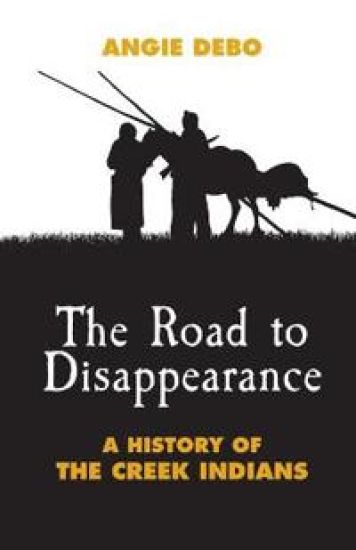
Two hundred years ago, when the activities of the white man in North America were dominated by clashing imperial ambitions and colonial rivalry, the great Creek Confederacy rested in savage contentment under the reign of native law. No one in their whole world could do the Creeks harm, and they welcomed the slight white man who came with gifts and promises to enjoy the hospitality of their invincible towns.Their reputation as warriors and diplomats, during the eighteenth and early nineteenth centuries, extended to the most distant reaches of the Indian country. Secure in their careless strength, friendly toward the white man until his encroachment made them resentful and desperate, they learned that they had no guile to match broken promises, and no disciplined courage to provide unity against white ruthlessness. Broken, dissembled, and their ranks depleted by the Creek and Seminole wars, they were subjected to that shameful and tragic removal which forced all the Five Civilized Tribes to a new home in the untried wilderness west of the Mississippi.There, when they found the land good, they revitalized their shattered tribal institutions and rebuilt them upon the pattern of the American constitutional republic. But contentment again was short-lived as they were encircled by the encroaching white man with his hunger for land, his herds of cattle, and his desire for lumber, minerals, and railway concessions. They were faced, moreover, with internal political strife, and split by the sectionalism of the Civil War. Yet, they still survived in native steadfastness-a trait which is characteristic of the Creek-until the final denouement produced by the Dawes Act.In The Road to Disappearance, Miss Debo tells for the first time the full Creek story from its vague anthropological beginnings to the loss by the tribe of independent political identity, when during the first decade of this century the lands of the Five Civilized Tribes were divided into severalty ownership. Her book is an absorbing narrative of a minority people, clinging against all odds to native custom, language, and institution. It is the chronicle of the internal life of the tribe - the structure of Creek society - with its folkways, religious beliefs, politics, wars, privations, and persecutions. Miss Debo's research has divulged many new sources of information, and her history of the Creeks since the Civil War is a special contribution because that period has been largely neglected by the historians of the American Indian.""The vitality of our race still persists,"" said a Creek orator. ""We have not lived for naught.... We have given to the European people on this continent our thought forces-the best blood of our ancestors having intermingled with that of their best statesmen and leading citizens. We made ourselves an indestructible element in their national history. We have shown that what they believed were arid and desert places were habitable and capable of sustaining millions of people.... The race that has rendered this service to the other nations of mankind cannot utterly perish.""
The Rise and Fall of the Choctaw Republic

The Rise and Fall of the Choctaw Republic

Angie Debo

University of Oklahoma Press
1975
nidottu
Here is the story of the Choctaws, a proud and gifted tribe among the Five Civilized Tribes of Indians. It is the record of a people whose forced migration from their ancestral homes in the South to what is now Oklahoma and whose subsequent efforts from the Civil War to the close of the century to maintain an autonomous government and institutions form a distinctive and arresting chapter in the history of the West.While the political, social, and economic customs of the Choctaws were closely circumscribed, the thread of Choctaw history was at all times closely interwoven witht he larger fabric of American history as a whole. Choctaw law was a curious combination of ancient tribal custom and Anglo-American legal practice; Choctaw churches and schools were copied almost wholly from the white man's society; and Choctaw economic institutions represented an attempt to adjust the customs of tribal control of the land to the white system of individual ownership.
Indian Removal

Indian Removal

Grant Foreman; Angie Debo

University of Oklahoma Press
1974
nidottu
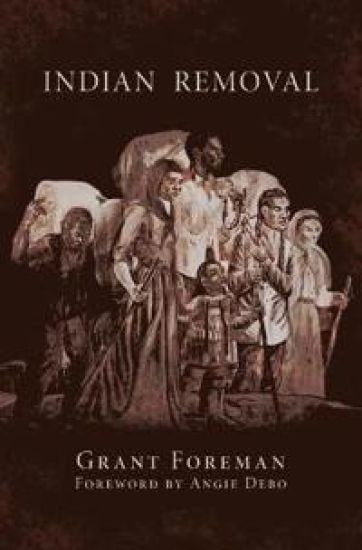
It is unlikely that any single book or document will ever earn a more firmly-fixed position of respect and authority than this distinguished volume by Grant Foreman. Originally published in 1932, on the date of the hundredth anniversary of the arrival in Oklahoma of the first Indians as a result of the United States government's relocation of the Five Civilized Tribes, Indian Removal remains today the definitive book in its field.The forcible uprooting and expulsion of the 60,000 Indians comprising the Five Civilized Tribes, including the Choctaw, Chickasaw, Creek, Cherokee, and Seminole, unfolded a story without parallel in the history of the United States. For more than a decade thousands of tragedies and experiences of absorbing interest marked the removal over the ""Trail of Tears,"" but there were no chroniclers at hand to record them. Only occasionally did the tragedy and pathos of some phase of this history-making undertaking beguile a sympathetic officer to turn from routine and write a line or a paragraph of comment.From fragments in thousands of manuscripts and in official and unofficial reports Grant Foreman gleaned the materials for this book to provide readers with an unbiased day-by-day recital of events.