Kirjojen hintavertailu. Mukana 12 595 353 kirjaa ja 12 kauppaa.

Kirjailija

Anil Hira

Kirjat ja teokset yhdessä paikassa: 15 kirjaa, julkaisuja vuosilta 1998-2025, suosituimpien joukossa Cooperatives across Clusters. Vertaile teosten hintoja ja tarkista saatavuus suomalaisista kirjakaupoista.

15 kirjaa

Kirjojen julkaisuhaarukka 1998-2025.

Cooperatives across Clusters

Cooperatives across Clusters

Anil Hira; Paul Gottlieb; Neil Reid; Stephan Goetz; Elizabeth Dobis

Oregon State University
2024
nidottu
Most agricultural production is of commodity or undifferentiated products. Producers suffer from a roller-coaster ride of price swings, over- or under-production, weather and pest threats, and the inability of family famers to capture anything beyond a small percentage of the final price. Cooperatives Across Clusters provides lessons from the cranberry industry, a commodity product organized mostly into family farms in seven different clusters around North America. The industry is remarkable in that it's substantially organized around one large cooperative, Ocean Spray. The authors examine how the cooperative came to be, the challenges of coordination and industry leadership across the diverging clusters, and the lessons for cooperation for other agricultural industries. The book provides a multi-layered contribution to agricultural economics. First, it examines location decisions and what factors supersede growing conditions to allow industries to arise around production. Second, it explores pathways available for farmers to try to overcome, through cooperative organization, the natural boom-bust cycles of commodity price swings. Third, it looks at how cooperative decisions are made, and the challenges of providing industry leadership, including research and development and collective marketing, through a cooperative that faces continual defections and new problems. Finally, through in-depth historical, statistical, and field research, it provides a comprehensive study of the cranberry industry and suggests ways farmers can grow the industry. Agricultural policymakers, farmers, industry specialists, and researchers of agriculture and clusters more generally will find this to be an important and informative new resource.

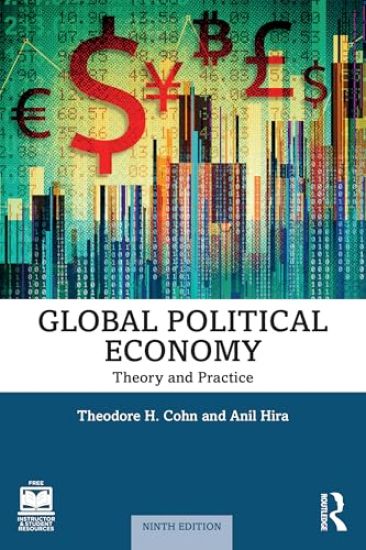
Global Political Economy

Global Political Economy

Theodore H. Cohn; Anil Hira

TAYLOR FRANCIS LTD
2025
sidottu
Global Political Economy places the study of IPE in broad theoretical context, equally emphasizing theory and practice to provide a framework for analyzing current events and long-term developments in the global economy.Andy Hira updates this essential book and the related instructor and student resources, to cover recent global developments and shifts in scholarship.New and updated for the Ninth Edition • Provides an economics primer on how markets, interest, and exchange rates work, comparative advantage, and monetary and fiscal policy; and material on getting a job in political economy.• Includes the basic tenets of realism.• Expands coverage on China, including on bipolarity/U.S. relations, security-economic tradeoffs, Taiwan, the Belt and Road Initiative, and the failure of TPP.• Discusses Russia’s invasion of Ukraine and builds on the material on sanctions.• Investigates the effects of the pandemic, including post-pandemic inflation.• Explores critical approaches to IR and different theoretical perspectives, and gives more weight to the Global South, including postcolonialism and intersectionality.• Focuses more on climate change and the environment, technological advances, and migration.• Adds material on club goods, cryptocurrencies, labor rights, global tax and offshoring, socially responsible investment, corporate social responsibility, the “Beijing Model,” the proposed global minimum tax, ASEAN, and the African Continental Free Trade Agreement.• Updates the tables, figures, graphics, references, and supplementary readings throughout.• Provides updated instructor resources including a Test Bank, PowerPoint slides, Exercises, and an Instructor’s Manual, and a new student website with practice quizzes, flashcards, lecture videos, and links to extensive additional resources including videos, podcasts, readings, and data sources to support learning and engagement.Praised for its authoritative coverage, Global Political Economy is essential reading for both introductory and advanced IPE courses.
The Smoke and Mirrors Game of Global CSR Reporting
This book examines corporate social responsibility reporting systems. Corporate social responsibility or CSR is the idea that corporations should act ethically, with a sense of obligation to society beyond financial return. We focus on the main ways that corporations report CSR at the global level. We find that the main reporting systems, whether administered through the UN through The Global Compact, or through the various financial reporting systems such as Bloomberg, are fundamentally flawed. In fact, it would be very hard for an ethical investor or consumer to find adequate and accurate information. The book closes with suggestions on how to reform the CSR information system so that corporations can be held accountable and incentivized to do the right thing.
The Smoke and Mirrors Game of Global CSR Reporting
This book examines corporate social responsibility reporting systems. Corporate social responsibility or CSR is the idea that corporations should act ethically, with a sense of obligation to society beyond financial return. We focus on the main ways that corporations report CSR at the global level. We find that the main reporting systems, whether administered through the UN through The Global Compact, or through the various financial reporting systems such as Bloomberg, are fundamentally flawed. In fact, it would be very hard for an ethical investor or consumer to find adequate and accurate information. The book closes with suggestions on how to reform the CSR information system so that corporations can be held accountable and incentivized to do the right thing.
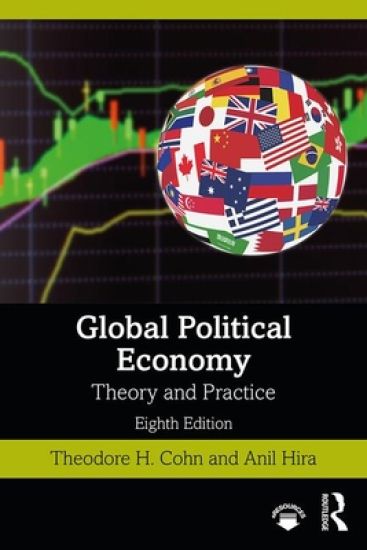
Global Political Economy

Global Political Economy

Theodore H. Cohn; Anil Hira

Routledge
2020
nidottu
Praised for its authoritative coverage, Global Political Economy places the study of IPE in broad theoretical context and has been updated to cover the rise of populism, Brexit, the USMCA, US–China trade wars, tariffs, refugees and global migration, the Keynesian–monetarist debate, Fordism, automation, the "gig" economy, global value chains, climate change, cryptocurrencies, and the residual effects of global economic crises and regional relationships and impacts. Written by leading IPE scholar Theodore Cohn, now joined by his prolific colleague Andy Hira, this book equally emphasizes theory and practice to provide a framework for analyzing current events and long-term developments in the global economy. This text is suitable for both introductory and advanced IPE courses.New to the Eighth Edition Expands upon the growing US–China competition in many areas of the global political economy. Discusses the problems Brexit is posing for Britain and the European Union (EU). Explores the growth of populism. Focuses more on environmental degradation/climate change along with the increase in global migration. Incorporates a new theme of South–South global economic relations. Highlights the relationship among economics, geopolitics, and security issues. Emphasizes the importance of global value chains.Looks at the potential for future global financial crises. Updates and expands the number of tables, figures, and graphics throughout. Provides an updated Test Bank and new PowerPoint slides in an Instructor’s e-Resource.
The Great Disruption

The Great Disruption

Anil Hira

Peter Lang Publishing Inc
2019
sidottu
The Great Disruption: Understanding the Populist Forces Behind Trump, Brexit, and LePen aims to put the shocking events of 2016–17 into a long-term, historical perspective. The seemingly disparate and separately discussed election of Donald Trump, Brexit vote, success of Marine LePen’s National Front Party, and the wider spread of populism have an overlooked commonality: They all start with a similar core constituency of disaffected older blue collar workers. Using a data-driven analysis, author Anil Hira shows that racism and xenophobia are linked to economic populism—xenophobia becoming widespread under conditions of economic stress. Hira shows further that since economic stress is felt very deeply, conventional solutions are inadequate. There is a perception among the affected group that politicians can not offer "normal" solutions and thus turn to populism. The Great Disruption traces long-term and largely un-linked shifts in the economy from globalization to automation to uncover the deeper sources of populist outbreaks. This book demonstrates that racial and immigrant attitudes have not changed, rather any backlash is a scapegoating effect of economic loss and dislocation. Populism not only misdiagnoses the situation but also misses the wider long-term threats of climate change, demographic shifts, and the rise of China. Recognizing the transformational nature of such threats depends on the maturation of the Millennial generation and its willingness to evolve towards a more global style of governance, in the process rejecting the shallow promises of populism.
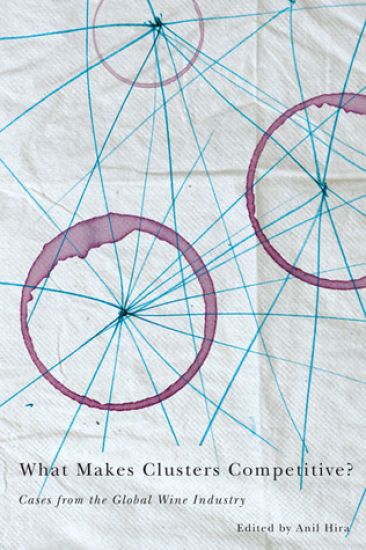
What Makes Clusters Competitive?

What Makes Clusters Competitive?

Anil Hira

McGill-Queen's University Press
2013
sidottu
While global competitiveness is increasingly invoked as necessary for economic success stories, there are few answers available about how it can be achieved or maintained. The idea of stimulating industries to spur on economies is often proposed, but industrial policy can be seen as a boondoggle of government spending, and theorists of globalization are doubtful that such efforts can succeed in a world of fragmented supply chains. What Makes Clusters Competitive? tests fundamental theoretical hypotheses about what makes industries competitive in a globalized world by using the wine industries of several countries as case studies: Extremadura (Spain), Tuscany (Italy), South Australia, Chile, and British Columbia (Canada), Taking into account historical and location-specific characteristics, and drawing out policy lessons for other regions that would like to promote their industries, this volume demonstrates the value of applying cluster theory to understand market forces, while also describing the forces underlying the development of the wine industry in a range of different settings. An excellent resource for those interested in what makes industries succeed or struggle, What Makes Clusters Competitive? offers guidance for policymakers and the private sector on how to promote local industries. Contributors include David Aylward, Alexis Bwenge, Sara Daniele, F.J. Mesias Diaz, Christian Felzenstein, Husam Gabreldar, F. Pulido Garcia, Sarah Giest, Elisa Giuliani, Andy Hira, Mike Howlett, A.F. Pulido Moreno, and Oriana Perrone.
What Makes Clusters Competitive?

What Makes Clusters Competitive?

Anil Hira

McGill-Queen's University Press
2013
nidottu
While global competitiveness is increasingly invoked as necessary for economic success stories, there are few answers available about how it can be achieved or maintained. The idea of stimulating industries to spur on economies is often proposed, but industrial policy can be seen as a boondoggle of government spending, and theorists of globalization are doubtful that such efforts can succeed in a world of fragmented supply chains. What Makes Clusters Competitive? tests fundamental theoretical hypotheses about what makes industries competitive in a globalized world by using the wine industries of several countries as case studies: Extremadura (Spain), Tuscany (Italy), South Australia, Chile, and British Columbia (Canada), Taking into account historical and location-specific characteristics, and drawing out policy lessons for other regions that would like to promote their industries, this volume demonstrates the value of applying cluster theory to understand market forces, while also describing the forces underlying the development of the wine industry in a range of different settings. An excellent resource for those interested in what makes industries succeed or struggle, What Makes Clusters Competitive? offers guidance for policymakers and the private sector on how to promote local industries. Contributors include David Aylward, Alexis Bwenge, Sara Daniele, F.J. Mesias Diaz, Christian Felzenstein, Husam Gabreldar, F. Pulido Garcia, Sarah Giest, Elisa Giuliani, Andy Hira, Mike Howlett, A.F. Pulido Moreno, and Oriana Perrone.
North American Homeland Security

North American Homeland Security

Imtiaz Hussain; Satya R. Pattnayak; Anil Hira

Praeger Publishers Inc
2008
sidottu
Did 9/11 revive a North American guns-butter trade-off? Established in the largest administrative overhaul since World War II, the Department of Homeland Security was charged with keeping the United States safe within a wider security community, but confronted the Washington Consensus-based Western Hemisphere free trade movement, beginning with the North American Free Trade Agreement (NAFTA) and extending to the Central American Free Trade Agreement (CAFTA) in 2003, to materialize a Free Trade Area of the Americas (FTAA) compact. Whether 9/11 restrictions impeded these trade-related thrusts or not, embracing neoliberalism permitted Canada and Mexico to pursue their own initiatives, such as proposing free-trade to the US—Canada in 1985, Mexico in 1990, but, as during the Cold War, security imperatives ultimately prevailed.This work investigates Canada's and Mexico's Department of Homeland Security responses through three bilateral studies of policy responses along comparative lines, case studies of security and intelligence apparatuses in each of the three countries, and a post-9/11 trilateral assessment. Ultimately, they raise a broader and more critical North American question: Will regional economic integration continue to be trumped by security considerations, as during the Cold War era, and thereby elevate second-best outcomes, or rise above the constraints to reassert the unquenchable post-Cold War thirst for unfettered markets replete with private enterprises, liberal policies, and full-fledged competitiveness?
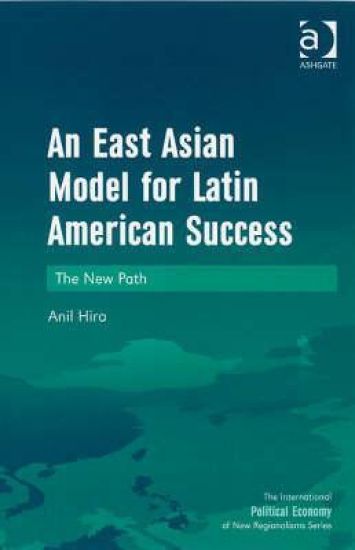
An East Asian Model for Latin American Success

An East Asian Model for Latin American Success

Anil Hira

Ashgate Publishing Limited
2007
sidottu
Latin America is at a uniquely important juncture in its history and the history of development more generally. Neoliberal market-orientated policies are being called into question, growth has been volatile and equity has stayed the same or worsened. In Latin America there is no clear direction for change. This book presents an alternative development path for Latin America based on an East Asian model. East Asia remains the only developing region so far with high stable and equitable economic development. Based on in depth analysis and the presentation of new and unique material, this study provides a new perspective on the lessons of China's rapid development and examines relations between states and companies that have led to greater success by East Asian companies entering new international markets. More importantly, it highlights how Latin American politics can and must be transformed.
Development Projects for a New Millennium

Development Projects for a New Millennium

Anil Hira; Trevor Parfitt

Praeger Publishers Inc
2004
nidottu
Economic matters entered a new phase of importance in the wake of the Cold War. Concerns within development-assistance efforts to the Third World have also shifted. The current macro-environment of development has been accompanied by a plethora of new concerns and methods, such as how to consider gender in development projects and how to develop participatory-centered projects. Yet no text has covered many of the new approaches and techniques related to development projects, including issues of participation, gender, and evaluation—until now. Hira and Parfitt bridge these serious gaps, drawing on their hands-on experience and teaching in the field. The end of the Cold War was supposed to bring a new era of peace prosperity, and development. However, the post-Cold War world has not led to any major improvements in development. In this book, Hira and Parfitt examine why 50 years of development have not led to the wiping out of poverty. In the first part of the book, they break down the political agendas behind development in the post-Cold War World, as well as the serious flaws in current development project management. In the remainder of the book they look carefully at a number of new initiatives that seek to correct these problems, examining carefully their promise for bringing about more tangible results. This book provides a thorough overview of the classic concerns and approaches of development project management, including clear explanations of predominant planning and evaluation practices. In addition, the book introduces the major new initiatives in development project management, including those regarding environmental sustainability, participation, gender, and the steps needed to create a real learning environment in development project planning. The result is a guide for the project manager and policymaker who want to know the implications of recent development ideas in terms of everyday practices, as well as for the student and interested citizen seeking to move beyond theory and critique to see how new practices can change the way that development projects are administered.
Development Projects for a New Millennium

Development Projects for a New Millennium

Anil Hira; Trevor Parfitt

Praeger Publishers Inc
2004
sidottu
Economic matters entered a new phase of importance in the wake of the Cold War. Concerns within development-assistance efforts to the Third World have also shifted. The current macro-environment of development has been accompanied by a plethora of new concerns and methods, such as how to consider gender in development projects and how to develop participatory-centered projects. Yet no text has covered many of the new approaches and techniques related to development projects, including issues of participation, gender, and evaluation—until now. Hira and Parfitt bridge these serious gaps, drawing on their hands-on experience and teaching in the field.The end of the Cold War was supposed to bring a new era of peace prosperity, and development. However, the post-Cold War world has not led to any major improvements in development. In this book, Hira and Parfitt examine why 50 years of development have not led to the wiping out of poverty. In the first part of the book, they break down the political agendas behind development in the post-Cold War World, as well as the serious flaws in current development project management. In the remainder of the book they look carefully at a number of new initiatives that seek to correct these problems, examining carefully their promise for bringing about more tangible results.This book provides a thorough overview of the classic concerns and approaches of development project management, including clear explanations of predominant planning and evaluation practices. In addition, the book introduces the major new initiatives in development project management, including those regarding environmental sustainability, participation, gender, and the steps needed to create a real learning environment in development project planning. The result is a guide for the project manager and policymaker who want to know the implications of recent development ideas in terms of everyday practices, as well as for the student and interested citizen seeking to move beyond theory and critique to see how new practices can change the way that development projects are administered.
Political Economy of Energy in the Southern Cone
Hira explores the impact of the neoliberal revolution in Latin America, which claims the superiority of markets that are freed from government intervention and restrictions on trade and investment. He examines changes in the energy policy of the Southern Cone (Argentina, Bolivia, Brazil, Chile, Paraguay, and Uruguay) and finds that, contrary to what is claimed and expected, there is a great deal of state intervention that continues through regulatory policy.All around the world, economic markets are in flux. Policies to change these markets are part of the neoliberal revolution that claims the superiority of markets freed from government intervention and restrictions on trade and investment. The general conclusion among most academic and policy analysts who study developing countries is that market liberalization is a foregone conclusion. Developing countries' choices are constrained by two primary factors: first, the burden of massive external debt that forces them to court international finance, and second, the need to gain access to the world's largest markets in Europe and/or the United States, optimally through free trade agreements. The effects of market liberalization, including deregulation, privatization, and integration, require further scrutiny.Hira examines the effects of international market pressures on energy policy at the national, regional, and sectoral levels in Latin America's Southern Cone—Argentina, Bolivia, Brazil, Chile, Paraguay, and Uruguay—who belong to the MERCOSUR common market. Contrary to what is claimed and expected, he finds that a great deal of state intervention continues through regulatory policy. He also provides an thorough set of comparative political economy case studies, along with a discussion of the MERCOSUR process with regards to energy. His analysis of the political economy of electricity and natural gas deregulation is especially relevant in the wake of the California energy crisis, the Enron debacle, and international discussions about energy deregulation. This book is of particular interest to scholars, students, and other researchers involved with Latin American economic development and energy policy.
Ideas and Economic Policy in Latin America

Ideas and Economic Policy in Latin America

Anil Hira

Praeger Publishers Inc
1998
sidottu
How are the economic policies which developing countries adopt selected and how do they change? Who are the key players in economic development policies? Professor Anil Hira answers these questions head on by suggesting new ways of looking at how ideas affect economic policy. He first traces the way that ideas become wedded to interest groups over time, and he interprets the debate over economic development policy as a series of changes in idea-interest networks, often marked by crises. He then looks closely at economic idea entrepreneurs.Through concrete case studies of networks in Latin America, with a focus on Chilean economic policy, Hira explains not only how ideas are introduced, but which ones win out in the economic policy process and why. He introduces the concept of economic knowledge networks to understand groups of economists wedded to certain sets of ideas, such as neoliberalism or structuralism. Economic knowledge networks extend beyond Latin America and can be found in such diverse places as Indonesia and Egypt. Hira identifies the characteristics of these groups and shows how they create political action through their organizational activities and ideas. Hira not only sheds light on how ideas affect economic policy, but also provides an inside story on the groups responsible for the new economic revolution that is sweeping Latin America and transforming the regional economy. An important resource for scholars, students, and policy makers involved with international political economy, emerging economies, and Latin American studies.