Kirjojen hintavertailu. Mukana 12 595 353 kirjaa ja 12 kauppaa.

Kirjailija

Anil Markandya

Kirjat ja teokset yhdessä paikassa: 13 kirjaa, julkaisuja vuosilta 1989-2016, suosituimpien joukossa Sustainable Development. Vertaile teosten hintoja ja tarkista saatavuus suomalaisista kirjakaupoista.

13 kirjaa

Kirjojen julkaisuhaarukka 1989-2016.

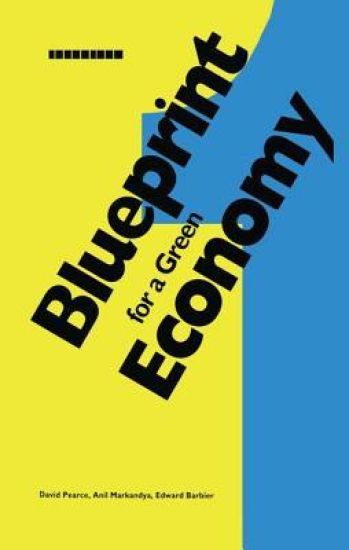
Blueprint 1

Blueprint 1

David Pearce; Anil Markandya; Edward Barbier

Routledge
2016
sidottu
This report has been prepared by the London Environmental Economics Centre (LEEC). LEEC is a joint venture, established in 1988, by the International Institute for Environment and Development (IIED) and the department of Economics of University College London (UCL). Popularly known as The Pearce Report, this book is a report prepared for the Department of the Environment. It demonstrates the ways in which elements in our environment at present under threat from many forms of pollution can be costed. The book goes on to show ways in which governments are able, as a consequence of this analysis, to construct systems of taxation which would both reduce pollution by making it too costly and generate revenue for cleaning up much of the damage. The book ends with a series of skeleton programmes for progress.
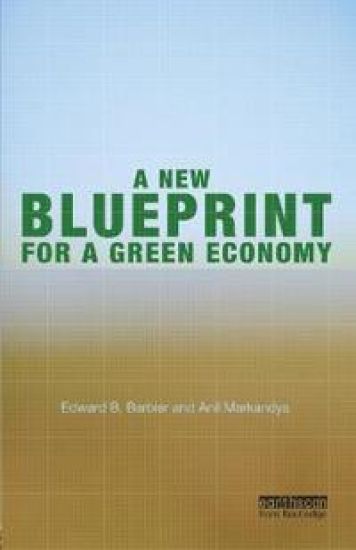
A New Blueprint for a Green Economy

A New Blueprint for a Green Economy

Edward B. Barbier; Anil Markandya

Earthscan Ltd
2013
nidottu
Published in 1989, Blueprint for a Green Economy presented, for the first time, practical policy measures for 'greening' modern economies and putting them on a path to sustainable development. This new book, written by two of the Blueprint for a Green Economy authors, revisits and updates its main messages by asking, first, what has been achieved in the past twenty years, and second, what more needs to be done to generate a truly 'green economy' in the twenty-first century? Blueprint for a Green Economy had one over-arching theme. Making economies more sustainable requires urgent progress in three key policy areas: valuing the environment, accounting for the environment and incentives for environmental improvement. Today, with the threat of global warming, the decline in major ecosystems and their services, and fears over energy security, achieving these goals is even more vital. The current book first summarizes the main messages from Blueprint for a Green Economy and explains why, given rapid and widespread global environmental degradation, they are still relevant. The book then examines the progress since Blueprint for a Green Economy in implementing policies and other measures to improve environmental valuation, accounting and incentives. Although much has been accomplished, additional advances are still required to green economies successfully. The book highlights the new policies and approaches needed for economic management of today's environmental concerns. Over twenty years later, A New Blueprint for a Green Economy once again emphasizes practical policies for greening modern economies, and explains why such an economic roadmap to a greener future is essential, if modern economies are to develop successfully and sustainably.
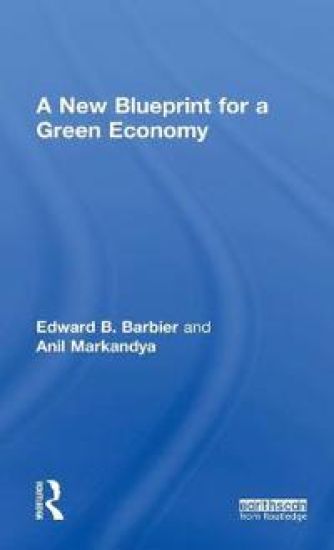
A New Blueprint for a Green Economy

A New Blueprint for a Green Economy

Edward B. Barbier; Anil Markandya

Earthscan Ltd
2012
sidottu
Published in 1989, Blueprint for a Green Economy presented, for the first time, practical policy measures for 'greening' modern economies and putting them on a path to sustainable development. This new book, written by two of the Blueprint for a Green Economy authors, revisits and updates its main messages by asking, first, what has been achieved in the past twenty years, and second, what more needs to be done to generate a truly 'green economy' in the twenty-first century? Blueprint for a Green Economy had one over-arching theme. Making economies more sustainable requires urgent progress in three key policy areas: valuing the environment, accounting for the environment and incentives for environmental improvement. Today, with the threat of global warming, the decline in major ecosystems and their services, and fears over energy security, achieving these goals is even more vital. The current book first summarizes the main messages from Blueprint for a Green Economy and explains why, given rapid and widespread global environmental degradation, they are still relevant. The book then examines the progress since Blueprint for a Green Economy in implementing policies and other measures to improve environmental valuation, accounting and incentives. Although much has been accomplished, additional advances are still required to green economies successfully. The book highlights the new policies and approaches needed for economic management of today's environmental concerns. Over twenty years later, A New Blueprint for a Green Economy once again emphasizes practical policies for greening modern economies, and explains why such an economic roadmap to a greener future is essential, if modern economies are to develop successfully and sustainably.
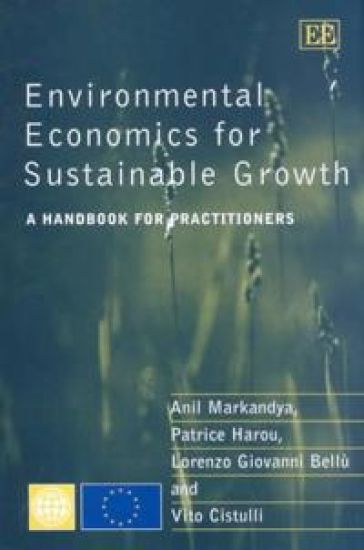
Environmental Economics for Sustainable Growth

Environmental Economics for Sustainable Growth

Anil Markandya; Patrice Harou; Lorenzo G. Bellù; Vito Cistulli

Edward Elgar Publishing Ltd
2002
nidottu
Environmental Economics for Sustainable Growth is a specially designed handbook for trainers, practitioners and government advisors involved in environmental policy making. It will enable professionals to initiate and implement environmental economic studies and identify policies and investments which will ensure sustainable development in their respective countries.The book focuses on economic tools but also encompasses ecological and sociological perspectives, all of which are essential to any successful environmental policy. The authors highlight the major issues in environmental policy making and the analysis of projects with environmental impacts. Features include:sustainable development in a global contextmacroeconomic policies and the environmentenvironmental policies and prioritieslegal and institutional dimensionsintegration of environmental assessment into project analysisvaluation techniques and case studies.This handbook will be of immense use in the training of policymakers, practitioners, and students of environmental policy as well as development managers and scholars working in the areas of environment and development.
Environmental Economics for Sustainable Growth

Environmental Economics for Sustainable Growth

Anil Markandya; Patrice Harou; Lorenzo G. Bellù; Vito Cistulli

Edward Elgar Publishing Ltd
2002
sidottu
Environmental Economics for Sustainable Growth is a specially designed handbook for trainers, practitioners and government advisors involved in environmental policy making. It will enable professionals to initiate and implement environmental economic studies and identify policies and investments which will ensure sustainable development in their respective countries.The book focuses on economic tools but also encompasses ecological and sociological perspectives, all of which are essential to any successful environmental policy. The authors highlight the major issues in environmental policy making and the analysis of projects with environmental impacts. Features include:sustainable development in a global contextmacroeconomic policies and the environmentenvironmental policies and prioritieslegal and institutional dimensionsintegration of environmental assessment into project analysisvaluation techniques and case studies.This handbook will be of immense use in the training of policymakers, practitioners, and students of environmental policy as well as development managers and scholars working in the areas of environment and development.
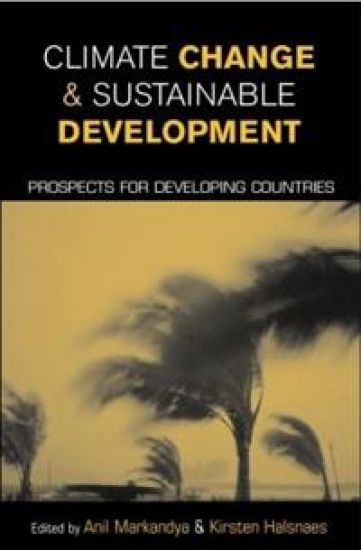
Climate Change and Sustainable Development

Climate Change and Sustainable Development

Anil Markandya; Kirsten Halsnaes

Earthscan Ltd
2002
sidottu
'Makes a substantial contribution to the practical, effective analysis of climate change mitigation options in developing countries.'Development And Cooperation'The book is an excellent exercise and a good source of detailed information, and a basis for further discussions. Any person interested in this major environmental problem should read it.'International Journal of Environment and Pollution'Markandya and Halsnaes' collection is thoughtfully put together and can be recommended to all the practitioners in the fields of climate change and sustainable development.'The Journal of Energy LiteratureThis text argues that the policies pursued by developing countries will be crucial in determining the progress of climate change. Many are industrializing rapidly and the largest, particularly China and India, could have an impact at least as significant as that of the already industrialized economies - the reason given by President Bush for taking the US out of the Kyoto Protocol. The future of sustainable development in large measure depends on developing countries. This book develops a pragmatic framework for evaluating the climate change options faced by each developing country, depending on their individual circumstances. It assesses present methods, suggests how these might be improved, and proposes ways in which social and developmental aspects can be taken into account. Its discussion of the issues and the methods presented contribute to the practical analysis of climate change mitigation options in developing countries. The book should be useful to professionals, governments, international organizations and environmental groups working on climate change issues; as well as researchers, academics and students in economics, environmental and development studies and international affairs.
Dictionary of Environmental Economics

Dictionary of Environmental Economics

Anil Markandya; Renat Perelet; Pamela Mason; Tim Taylor

Earthscan Ltd
2001
sidottu
A comprehensive dictionary of environmental economics, compiled by leading academics in the field. Each expression or phrase is explained clearly in non-technical language, with references given to its use in the growing literature on the subject area. From abatement to zonal travel cost method (ZTCM), there are over 1000 cross-referenced entries covering topics such as: environmental instruments for policy-making, techniques applied in environmental and natural resource economics, major issues in environmental economics and environmental management, economics of sustainable development, natural resource accounting, and international environmental agreements. As well as providing incisive answers to questions such as 'What is natural capital?' or 'when are crowding diseconomies important?', the dictionary includes a list of commonly used acronyms and abbreviations, and a complete bibliography detailing the major texts in the field is provided.
Dictionary of Environmental Economics

Dictionary of Environmental Economics

Anil Markandya; Renat Perelet; Pamela Mason; Tim Taylor

Earthscan Ltd
2000
nidottu
This comprehensive dictionary gives detailed information and definitions on environmental economics and key legal terms. A complete bibliography covers all the major texts in the field and a comprehensive list of acronyms is also provided.
Sustainable Development

Sustainable Development

David Pearce; Edward Barbier; Anil Markandya

Earthscan Ltd
2000
nidottu
Blueprint for a Green Economy put the economics of the environment onto the public agenda. Its authors have now widened the issue by applying the principles of their earlier, ground-breaking work to the tangled issue of sustainable Third World development. They offer a definition of sustainable development in terms of not depleting natural resources and then examine its economic implications. The bulk of the book contains six lively case-studies of major developmental issues, from the watersheds of Java to the drylands of the Sudan; from Amazonia to Africa, all of which show the crucial importance of incorporating the economics of sustainable development into our thinking.
Reconciling Trade and the Environment

Reconciling Trade and the Environment

Veena Jha; Anil Markandya; René Vossenaar

Edward Elgar Publishing Ltd
1999
sidottu
The link between trade and the environment has focused on two broad issues: how changing trade regimes have affected the environment and how stricter environmental regulations have affected trade. The answers are of particular importance to developing and transition countries where the relationship between trade and the environment has a major impact. This unique book, based on eleven case studies undertaken by research institutes in developing countries with the support of UNCTAD and UNDP, provides detailed empirical evidence from Brazil, China, Colombia, Costa Rica, India, Malaysia, The Philippines, Poland, Thailand, Turkey and Zimbabwe. The central questions addressed are:has the international programme of trade liberalization affected the environment negatively?are stricter environmental regulations in both developed and developing countries having an effect on exports and imports and how can these effects be addressed?what impacts, if any, result from differences in environmental standards between richer and poorer countries? what impacts have multilateral environmental agreements had on trade flows between developed and developing countrieswhat impacts are firms' voluntary measures to protect the environment having on the export flows from developing and transition countries?The book provides a wealth of information and shows a wide difference of outcomes from country to country, allowing the authors to draw an interesting set of conclusions. It will be useful for students and researchers in environmental and international economics and will be essential reading for policymakers in government and non-governmental organizations.
Sustainable Development

Sustainable Development

David Pearce; Edward B. Barbier; Anil Markandya

Edward Elgar Publishing Ltd
1990
sidottu
This major book makes a significant contribution to the development of economic principles and practice for natural resource management in Third World countries.The 1980s witnessed the second environmental revolution: its theme is 'sustainable development'. This book offers a definition of sustainable development in terms of the non-depletion of natural environments. It investigates the economic implications of sustainability, with special reference to the practice of cost-benefit analysis and problems of accounting for the interests of future generations. The major part of the book is devoted to an analysis of environmental problems in the developing world. The essential ingredients of policy measures aimed at sustainable development are discussed.
Blueprint 1

Blueprint 1

David Pearce; Anil Markandya; Edward Barbier

Earthscan Ltd
1989
nidottu
Popularly known as "The Pearce Report", this book is a report prepared for the Department of the Environment. It demonstrates the ways in which elements in our environment at present under threat from many forms of pollution can be "costed".