Kirjojen hintavertailu. Mukana 12 305 150 kirjaa ja 12 kauppaa.

Kirjailija

Aniruddha Datta

Kirjat ja teokset yhdessä paikassa: 7 kirjaa, julkaisuja vuosilta 1998-2012, suosituimpien joukossa Adaptive Internal Model Control. Vertaile teosten hintoja ja tarkista saatavuus suomalaisista kirjakaupoista.

7 kirjaa

Kirjojen julkaisuhaarukka 1998-2012.

Adaptive Internal Model Control

Adaptive Internal Model Control

Aniruddha Datta

Springer London Ltd
2012
nidottu
Adaptive Internal Model Control is a methodology for the design and analysis of adaptive internal model control schemes with provable guarantees of stability and robustness. Written in a self-contained tutorial fashion, this research monograph successfully brings the latest theoretical advances in the design of robust adaptive systems to the realm of industrial applications. It provides a theoretical basis for analytically justifying some of the reported industrial successes of existing adaptive internal model control schemes, and enables the reader to synthesise adaptive versions of their own favourite robust internal model control scheme by combining it with a robust adaptive law. The net result is that earlier empirical IMC designs can now be systematically robustified or replaced altogether by new designs with assured guarantees of stability and robustness.
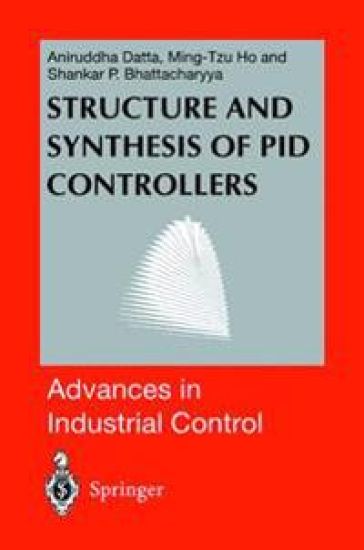
Structure and Synthesis of PID Controllers

Structure and Synthesis of PID Controllers

Aniruddha Datta; Ming-Tzu Ho; Shankar P. Bhattacharyya

Springer London Ltd
2010
nidottu
In many industrial applications, the existing constraints mandate the use of controllers of low and fixed order while typically, modern methods of optimal control produce high-order controllers. The authors seek to start to bridge the resultant gap and present a novel methodology for the design of low-order controllers such as those of the P, PI and PID types. Written in a self-contained and tutorial fashion, this book first develops a fundamental result, generalizing a classical stability theorem – the Hermite–Biehler Theorem – and then applies it to designing controllers that are widely used in industry. It contains material on: • current techniques for PID controller design; • stabilization of linear time-invariant plants using PID controllers; • optimal design with PID controllers; • robust and non-fragile PID controller design; • stabilization of first-order systems with time delay; • constant-gain stabilization with desired damping • constant-gain stabilization of discrete-time plants.
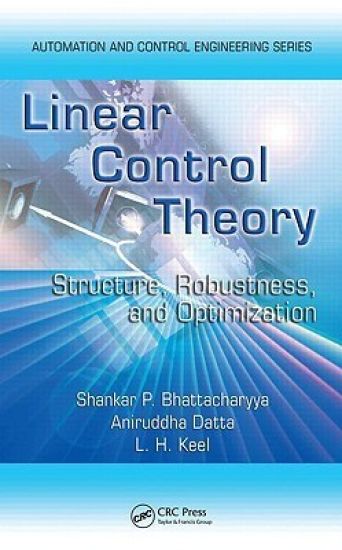
Linear Control Theory

Linear Control Theory

Shankar P. Bhattacharyya; Aniruddha Datta; Lee H. Keel

CRC Press Inc
2009
sidottu
Successfully classroom-tested at the graduate level, Linear Control Theory: Structure, Robustness, and Optimization covers three major areas of control engineering (PID control, robust control, and optimal control). It provides balanced coverage of elegant mathematical theory and useful engineering-oriented results.The first part of the book develops results relating to the design of PID and first-order controllers for continuous and discrete-time linear systems with possible delays. The second section deals with the robust stability and performance of systems under parametric and unstructured uncertainty. This section describes several elegant and sharp results, such as Kharitonov’s theorem and its extensions, the edge theorem, and the mapping theorem. Focusing on the optimal control of linear systems, the third part discusses the standard theories of the linear quadratic regulator, Hinfinity and l1 optimal control, and associated results. Written by recognized leaders in the field, this book explains how control theory can be applied to the design of real-world systems. It shows that the techniques of three term controllers, along with the results on robust and optimal control, are invaluable to developing and solving research problems in many areas of engineering.
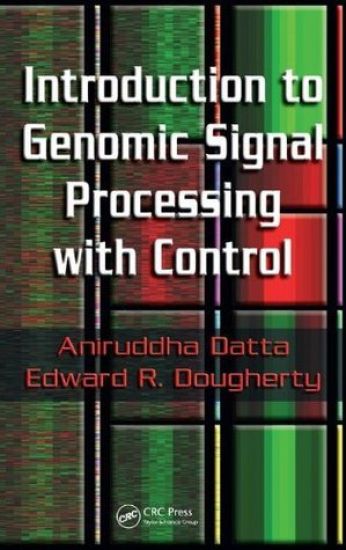
Introduction to Genomic Signal Processing with Control

Introduction to Genomic Signal Processing with Control

Aniruddha Datta; Edward R. Dougherty

CRC Press Inc
2006
sidottu
Studying large sets of genes and their collective function requires tools that can easily handle huge amounts of information. Recent research indicates that engineering approaches for prediction, signal processing, and control are well suited for studying multivariate interactions. A tutorial guide to the current engineering research in genomics, Introduction to Genomic Signal Processing with Control provides a state-of-the-art account of the use of control theory to obtain intervention strategies for gene regulatory networks. The book builds up the necessary molecular biology background with a basic review of organic chemistry and an introduction of DNA, RNA, and proteins, followed by a description of the processes of transcription and translation and the genetic code that is used to carry out the latter. It discusses control of gene expression, introduces genetic engineering tools such as microarrays and PCR, and covers cell cycle control and tissue renewal in multi-cellular organisms. The authors then delineate how the engineering approaches of classification and clustering are appropriate for carrying out gene-based disease classification. This leads naturally to expression prediction, which in turn leads to genetic regulatory networks. The book concludes with a discussion of control approaches that can be used to alter the behavior of such networks in the hope that this alteration will move the network from a diseased state to a disease-free state. Written by recognized leaders in this emerging field, the book provides the exact amount of molecular biology required to understand the engineering applications. It is a self-contained resource that spans the diverse disciplines of molecular biology and electrical engineering.
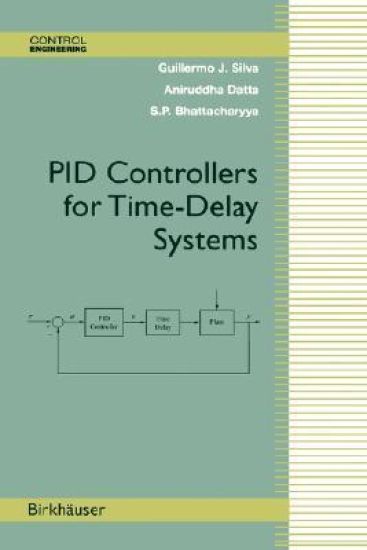
PID Controllers for Time-Delay Systems

PID Controllers for Time-Delay Systems

Guillermo J. Silva; Aniruddha Datta; Shankar P. Bhattacharyya

Birkhauser Boston Inc
2004
sidottu
This monograph presents our recent results on the proportional-integr- derivative (PID) controller and its design, analysis, and synthesis. The fo­ cus is on linear time-invariant plants that may contain a time delay in the feedback loop. This setting captures many real-world practical and in­ dustrial situations. The results given here include and complement those published in Structure and Synthesis of PID Controllers by Datta, Ho, and Bhattacharyya [10]. In [10] we mainly dealt with the delay-free case. The main contribution described here is the efficient computation of the entire set of PID controllers achieving stability and various performance specifications. The performance specifications that can be handled within our machinery are classical ones such as gain and phase margin as well as modern ones such as Hoo norms of closed-loop transfer functions. Finding the entire set is the key enabling step to realistic design with several design criteria. The computation is efficient because it reduces most often to lin­ ear programming with a sweeping parameter, which is typically the propor­ tional gain. This is achieved by developing some preliminary results on root counting, which generalize the classical Hermite-Biehler Theorem, and also by exploiting some fundamental results of Pontryagin on quasi-polynomials to extract useful information for controller synthesis. The efficiency is im­ portant for developing software design packages, which we are sure will be forthcoming in the near future, as well as the development of further capabilities such as adaptive PID design and online implementation.
Structure and Synthesis of PID Controllers

Structure and Synthesis of PID Controllers

Aniruddha Datta; Ming-Tzu Ho; Shankar P. Bhattacharyya

Springer London Ltd
1999
sidottu
In many industrial applications, the existing constraints mandate the use of controllers of low and fixed order while typically, modern methods of optimal control produce high-order controllers. The authors seek to start to bridge the resultant gap and present a novel methodology for the design of low-order controllers such as those of the P, PI and PID types. Written in a self-contained and tutorial fashion, this book first develops a fundamental result, generalizing a classical stability theorem – the Hermite–Biehler Theorem – and then applies it to designing controllers that are widely used in industry. It contains material on: • current techniques for PID controller design; • stabilization of linear time-invariant plants using PID controllers; • optimal design with PID controllers; • robust and non-fragile PID controller design; • stabilization of first-order systems with time delay; • constant-gain stabilization with desired damping • constant-gain stabilization of discrete-time plants.
Adaptive Internal Model Control

Adaptive Internal Model Control

Aniruddha Datta

Springer-Verlag Berlin and Heidelberg GmbH Co. K
1998
sidottu
Adaptive Internal Model Control is a methodology for the design and analysis of adaptive internal model control schemes with provable guarantees of stability and robustness. Written in a self-contained tutorial fashion, this research monograph successfully brings the latest theoretical advances in the design of robust adaptive systems to the realm of industrial applications. It provides a theoretical basis for analytically justifying some of the reported industrial successes of existing adaptive internal model control schemes, and enables the reader to synthesise adaptive versions of their own favourite robust internal model control scheme by combining it with a robust adaptive law. The net result is that earlier empirical IMC designs can now be systematically robustified or replaced altogether by new designs with assured guarantees of stability and robustness.