Kirjojen hintavertailu. Mukana 12 595 353 kirjaa ja 12 kauppaa.

Kirjailija

Anne Rawls

Kirjat ja teokset yhdessä paikassa: 4 kirjaa, julkaisuja vuosilta 2005-2008, suosituimpien joukossa Toward A Sociological Theory of Information. Vertaile teosten hintoja ja tarkista saatavuus suomalaisista kirjakaupoista.

4 kirjaa

Kirjojen julkaisuhaarukka 2005-2008.

Toward A Sociological Theory of Information

Toward A Sociological Theory of Information

Harold Garfinkel; Anne Rawls

Paradigm
2008
nidottu
In 1952 at Princeton University, Harold Garfinkel developed a sociological theory of information. Other prominent theories then being worked out at Princeton, including game theory, neglected the social elements of "information," modeling a rational individual whose success depends on completeness of both reason and information. In real life these conditions are not possible and these approaches therefore have always had limited and problematic practical application. Garfinkel's sociological theory treats information as a thoroughly organized social phenomenon in a way that addresses these shortcomings comprehensively. Although famous as a sociologist of everyday life, Garfinkel focuses in this new book-never before published-on the concerns of large-scale organization and decisionmaking. In the fifty years since Garfinkel wrote this treatise, there has been no systematic treatment of the problems and issues he raises. Nor has anyone proposed a theory of information like the one he proposed. Many of the same problems that troubled theorists of information and predictable order in 1952 are still problematic today.
Toward A Sociological Theory of Information

Toward A Sociological Theory of Information

Harold Garfinkel; Anne Rawls

Paradigm
2008
sidottu
In 1952 at Princeton University, Harold Garfinkel developed a sociological theory of information. Other prominent theories then being worked out at Princeton, including game theory, neglected the social elements of "information," modeling a rational individual whose success depends on completeness of both reason and information. In real life these conditions are not possible and these approaches therefore have always had limited and problematic practical application. Garfinkel's sociological theory treats information as a thoroughly organized social phenomenon in a way that addresses these shortcomings comprehensively. Although famous as a sociologist of everyday life, Garfinkel focuses in this new book-never before published-on the concerns of large-scale organization and decisionmaking. In the fifty years since Garfinkel wrote this treatise, there has been no systematic treatment of the problems and issues he raises. Nor has anyone proposed a theory of information like the one he proposed. Many of the same problems that troubled theorists of information and predictable order in 1952 are still problematic today.
Seeing Sociologically

Seeing Sociologically

Harold Garfinkel; Anne Rawls; Charles C. Lemert

Paradigm
2005
nidottu
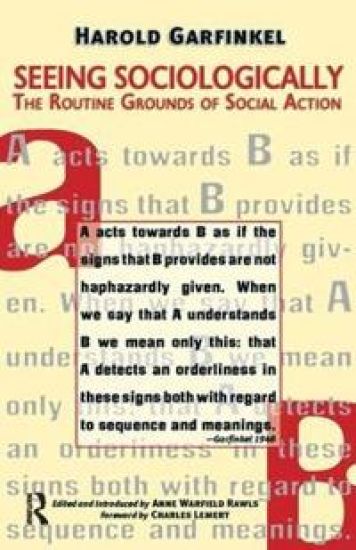
This book-never before published-is eminent sociologist Harold Garfinkel's earliest attempt, while at Harvard in 1948, to bridge the growing gap in American sociology. This gap was generated by a Parsonian paradigm that emphasised a scientific approach to sociological description, one that increasingly distanced itself from social phenomena in the increasingly influential ways studied by phenomenologists. It was Garfinkel's idea that phenomenological description, rendered in more empirical and interactive terms, might remedy shortcomings in the reigning Parsonian view. Garfinkel soon gave up the attempt to repair scientific description, and his focus became increasingly empirical until, in 1954, he famously coined the term "Ethnomethodology." However, in this early manuscript can be seen more clearly than in some of his later work the struggle with a conceptual and positivist rendering of social relations that ultimately informed Garfinkel's position. Here we find the sources of his turn toward ethnomethodology, which would influence subsequent generations of sociologists. Essential reading for all social theory scholars and graduate students and for a wider range of social scientists in anthropology, ethnomethodology, and other fields.
Seeing Sociologically

Seeing Sociologically

Harold Garfinkel; Anne Rawls; Charles C. Lemert

Paradigm
2005
sidottu
This book-never before published-is eminent sociologist Harold Garfinkel's earliest attempt, while at Harvard in 1948, to bridge the growing gap in American sociology. This gap was generated by a Parsonian paradigm that emphasised a scientific approach to sociological description, one that increasingly distanced itself from social phenomena in the increasingly influential ways studied by phenomenologists. It was Garfinkel's idea that phenomenological description, rendered in more empirical and interactive terms, might remedy shortcomings in the reigning Parsonian view. Garfinkel soon gave up the attempt to repair scientific description, and his focus became increasingly empirical until, in 1954, he famously coined the term "Ethnomethodology." However, in this early manuscript can be seen more clearly than in some of his later work the struggle with a conceptual and positivist rendering of social relations that ultimately informed Garfinkel's position. Here we find the sources of his turn toward ethnomethodology, which would influence subsequent generations of sociologists. Essential reading for all social theory scholars and graduate students and for a wider range of social scientists in anthropology, ethnomethodology, and other fields.