Kirjojen hintavertailu. Mukana 12 390 323 kirjaa ja 12 kauppaa.

Kirjailija

Anselm

Kirjat ja teokset yhdessä paikassa: 20 kirjaa, julkaisuja vuosilta 1973-2026, suosituimpien joukossa The Devotions of Saint Anselm. Vertaile teosten hintoja ja tarkista saatavuus suomalaisista kirjakaupoista.

20 kirjaa

Kirjojen julkaisuhaarukka 1973-2026.

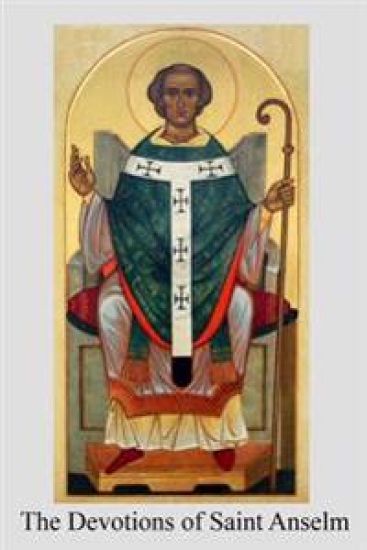
The Devotions of Saint Anselm: Archbishop of Canterbury

The Devotions of Saint Anselm: Archbishop of Canterbury

Anselm

Createspace Independent Publishing Platform
2016
nidottu
THE life of Saint Anselm is well known. It belongs to the history of England. By nature a recluse and a thinker, he was called upon to play an active part in political life under circumstances of great difficulty. In the midst of these he bore himself with a conscientious uprightness, a quiet dignity and a persistency in the refusal to sacrifice principle to expediency which justified those who called him against his will to the throne of Canterbury: but his heart was elsewhere, in that passionate search for the innermost meaning of his religious belief, of which the history of the Church affords no more striking example than his. The quarrels about investitures, about the relations of Church and State, of Pope and King, which distracted his outward life in his later years, have left no trace in his writings.l In a selection from these, intended to form part of a Library of Devotion, we need not dwell long upon them. The only one of the works here translated, the date of whose composition is known to us, was written before Anselm was archbishop, while he was still living in the seclusion of his abbey at Bec in Normandy. Even of this earlier part of his life information is so ready to hand that I do not propose to give here more than a very brief account of it. The following outline will be sufficient to inform the reader what manner of man the author was, whose devotions are put before him. Anselm was born in 1033 at Aosta in Piedmont, a Burgundian city of Roman origin, governed by its own prince-bishops, and lying at the Italian end of the road over the pass of the Great 8t Bernard. Both his parents were of noble rank, and his mother, Ermenburga, was a kinswoman of the counts of Maurienne, from whom the house of Savoy, who now sit on the throne of Italy, are descended. A pious and studious boyhood, during which he twice begged for admission to the monastic life from an abbot of his acquaintance, who twice refused him for fear of offending his father, was succeeded by a time in which indulgence in the pleasures of youth diverted him from more serious courses and called down upon him, after the restraining influence of his mother had been withdrawn by her death, the undiscriminating indignation of his father. Finding that nothing he could do availed to win back his father's favour, he at last turned his back upon home and kindred and, with one attendant, set out across the Mont Cenis, to seek. a new career beyond the Alps; and so came at last to Bec, drawn by the fame of his countryman, the Lombard scholar Lanfranc of Pavia, then a monk at Bec, afterwards Archbishop of Canterbury and chief counsellor of William the Conqueror. He was himself professed in the same monastery, being now twenty-seven years of age; and soon, in 1063, succeeded Lanfranc, who was then promoted to be Abbot of Duke William's newly founded .Abbey of St Stephen -at Caen, in the office of Prior; in which capacity he was, owing to the great age of the founder-abbot Herlwin, the principal governor of the society. In 1078 Herlwin died, and Anselm was elected his successor. The conquest of England by the Norman Duke William in 1066 had brought with it an accession to the abbey of property in that country, which it became the duty of Anselm occasionally to visit. On one of these visits it was that he persuaded his old master Lanfranc, who in 1070- had been raised to the Archbishopric of Canterbury, of the propriety, concerning which Lanfranc had doubted, of recognizing as a martyr his predecessor Alphege, who had been put to death by the heathen Danes, not expressly for refusing to deny the faith of Christ, but because he would not suffer his flock to be impoverished by providing a ransom for him. Anselm, we are told, defended the right of Alphege to the glorious title of martyr as one who had died for righteousness, as the Baptist for truth, and therefore both alike for Christ, who is very truth and. Very righteousness.
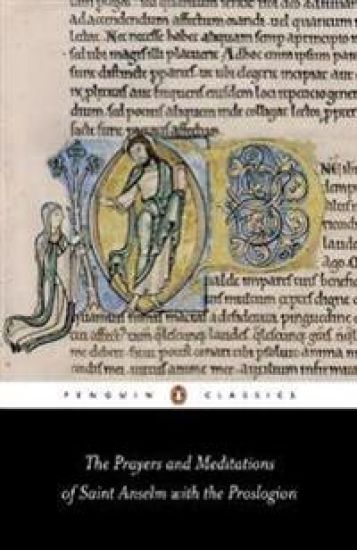
The Prayers and Meditations of St. Anselm with the Proslogion
Mostly written between 1070 and 1080, before he became Archbishop of Canterbury, the prayers and meditations of Anselm of Aosta created a tradition of intimate, intensely personal devotional works written in subtle and theologically daring prose. While the Prayer to God is based on the Lord's Prayer, the Prayer to Christ is inspired by ardent private emotion and other prayers invest saints with individual attributes, with John the Baptist as the friend, Peter as the shepherd and Mary Magdalene as the forgiving lover, among many others. The meditations include a searching exploration of the state of the soul and a lament on the loss of purity, and the Proslogion discusses the mysteries of faith. With their bright imagery, beautiful language and highly original thought, the works of Anselm have secured a lasting place in both religious and secular literature.
Proslogium and Monologium (Including In Behalf of the Fool by Gaunilon and Reply by Anselm)
The Monologion (Latin: Monologium, "Monologue"), originally entitled A Monologue on the Reason for Faith (Monoloquium de Ratione Fidei) and sometimes also known as An Example of Meditation on the Reason for Faith (Exemplum Meditandi de Ratione Fidei), was written in 1075 and 1076. The Proslogion (Latin: Proslogium, "Discourse"), originally entitled Faith Seeking Understanding (Fides Quaerens Intellectum) and then An Address on God's Existence (Alloquium de Dei Existentia), was written over the next two years (1077-1078).
Cur Deus Homo

Cur Deus Homo

Anselm

Lulu.com
2018
sidottu
The masterwork of Saint Anselm, Cur Deus Homo asks the essential question of theology - "Why was God a Man?"" Written by Anselm in the midst of his spiritual life and contemplation, Anselm attempts to answer this question with a reasoned discussion of the Christian canon. God's incarnation in the form of Jesus Christ is investigated, with the Biblical sources examined and discussed at length. The mission of Christ as a manifest teacher without sin, and his birth in an ordinary village in Palestine, is closely detailed by the studied Anselm. Saint Anselm eventually arrives at the conclusion that while man is an imperfect and sinful being without the ability to fully devote himself to God, God himself possesses the essential power and ability to place himself among and die for mankind in a bid for humanity to live for Him. It is thus that Anselm arrives at the 'satisfaction theory of atonement'.
Basic Writings

Basic Writings

Anselm; Thomas (TRN) Williams

Hackett Pub Co Inc
2007
pokkari
Ranging from his early treatises, the "Monologion" (a work written to show his monks how to meditate on the divine essence) and the Proslogion (best known for its advancement of the so-called ontological argument for the existence of God), to his three philosophical dialogues on metaphysical topics such as the relationship between freedom and sin, and late treatises on the Incarnation and salvation, this collection of Anselm's essential writings will be a boon to students of the history of philosophy and theology as well as to anyone interested in examining what Anselm calls "the reason of faith".
Three Philosophical Dialogues

Three Philosophical Dialogues

Anselm

Hackett Publishing Co, Inc
2002
sidottu
In these three dialogues, renowned for their dialectical structure and linguistic precision, Anselm sets out his classic account of the relationship between freedom and sin--its linchpin his definition of freedom of choice as the power to preserve rectitude of will for its own sake. In doing so, Anselm explores the fascinating implications for God, human beings, and angels (good and bad) of his conclusion that freedom of choice neither is nor entails the power to sin. In addition to an Introduction, notes, and a glossary, Thomas Williams brings to the translation of these important dialogues the same precision and clarity that distinguish his previous translation of Anselm's Proslogion and Monologion , which Professor Paul Spade of Indiana University called "scrupulously faithful and accurate without being slavishly literal, yet lively and graceful to both the eye and ear.
Three Philosophical Dialogues

Three Philosophical Dialogues

Anselm; Thomas (TRN) Williams

Hackett Pub Co Inc
2002
pokkari
In these three dialogues, renowned for their dialectical structure and linguistic precision, Anselm sets out his classic account of the relationship between freedom and sin-its linchpin his definition of freedom of choice as 'the power to preserve rectitude of will for its own sake'. In doing so, Anselm explores the fascinating implications for God, human beings, and angels (good and bad) of his conclusion that freedom of choice neither is nor entails the power to sin. In addition to an Introduction, notes, and a glossary, Thomas Williams brings to the translation of these important dialogues the same precision and clarity that distinguish his previous translation of Anselm's Proslogion and Monologion, which Professor Paul Spade of Indiana University called 'scrupulously faithful and accurate without being slavishly literal, yet lively and graceful to both the eye and ear'.
Proslogion

Proslogion

Anselm

Hackett Publishing Co, Inc
2001
pokkari
Thomas Williams' edition offers an Introduction well suited for use in an introductory philosophy course, as well as his own preeminent translation of the text.