Kirjojen hintavertailu. Mukana 12 390 323 kirjaa ja 12 kauppaa.

Kirjailija

Anselm L. Strauss

Kirjat ja teokset yhdessä paikassa: 19 kirjaa, julkaisuja vuosilta 1981-2021, suosituimpien joukossa Social Psychology. Vertaile teosten hintoja ja tarkista saatavuus suomalaisista kirjakaupoista.

19 kirjaa

Kirjojen julkaisuhaarukka 1981-2021.

Social Psychology

Social Psychology

Alfred Ray Lindesmith; Anselm L. Strauss

Literary Licensing, LLC
2012
sidottu
Social Psychology by Alfred Ray Lindesmith is a comprehensive textbook that explores the fundamental principles and theories of social psychology. The book is divided into three sections: social perception, social influence, and social interaction. In the first section, readers will learn about the ways in which people perceive and interpret social information, including the role of stereotypes, attitudes, and social cognition. The second section focuses on the ways in which social influence affects behavior, including conformity, obedience, and persuasion. The final section explores the dynamics of social interaction, including group processes, intergroup relations, and interpersonal attraction. Throughout the book, Lindesmith provides numerous examples and case studies to illustrate key concepts and theories. The book is written in an accessible style and is suitable for undergraduate students studying social psychology or related fields. Overall, Social Psychology offers a comprehensive and engaging introduction to the field of social psychology.This scarce antiquarian book is a facsimile reprint of the old original and may contain some imperfections such as library marks and notations. Because we believe this work is culturally important, we have made it available as part of our commitment for protecting, preserving, and promoting the world's literature in affordable, high quality, modern editions, that are true to their original work.

Social Psychology

Social Psychology

Alfred Ray Lindesmith; Anselm L. Strauss

Literary Licensing, LLC
2012
nidottu
The Eighth Edition of this classic text provides a basic introduction to the field of social psychology. Taking a critical symbolic interactionist approach, Social Psychology helps students understand the very nature of how individuals do things together in today's society. The book has been significantly revised taking into consideration a number of recent turns in the field, such as: the increased sense that American social psychology is deeply embedded in world culture; that postmodernism has much to offer the sudy of the social world; and that new theories on sexuality, identity, deviance and the body provide a fascinating viewpoint on a person within society.
Images of the American City. --

Images of the American City. --

Anselm L. Strauss

Hassell Street Press
2021
nidottu
This work has been selected by scholars as being culturally important and is part of the knowledge base of civilization as we know it.This work is in the public domain in the United States of America, and possibly other nations. Within the United States, you may freely copy and distribute this work, as no entity (individual or corporate) has a copyright on the body of the work.Scholars believe, and we concur, that this work is important enough to be preserved, reproduced, and made generally available to the public. To ensure a quality reading experience, this work has been proofread and republished using a format that seamlessly blends the original graphical elements with text in an easy-to-read typeface.We appreciate your support of the preservation process, and thank you for being an important part of keeping this knowledge alive and relevant.
Images of the American City. --

Images of the American City. --

Anselm L. Strauss

Hassell Street Press
2021
sidottu
This work has been selected by scholars as being culturally important and is part of the knowledge base of civilization as we know it.This work is in the public domain in the United States of America, and possibly other nations. Within the United States, you may freely copy and distribute this work, as no entity (individual or corporate) has a copyright on the body of the work.Scholars believe, and we concur, that this work is important enough to be preserved, reproduced, and made generally available to the public. To ensure a quality reading experience, this work has been proofread and republished using a format that seamlessly blends the original graphical elements with text in an easy-to-read typeface.We appreciate your support of the preservation process, and thank you for being an important part of keeping this knowledge alive and relevant.
Professions, Work and Careers

Professions, Work and Careers

Anselm L. Strauss

Routledge
2018
sidottu
Professions, Work and Careers addresses some of the central themes that preoccupied the eminent sociologist Anselm Strauss. This collection is directed at sociologists concerned with the development of theory and graduate and undergraduate students in the sociology of work and the sociology of medicine. His approach is both thematic and topical.Straus examines organization, profession, career, and work, in addition to related matters such as socialization, occupational identity, social mobility, and professional relationships, all in a social psychological context. Because medicine is considered by many to be the prototype profession, Strauss effectively illustrates many of the points by allusion to nurses, chemists, hospitals, wards, and terminal care. The progression of ideas in these essays are a befitting source for the study of structure, interaction and process, other themes that occupied Strauss in his other research enterprises.As Irving Louis Horowitz noted at the time of Anselm Strauss's death in 1996: "Anselm was and remained a social psychologist of a special sort. He appreciated that what takes place in the privacy of our minds translates into public consequences for the social fabric. His statements on personal problems are invariably followed in quick succession by intensely sociological essays on close awareness, face-to-face interaction, and structured interactions. The subtext distinguishes sociological from psychiatric conventions, seeing everything from daydreams to visions in interactionist frames rather than as pathology. The implications of his explorations into the medical profession are stated gently, but carry deep ramifications, for the act of people treating each other compassionately, not less than professionally, is also an act of awareness. Treating the human person as a creature of dignity, when generalized, becomes the basis for constructing human society."The late Anselm Strauss was a pioneer in bridging the gap between theory and data in sociology. This collection of his works, available in paperback for the first time, will be a valuable resource for professionals and students interested in grounded social theory.Anselm L. Strauss was professor of sociology and chairman of the graduate program in sociology, University of California, San Francisco. He is the author of numerous books including Creating Sociological Awareness and editor of Where Medicine Fails, both published by Transaction.
Awareness of Dying

Awareness of Dying

Barney G. Glaser; Anselm L. Strauss

Routledge
2017
sidottu
Should patients be told they are dying? How do families react when one of their members is facing death? Who should reveal that death is imminent? How does hospital staff-doctors, nurses, and attendants-act toward the dying patient and his family?
Mirrors and Masks

Mirrors and Masks

Anselm L. Strauss

Routledge
2017
sidottu
Identity as a concept is as elusive as everyone's sense of his own personal identity. It is connected with appraisals made by oneself and by others. Each person sees himself mirrored in the judgments of others. The masks he presents to the world are fashioned upon his anticipations of judgments. In Mirrors and Masks, Anselm Strauss uses the notion of identity to organize materials and thoughts about certain aspects of problems traditionally intriguing to social psychologists.The problems Strauss considers to be intriguing traditionally are those encountered when studying group membership, motivation, personality development, and social interaction. The topics covered include: the basic importance of language for human action and identity; the perpetual indeterminacy of identities in constantly changing social contexts; the symbolic and developmental character of human interaction; the theme of identity as it affects adult behaviqr; relations between generations and their role in personality development; and the symbolic character of membership in groups.By focusing on symbolic behavior with an emphasis on social organization, Strauss presents a fruitful, systematic perspective from which to view traditional problems of social psychology. He opens up new areas of thought and associates matters that are not ordinarily considered to be related. Strauss believes that psychiatrists* and psychologists underestimate immensely the influence of social organization upon individual behavior and individual structure, and that sociologists, whose major concern is with social organization, should employ some kind of social psychology in their research. Mirrors and Masks shows that the fusion of theoretical approaches benefits the analyses of many scholars. This fascinating work should be read by sociologists, anthropologists, psychologists, and psychiatrists.
Psychiatric Ideologies and Institutions

Psychiatric Ideologies and Institutions

Anselm L. Strauss

Routledge
2017
sidottu
The authors of this volume point out that what is ordinarily termed the psychiatric hospital's "social structure" is principally derived from three sources: the number and kinds of professionals who work there; the treatment ideologies and professional identities of these professionals; and the relationships of the institution and its professionals to outside communities, both professional and lay. They describe hospitals as sites where ideological battles characterizing the mental health arena are being fought, implemented, critiqued, modified, and transformed.This classic monograph in medical sociology was originally published in the 1960s. The period studied was 1958 through 1963, when somatic and psychotherapeutic ideologies were flourishing as now and milieutherapy was just emerging. The research team was multidisciplinary: three sociologists, one psychologist, and one psychiatrist.Three distinct psychiatric environments were researched: two at the Chicago State Hospital "chronic services" and "treatment services" and one at a private hospital. What evolved were thoughtful comparative analyses of hospitals, wards, professionals, ideological positions, careers, and organizational and situational placements.
The Contexts of Social Mobility

The Contexts of Social Mobility

Anselm L. Strauss

Routledge
2017
sidottu
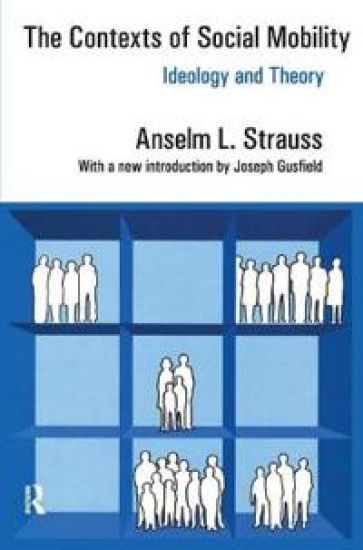
This book contains a major statement by one of America's most preeminent sociologists on what remains an important problem in American history and social analysis: the nature and extent of movement within American society from one status to another. The most important images of mobility involve self-improvement by changing location (going to the frontier, coming to the big city), and by changing social class (second-generation immigrants). Almost all sociological and historical analysis has been limited to these themes.Strauss extends the concept to a wide range of ideologies, institutional contexts, and social movements; his analysis is based on a formal theory of status passage and develops a partial theory of mobility. Strauss addresses a theme that underscores much of one strand of his work: the changing articulation of individuals with their social structure and institutions.The book follows on from the theoretical presuppositions of Discovery of Grounded Theory and the formal theory presented in Status Passage. Strauss was continually concerned with American social and intellectual life in its historical and contemporary manifestations. No one else has looked at the important phenomenon of mobility in this broad a context and from this point of view. The book remains important to those concerned with the social history of America and with problems of social change.
Status Passage

Status Passage

Anselm L. Strauss

Routledge
2017
sidottu
The French writer Arnold van Gennep first called attention to the phenomena of status passages in his Rites of Passage one hundred years ago. In Status Passage, first published in 1971, the movement of individuals and groups in contemporary society from one status to another is examined in the light of Gennep's original theory. Glaser and Strauss demonstrate that society emerges as a comparative order. In this order, every organized action, collective or individual, can be seen as a form of status passage.From one status to another-from childhood to adolescence to adulthood, from being single to being married, movement from one income group, social class or religion to another-there are passages that entail movement into different parts of a social structure and loss or gain in privileges. Types of status passage are described by their proper ties. The authors present a formal theory of status passage in the form of a running theoretical discussion.The concepts and categories discussed in Status Passage are illuminated by a large number of examples chosen from a wide range of human behavior, and the applicability of the theory to still other examples is made apparent. The result is a stimulating and provocative book that will interest a wide range of sociologists, social psychologists, and other social scientists, and will be useful in a variety of courses.
Creating Sociological Awareness

Creating Sociological Awareness

Anselm L. Strauss

AldineTransaction
2016
nidottu
In this volume the distinguished sociologist Anselm Strauss reflects on his self-professed, lifelong intention to create sociological awareness in his readers and students. Strauss democratizes sociology by making sure that relativities of status, power, and wealth are acknowledged in the conduct of everyday life, and by recognizing that all collective life is subject to negotiation, rearrangement, and reconstruction.Represented here are some ideas for which Strauss is best known. He addresses work, leisure, culture, illness, identity, and policy. These disparate topics are linked by Strauss' "web of negotiation" by which organizational arrangements can be changed. The volume concludes with discussion about problems of method, consultation, and teaching, affirming Strauss' commitment to passing along the sociological awareness reflected in this volume to a next generation.Squarely in the long tradition of the Chicago School of sociology, the work of Anselm Strauss represents the very best thinking in modern sociological and psychological analysis. Those interested in the origins of his major conceptual frameworks will find this an essential volume.
The Professional Scientist

The Professional Scientist

Lee Rainwater; Anselm L. Strauss

AldineTransaction
2011
nidottu
This classic book, available in paperback for the first time, is based on a 1962 study of the American Chemical Society, one of the great U. S. scientific societies. The society has a membership educated in the fundamental scientific field of chemistry, whose knowledge and talents are essential to modem industrial civilization. Without chemistry, we would have neither automobiles, nuclear devices, nor all the varied products essential to our modern way of life.Chemists are caught up in the dynamic changes in our society. The explosive advance of scientific knowledge leads to increasing specialization until experts in one field may have little in common with those in another. Also, as the knowledge and skills of chemistry are incorporated in the workaday world of industry, more and more trained chemists spend their days in routine application and organization of their skills and knowledge.The unique element of this study is its assessment of the role and function of a professional society for its members. Not much is known of how professionals feel about their societies, what they expect of them, or how they function for their members.Such studies assume increasing importance as the trend toward professionalization incorporates more specialized skills and as the members of these professions look increasingly to their societies for assistance in establishing their rights and privileges vis-à-vis the rest of society. This remains a unique effort at professional ethnography.
Status Passage

Status Passage

Anselm L. Strauss

AldineTransaction
2009
nidottu
The French writer Arnold van Gennep first called attention to the phenomena of status passages in his Rites of Passage one hundred years ago. In Status Passage, first published in 1971, the movement of individuals and groups in contemporary society from one status to another is examined in the light of Gennep's original theory. Glaser and Strauss demonstrate that society emerges as a comparative order. In this order, every organized action, collective or individual, can be seen as a form of status passage.From one status to another-from childhood to adolescence to adulthood, from being single to being married, movement from one income group, social class or religion to another-there are passages that entail movement into different parts of a social structure and loss or gain in privileges. Types of status passage are described by their proper ties. The authors present a formal theory of status passage in the form of a running theoretical discussion.The concepts and categories discussed in Status Passage are illuminated by a large number of examples chosen from a wide range of human behavior, and the applicability of the theory to still other examples is made apparent. The result is a stimulating and provocative book that will interest a wide range of sociologists, social psychologists, and other social scientists, and will be useful in a variety of courses.
The Contexts of Social Mobility

The Contexts of Social Mobility

Anselm L. Strauss

AldineTransaction
2005
nidottu
This book contains a major statement by one of America's most preeminent sociologists on what remains an important problem in American history and social analysis: the nature and extent of movement within American society from one status to another. The most important images of mobility involve self-improvement by changing location (going to the frontier, coming to the big city), and by changing social class (second-generation immigrants). Almost all sociological and historical analysis has been limited to these themes.Strauss extends the concept to a wide range of ideologies, institutional contexts, and social movements; his analysis is based on a formal theory of status passage and develops a partial theory of mobility. Strauss addresses a theme that underscores much of one strand of his work: the changing articulation of individuals with their social structure and institutions.The book follows on from the theoretical presuppositions of Discovery of Grounded Theory and the formal theory presented in Status Passage. Strauss was continually concerned with American social and intellectual life in its historical and contemporary manifestations. No one else has looked at the important phenomenon of mobility in this broad a context and from this point of view. The book remains important to those concerned with the social history of America and with problems of social change.
Awareness of Dying

Awareness of Dying

Barney G. Glaser; Anselm L. Strauss

AldineTransaction
2005
nidottu
Should patients be told they are dying? How do families react when one of their members is facing death? Who should reveal that death is imminent? How does hospital staff-doctors, nurses, and attendants-act toward the dying patient and his family?
Professions, Work and Careers

Professions, Work and Careers

Anselm L. Strauss

Transaction Publishers
2001
nidottu
Professions, Work and Careers addresses some of the central themes that preoccupied the eminent sociologist Anselm Strauss. This collection is directed at sociologists concerned with the development of theory and graduate and undergraduate students in the sociology of work and the sociology of medicine. His approach is both thematic and topical.Straus examines organization, profession, career, and work, in addition to related matters such as socialization, occupational identity, social mobility, and professional relationships, all in a social psychological context. Because medicine is considered by many to be the prototype profession, Strauss effectively illustrates many of the points by allusion to nurses, chemists, hospitals, wards, and terminal care. The progression of ideas in these essays are a befitting source for the study of structure, interaction and process, other themes that occupied Strauss in his other research enterprises.As Irving Louis Horowitz noted at the time of Anselm Strauss's death in 1996: "Anselm was and remained a social psychologist of a special sort. He appreciated that what takes place in the privacy of our minds translates into public consequences for the social fabric. His statements on personal problems are invariably followed in quick succession by intensely sociological essays on close awareness, face-to-face interaction, and structured interactions. The subtext distinguishes sociological from psychiatric conventions, seeing everything from daydreams to visions in interactionist frames rather than as pathology. The implications of his explorations into the medical profession are stated gently, but carry deep ramifications, for the act of people treating each other compassionately, not less than professionally, is also an act of awareness. Treating the human person as a creature of dignity, when generalized, becomes the basis for constructing human society."The late Anselm Strauss was a pioneer in bridging the gap between theory and data in sociology. This collection of his works, available in paperback for the first time, will be a valuable resource for professionals and students interested in grounded social theory.Anselm L. Strauss was professor of sociology and chairman of the graduate program in sociology, University of California, San Francisco. He is the author of numerous books including Creating Sociological Awareness and editor of Where Medicine Fails, both published by Transaction.
Mirrors and Masks

Mirrors and Masks

Anselm L. Strauss

Transaction Publishers
1997
nidottu
Identity as a concept is as elusive as everyone's sense of his own personal identity. It is connected with appraisals made by oneself and by others. Each person sees himself mirrored in the judgments of others. The masks he presents to the world are fashioned upon his anticipations of judgments. In Mirrors and Masks, Anselm Strauss uses the notion of identity to organize materials and thoughts about certain aspects of problems traditionally intriguing to social psychologists.The problems Strauss considers to be intriguing traditionally are those encountered when studying group membership, motivation, personality development, and social interaction. The topics covered include: the basic importance of language for human action and identity; the perpetual indeterminacy of identities in constantly changing social contexts; the symbolic and developmental character of human interaction; the theme of identity as it affects adult behaviqr; relations between generations and their role in personality development; and the symbolic character of membership in groups.By focusing on symbolic behavior with an emphasis on social organization, Strauss presents a fruitful, systematic perspective from which to view traditional problems of social psychology. He opens up new areas of thought and associates matters that are not ordinarily considered to be related. Strauss believes that psychiatrists* and psychologists underestimate immensely the influence of social organization upon individual behavior and individual structure, and that sociologists, whose major concern is with social organization, should employ some kind of social psychology in their research. Mirrors and Masks shows that the fusion of theoretical approaches benefits the analyses of many scholars. This fascinating work should be read by sociologists, anthropologists, psychologists, and psychiatrists.
Creating Sociological Awareness

Creating Sociological Awareness

Anselm L. Strauss

Transaction Publishers
1991
sidottu
This volume of papers from the distinguished sociologist Anselm Strauss reflects his self-professed lifelong intention to create sociological awareness in his readers and students. As Irving Louis Horowitz notes in his foreword to the book, at the center of Strauss's effort has been the democratization of sociology. He has achieved this goal by making sure that relativities of status, power, and wealth are acknowledged in the conduct of everyday life, and by recognition that all collective life is subject to negotiation, rearrangement and reconstruction.Represented here is some of the work for which Strauss is best known, and the principal themes that have captured his imagination throughout his productive career. These include work, leisure, culture, illness, identity, and policy. All are linked by Strauss's "web of negotiation" by which organizational arrangements can be changed. The volume concludes with a selection of his work in problems of method, consultation, and teaching, affirming Strauss's commitment to passing along the sociological awareness reflected in this volume to a next generation.Squarely in the long tradition of the Chicago School of sociology, the work of Anselm Strauss represents the very best thinking in modem sociological and psychological analysis. Those interested in the development of his major conceptual frameworks, as well as those interested in the development of the specific subject areas to which Anselm Strauss has devoted his career will find this an essential volume. Professionals in the history of sociology, the sociology of knowledge, or medical sociology will find the book of particular interest.
Psychiatric Ideologies and Institutions

Psychiatric Ideologies and Institutions

Anselm L. Strauss

Transaction Publishers
1981
nidottu
The authors of this volume point out that what is ordinarily termed the psychiatric hospital's "social structure" is principally derived from three sources: the number and kinds of professionals who work there; the treatment ideologies and professional identities of these professionals; and the relationships of the institution and its professionals to outside communities, both professional and lay. They describe hospitals as sites where ideological battles characterizing the mental health arena are being fought, implemented, critiqued, modified, and transformed.This classic monograph in medical sociology was originally published in the 1960s. The period studied was 1958 through 1963, when somatic and psychotherapeutic ideologies were flourishing—as now—and milieutherapy was just emerging. The research team was multidisciplinary: three sociologists, one psychologist, and one psychiatrist.Three distinct psychiatric environments were researched: two at the Chicago State Hospital—"chronic services" and "treatment services"—and one at a private hospital. What evolved were thoughtful comparative analyses of hospitals, wards, professionals, ideological positions, careers, and organizational and situational placements.