Kirjojen hintavertailu. Mukana 12 390 323 kirjaa ja 12 kauppaa.

Kirjailija

Ansgar Jüngel

Kirjat ja teokset yhdessä paikassa: 7 kirjaa, julkaisuja vuosilta 2001-2023, suosituimpien joukossa Transport Equations for Semiconductors. Vertaile teosten hintoja ja tarkista saatavuus suomalaisista kirjakaupoista.

7 kirjaa

Kirjojen julkaisuhaarukka 2001-2023.

Mathematik für Chemiker

Mathematik für Chemiker

Ansgar Jüngel; Hans Gerhard Zachmann

Wiley-VCH Verlag GmbH
2023
sidottu
Ein unentbehrlicher Begleiter für die Grundvorlesung in Mathematik, der während des gesamten Chemiestudiums gute Dienste bei allen mathematischen Fragen und Problemen leistet. In bewährter Weise wird auch in der 8. Auflage das notwendige mathematische Rüstzeug für das Chemiestudium in leicht verständlicher Form vermittelt. Viele anschauliche Beispiele aus der Chemie stellen den Bezug zur fachlichen Anwendung her. Übungsaufgaben zu jedem Unterkapitel - mit Lösungen im Anhang - ermöglichen es, das erworbene Wissen selbstständig zu überprüfen. Die 8. Auflage wurde um neue Abschnitte zu den Grundlagen der Dichtefunktionaltheorie und zum maschinellen Lernen ergänzt; Letzteres spielt eine immer größere Rolle beim Einsatz von Expertensystemen bzw. von künstlicher Intelligenz für die Analyse und Vorhersage von chemischen Reaktionen und Strukturen.

Entropy Methods for Diffusive Partial Differential Equations

Entropy Methods for Diffusive Partial Differential Equations

Ansgar Jüngel

Springer International Publishing AG
2016
nidottu
This book presents a range of entropy methods for diffusive PDEs devised by many researchers in the course of the past few decades, which allow us to understand the qualitative behavior of solutions to diffusive equations (and Markov diffusion processes). Applications include the large-time asymptotics of solutions, the derivation of convex Sobolev inequalities, the existence and uniqueness of weak solutions, and the analysis of discrete and geometric structures of the PDEs. The purpose of the book is to provide readers an introduction to selected entropy methods that can be found in the research literature. In order to highlight the core concepts, the results are not stated in the widest generality and most of the arguments are only formal (in the sense that the functional setting is not specified or sufficient regularity is supposed). The text is also suitable for advanced master and PhD students and could serve as a textbook for special courses and seminars.
Quasi-hydrodynamic Semiconductor Equations

Quasi-hydrodynamic Semiconductor Equations

Ansgar Jüngel

Springer Basel
2012
nidottu
In this book a hierarchy of macroscopic models for semiconductor devices is presented. Three classes of models are studied in detail: isentropic drift-diffusion equations, energy-transport models, and quantum hydrodynamic equations. The derivation of each of the models is shown, including physical discussions. Furthermore, the corresponding mathematical problems are analyzed, using modern techniques for nonlinear partial differential equations. The equations are discretized employing mixed finite-element methods. Also, numerical simulations for modern semiconductor devices are performed, showing the particular features of the models.Modern analytical techniques have been used and further developed, such as positive solution methods, local energy methods for free-boundary problems and entropy methods. The book is aimed at applied mathematicians and physicists interested in mathematics, as well as graduate and postdoc students and researchers in these fields.
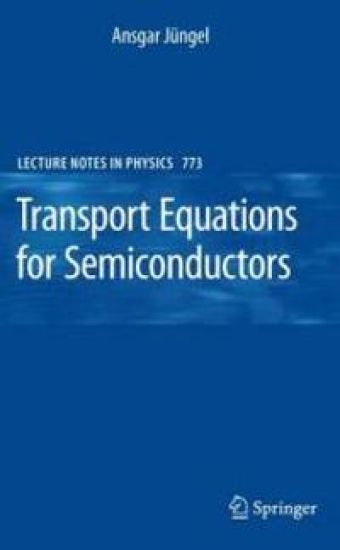
Transport Equations for Semiconductors

Transport Equations for Semiconductors

Ansgar Jüngel

Springer-Verlag Berlin and Heidelberg GmbH Co. K
2010
nidottu
Semiconductor devices are ubiquitous in the modern computer and telecommunications industry. A precise knowledge of the transport equations for electron flow in semiconductors when a voltage is applied is therefore of paramount importance for further technological breakthroughs. In the present work, the author tackles their derivation in a systematic and rigorous way, depending on certain key parameters such as the number of free electrons in the device, the mean free path of the carriers, the device dimensions and the ambient temperature. Accordingly a hierarchy of models is examined which is reflected in the structure of the book: first the microscopic and macroscopic semi-classical approaches followed by their quantum-mechanical counterparts.
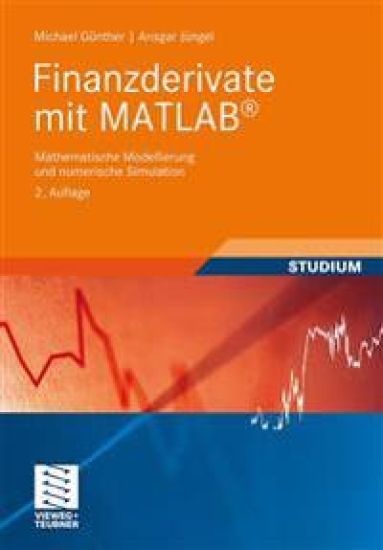
Finanzderivate mit MATLAB

Finanzderivate mit MATLAB

Michael Günther; Ansgar Jüngel

Vieweg+teubner Verlag
2010
nidottu
In der Finanzwelt ist der Einsatz von Finanzderivaten zu einem unentbehrlichen Hilfsmittel zur Absicherung von Risiken geworden. Dieses Buch richtet sich an Studierende der (Finanz-) Mathematik und der Wirtschaftswissenschaften im Hauptstudium, die mehr über Finanzderivate und ihre mathematische Behandlung erfahren möchten. Es werden moderne numerische Methoden vorgestellt, mit denen die entsprechenden Bewertungsgleichungen in der Programmierumgebung MATLAB gelöst werden können. Betrachtet werden Binomialmethoden, Monte-Carlo-Simulationen und Verfahren zur Lösung parabolischer Differentialgleichungen und freier Randwertprobleme. Auch auf neuere Entwicklungen wie die Bewertung von Zins- und Wetterderivaten wird eingegangen. MATLAB-Befehle und theoretische Hilfsmittel (aus der Stochastik) sind in die einzelnen Kapitel integriert, so dass keine Vorkenntnisse notwendig sind. Das Buch eignet sich hervorragend zum Selbststudium. Der Text wurde für die zweite Auflage gründlich überarbeitet und durch aktuelle Entwicklungen auf den Finanzmärkten ergänzt: u.a. Bewertung von Energiederivaten, die im Zuge der Liberalisierung der Energiemärkte entwickelt wurden - spezielle Kreditderivate, deren riskanter Umgang die Finanzkrise mit verursacht zu haben scheint - Adjusting Options, die in globalisierten Märkten von großer Bedeutung sind.
Transport Equations for Semiconductors

Transport Equations for Semiconductors

Ansgar Jüngel

Springer-Verlag Berlin and Heidelberg GmbH Co. K
2009
sidottu
Semiconductor devices are ubiquitous in the modern computer and telecommunications industry. A precise knowledge of the transport equations for electron flow in semiconductors when a voltage is applied is therefore of paramount importance for further technological breakthroughs. In the present work, the author tackles their derivation in a systematic and rigorous way, depending on certain key parameters such as the number of free electrons in the device, the mean free path of the carriers, the device dimensions and the ambient temperature. Accordingly a hierarchy of models is examined which is reflected in the structure of the book: first the microscopic and macroscopic semi-classical approaches followed by their quantum-mechanical counterparts.
Quasi-hydrodynamic Semiconductor Equations

Quasi-hydrodynamic Semiconductor Equations

Ansgar Jüngel

Birkhauser Verlag AG
2001
sidottu
In this book a hierarchy of macroscopic models for semiconductor devices is presented. Three classes of models are studied in detail: isentropic drift-diffusion equations, energy-transport models, and quantum hydrodynamic equations. The derivation of each of the models is shown, including physical discussions. Furthermore, the corresponding mathematical problems are analyzed, using modern techniques for nonlinear partial differential equations. The equations are discretized employing mixed finite-element methods. Also, numerical simulations for modern semiconductor devices are performed, showing the particular features of the models.Modern analytical techniques have been used and further developed, such as positive solution methods, local energy methods for free-boundary problems and entropy methods. The book is aimed at applied mathematicians and physicists interested in mathematics, as well as graduate and postdoc students and researchers in these fields.