Kirjojen hintavertailu. Mukana 12 595 353 kirjaa ja 12 kauppaa.

Kirjailija

Anshul Joshi

Kirjat ja teokset yhdessä paikassa: 2 kirjaa, julkaisuja vuosilta 2016-2017, suosituimpien joukossa Learning Julia. Vertaile teosten hintoja ja tarkista saatavuus suomalaisista kirjakaupoista.

2 kirjaa

Kirjojen julkaisuhaarukka 2016-2017.

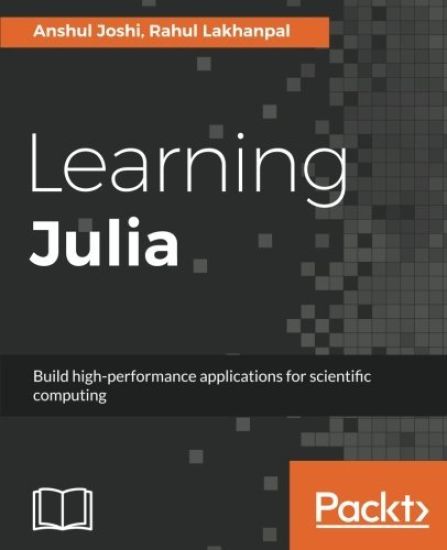
Learning Julia

Learning Julia

Anshul Joshi; Rahul Lakhanpal

Packt Publishing Limited
2017
nidottu
Learn Julia language for data science and data analytics About This Book • Set up Julia's environment and start building simple programs • Explore the technical aspects of Julia and its potential when it comes to speed and data processing • Write efficient and high-quality code in Julia Who This Book Is For This book allows existing programmers, statisticians and data scientists to learn the Julia and take its advantage while building applications with complex numerical and scientific computations. Basic knowledge of mathematics is needed to understand the various methods that will be used or created in the book to exploit the capabilities for which Julia is made. What You Will Learn • Understand Julia's ecosystem and create simple programs • Master the type system and create your own types in Julia • Understand Julia's type system, annotations, and conversions • Define functions and understand meta-programming and multiple dispatch • Create graphics and data visualizations using Julia • Build programs capable of networking and parallel computation • Develop real-world applications and use connections for RDBMS and NoSQL • Learn to interact with other programming languages–C and Python—using Julia In Detail Julia is a highly appropriate language for scientific computing, but it comes with all the required capabilities of a general-purpose language. It allows us to achieve C/Fortran-like performance while maintaining the concise syntax of a scripting language such as Python. It is perfect for building high-performance and concurrent applications. From the basics of its syntax to learning built-in object types, this book covers it all. This book shows you how to write effective functions, reduce code redundancies, and improve code reuse. It will be helpful for new programmers who are starting out with Julia to explore its wide and ever-growing package ecosystem and also for experienced developers/statisticians/data scientists who want to add Julia to their skill-set. The book presents the fundamentals of programming in Julia and in-depth informative examples, using a step-by-step approach. You will be taken through concepts and examples such as doing simple mathematical operations, creating loops, metaprogramming, functions, collections, multiple dispatch, and so on. By the end of the book, you will be able to apply your skills in Julia to create and explore applications of any domain. Style and approach This book demonstrates the basics of Julia along with some data structures and testing tools that will give you enough material to get started with the language from an application standpoint.
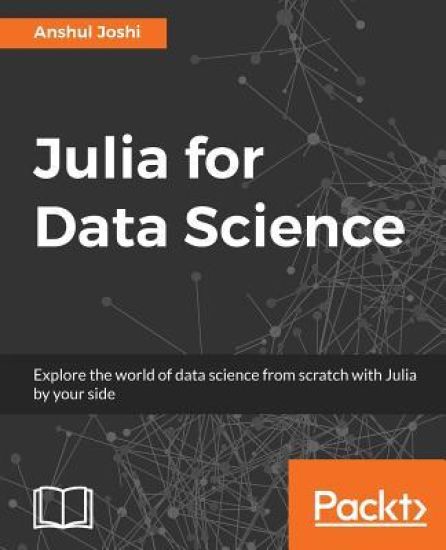
Julia for Data Science

Julia for Data Science

Anshul Joshi

Packt Publishing Limited
2016
nidottu
Explore the world of data science from scratch with Julia by your side About This Book • An in-depth exploration of Julia's growing ecosystem of packages • Work with the most powerful open-source libraries for deep learning, data wrangling, and data visualization • Learn about deep learning using Mocha.jl and give speed and high performance to data analysis on large data sets Who This Book Is For This book is aimed at data analysts and aspiring data scientists who have a basic knowledge of Julia or are completely new to it. The book also appeals to those competent in R and Python and wish to adopt Julia to improve their skills set in Data Science. It would be beneficial if the readers have a good background in statistics and computational mathematics. What You Will Learn • Apply statistical models in Julia for data-driven decisions • Understanding the process of data munging and data preparation using Julia • Explore techniques to visualize data using Julia and D3 based packages • Using Julia to create self-learning systems using cutting edge machine learning algorithms • Create supervised and unsupervised machine learning systems using Julia. Also, explore ensemble models • Build a recommendation engine in Julia • Dive into Julia's deep learning framework and build a system using Mocha.jl In Detail Julia is a fast and high performing language that's perfectly suited to data science with a mature package ecosystem and is now feature complete. It is a good tool for a data science practitioner. There was a famous post at Harvard Business Review that Data Scientist is the sexiest job of the 21st century. (https://hbr.org/2012/10/data-scientist-the-sexiest-job-of-the-21st-century). This book will help you get familiarised with Julia's rich ecosystem, which is continuously evolving, allowing you to stay on top of your game. This book contains the essentials of data science and gives a high-level overview of advanced statistics and techniques. You will dive in and will work on generating insights by performing inferential statistics, and will reveal hidden patterns and trends using data mining. This has the practical coverage of statistics and machine learning. You will develop knowledge to build statistical models and machine learning systems in Julia with attractive visualizations. You will then delve into the world of Deep learning in Julia and will understand the framework, Mocha.jl with which you can create artificial neural networks and implement deep learning. This book addresses the challenges of real-world data science problems, including data cleaning, data preparation, inferential statistics, statistical modeling, building high-performance machine learning systems and creating effective visualizations using Julia. Style and approach This practical and easy-to-follow yet comprehensive guide will get you learning about Julia with respect to data science. Each topic is explained thoroughly and placed in context. For the more inquisitive, we dive deeper into the language and its use case. This is the one true guide to working with Julia in data science.