Kirjojen hintavertailu. Mukana 12 459 402 kirjaa ja 12 kauppaa.
Kirjailija
Anthony Grafton
Kirjat ja teokset yhdessä paikassa: 37 kirjaa, julkaisuja vuosilta 1983-2025, suosituimpien joukossa Magus. Vertaile teosten hintoja ja tarkista saatavuus suomalaisista kirjakaupoista.
A follow-up to the popular Graduate Study for the 21st Century , this book seeks to expand professional development to include the personal aspects of daily lives in the humanities. How to Build a Life in the Humanities delves into pressing work-life issues such as post-tenure depression, academic life with children, aging, and adjuncting.
A follow-up to the popular Graduate Study for the 21st Century , this book seeks to expand professional development to include the personal aspects of daily lives in the humanities. How to Build a Life in the Humanities delves into pressing work-life issues such as post-tenure depression, academic life with children, aging, and adjuncting.
From the late fifteenth century onwards, scholars across Europe began to write books about how to read and evaluate histories. These pioneering works grew from complex early modern debates about law, religion and classical scholarship. Anthony Grafton's book is based on his Trevelyan Lectures of 2005, and it proves to be a powerful and imaginative exploration of some central themes in the history of European ideas. Grafton explains why so many of these works were written, why they attained so much insight – and why, in the centuries that followed, most scholars gradually forgot that they had existed. Elegant and accessible, What Was History? is a deliberate evocation of E. H. Carr's celebrated Trevelyan Lectures, What Is History?.
In this book Anthony Grafton lets us in on one of the great secrets of scholars and intellectuals: although scholars lead solitary lives in order to win independence of mind, they also enjoy the conviviality of sharing a project sustained by common ideals, practices, and institutions. It’s like Masonry, but without the secret handshakes. Grafton reveals the microdynamics of the scholarly life through a series of essays on institutions and on scholars ranging from early modern polymaths to modern intellectual historians to American thinkers and writers. He takes as his starting point the republic of letters—that loose society of intellectuals that first took shape in the sixteenth century and continued into the eighteenth. Its inhabitants were highly original, individual thinkers and writers. Yet as Grafton shows, they were all formed, in some way, by the very groups and disciplines that they set out to build. In our noisy, caffeinated world it has never been more challenging to be a scholar. When many of our fellow citizens seem to have forgotten why we collect books in the buildings we call libraries, Grafton’s engaging, erudite essays could be a rallying cry for the revival of the liberal arts.
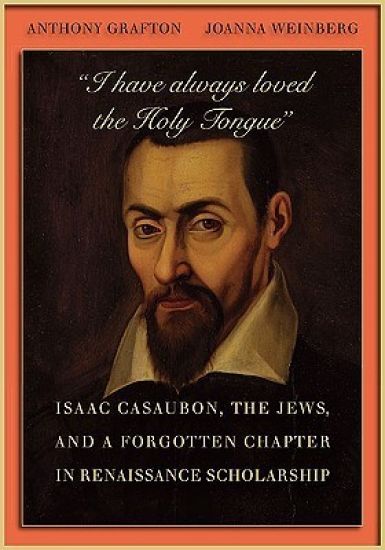
“[An] extraordinary book.” —New Republic Fusing high scholarship with high drama, Anthony Grafton and Joanna Weinberg uncover a secret and extraordinary aspect of a legendary Renaissance scholar’s already celebrated achievement. The French Protestant Isaac Casaubon (1559–1614) is known to us through his pedantic namesake in George Eliot’s Middlemarch. But in this book, the real Casaubon emerges as a genuine literary hero, an intrepid explorer in the world of books. With a flair for storytelling reminiscent of Umberto Eco, Grafton and Weinberg follow Casaubon as he unearths the lost continent of Hebrew learning—and adds this ancient lore to the well-known Renaissance revival of Latin and Greek. The mystery begins with Mark Pattison’s nineteenth-century biography of Casaubon. Here we encounter the Protestant Casaubon embroiled in intellectual quarrels with the Italian and Catholic orator Cesare Baronio. Setting out to understand the nature of this imbroglio, Grafton and Weinberg discover Casaubon’s knowledge of Hebrew. Close reading and sedulous inquiry were Casaubon’s tools in recapturing the lost learning of the ancients—and these are the tools that serve Grafton and Weinberg as they pore through pre-1600 books in Hebrew, and through Casaubon’s own manuscript notebooks. Their search takes them from Oxford to Cambridge, from Dublin to Cambridge, Massachusetts, as they reveal how the scholar discovered the learning of the Hebrews—and at what cost.
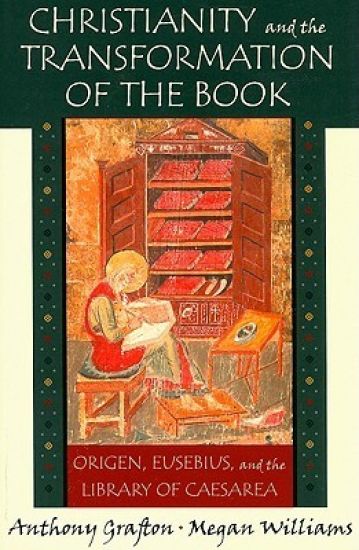
When early Christians began to study the Bible, and to write their own history and that of the Jews whom they claimed to supersede, they used scholarly methods invented by the librarians and literary critics of Hellenistic Alexandria. But Origen and Eusebius, two scholars of late Roman Caesarea, did far more. Both produced new kinds of books, in which parallel columns made possible critical comparisons previously unenvisioned, whether between biblical texts or between national histories. Eusebius went even farther, creating new research tools, new forms of history and polemic, and a new kind of library to support both research and book production.Christianity and the Transformation of the Book combines broad-gauged synthesis and close textual analysis to reconstruct the kinds of books and the ways of organizing scholarly inquiry and collaboration among the Christians of Caesarea, on the coast of Roman Palestine. The book explores the dialectical relationship between intellectual history and the history of the book, even as it expands our understanding of early Christian scholarship. Christianity and the Transformation of the Book attends to the social, religious, intellectual, and institutional contexts within which Origen and Eusebius worked, as well as the details of their scholarly practices--practices that, the authors argue, continued to define major sectors of Christian learning for almost two millennia and are, in many ways, still with us today.,
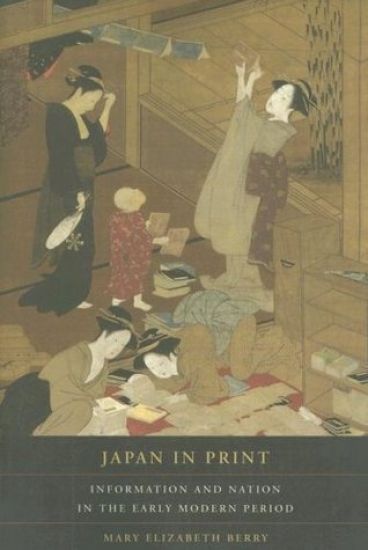
A quiet revolution in knowledge separated the early modern period in Japan from all previous time. After 1600, self-appointed investigators used the model of the land and cartographic surveys of the newly unified state to observe and order subjects such as agronomy, medicine, gastronomy, commerce, travel, and entertainment. They subsequently circulated their findings through a variety of commercially printed texts: maps, gazetteers, family encyclopedias, urban directories, travel guides, official personnel rosters, and instruction manuals for everything from farming to lovemaking. In this original and gracefully written book, Mary Elizabeth Berry considers the social processes that drove the information explosion of the 1600s. Inviting readers to examine the contours and meanings of this transformation, Berry provides a fascinating account of the conversion of the public from an object of state surveillance into a subject of self-knowledge. "Japan in Print" shows how, as investigators collected and disseminated richly diverse data, they came to presume in their audience a standard of cultural literacy that changed anonymous consumers into an 'us' bound by common frames of reference. This shared space of knowledge made society visible to itself and in the process subverted notions of status hierarchy. Berry demonstrates that the new public texts projected a national collectivity characterized by universal access to markets, mobility, sociability, and self-fashioning.
The work of the Renaissance humanists comes to life in Anthony Grafton’s exploration of the primary sources and modern scholarship, classical and modern elements in the world of European letters from the fifteenth to the nineteenth century. Tracing the ties that bound the world of humanistic learning in early modern Europe to other social and cultural spheres, Grafton defines the current state of the art of scholarship on early modern European cultural and intellectual history while simultaneously demonstrating how entertaining, enlightening, and relevant that history can be. Covering a dazzling variety of topics and authors as different as Alberti and Descartes, Grafton maps the grand and meticulous efforts of the past to connect the realm of nature with that of books, the realm of everyday experience with that of passionate reading in massive tomes, and the realm of codes of etiquette and institutions with that of extravagant and joyous erudition—efforts that this book itself brilliantly carries on.
Girolamo Cardano was an Italian doctor, natural philosopher, and mathematician who became a best-selling author in Renaissance Europe. He was also a leading astrologer of his day, whose predictions won him access to some of the most powerful people in sixteenth-century Europe. In Cardano’s Cosmos, Anthony Grafton invites readers to follow this astrologer’s extraordinary career and explore the art and discipline of astrology in the hands of a brilliant practitioner.Renaissance astrologers predicted everything from the course of the future of humankind to the risks of a single investment, or even the weather. They analyzed the bodies and characters of countless clients, from rulers to criminals, and enjoyed widespread respect and patronage. This book traces Cardano’s contentious career from his first astrological pamphlet through his rise to high-level consulting and his remarkable autobiographical works. Delving into astrological principles and practices, Grafton shows how Cardano and his contemporaries adapted the ancient art for publication and marketing in a new era of print media and changing science. He maps the context of market and human forces that shaped Cardano’s practices—and the maneuvering that kept him at the top of a world rife with patronage, politics, and vengeful rivals.Cardano’s astrology, argues Grafton, was a profoundly empirical and highly influential art, one that was integral to the attempts of sixteenth-century scholars to understand their universe and themselves.
The weapon of pedants, the scourge of undergraduates, the b te noire of the "new" liberated scholar: the lowly footnote, long the refuge of the minor and the marginal, emerges in this book as a singular resource, with a surprising history that says volumes about the evolution of modern scholarship. In Anthony Grafton's engrossing account, footnotes to history give way to footnotes as history, recounting in their subtle way the curious story of the progress of knowledge in written form. Grafton treats the development of the footnote--the one form of proof normally supplied by historians in support of their assertions--as writers on science have long treated the development of laboratory equipment, statistical arguments, and reports on experiments: as a complex story, rich in human interest, that sheds light on the status of history as art, as science, and as an institution. The book starts in the Berlin of the brilliant nineteenth-century historian Leopold von Ranke, who is often credited with inventing documented history in its modern form. Casting back to antiquity and forward to the twentieth century, Grafton's investigation exposes Ranke's position as a far more ambiguous one and offers us a rich vision of the true origins and gradual triumph of the footnote. Among the protagonists of this story are Athanasius Kircher, who built numerous documents into his spectacularly speculative treatises on ancient Egypt and China; Pierre Bayle, who made the footnote a powerful tool in philosophical and historical polemics; and Edward Gibbon, who transformed it into a high form of literary artistry. Proceeding with the spirit of an intellectual mystery and peppered with intriguing and revealing remarks by those who "made" this history, The Footnote brings what is so often relegated to afterthought and marginalia to its rightful place in the center of the literary life of the mind.
The style of reading in Renaissance Europe, as seen in the margins of books and in the texts of Renaissance intellectuals themselves, is deftly charted in this welcome volume from Anthony Grafton. Growing out of the Thomas Spencer Jerome Lectures that Anthony Grafton gave at the University of Michigan in 1992, this book describes the interaction between books and readers in the Renaissance, as seen in four major case studies.Humanists Alberti, Pico, Bude, and Kepler, all major figures of their time and now major figures in intellectual history, are examined in the light of their distinctive ways of reading. Investigating a period of two centuries, Grafton vividly portrays the ways in which book/scholar interactions--and the established traditions that were reflected in these interactions--were part of and helped shape the subjects' Humanistic philosophy. The book also indicates how these traditions have implications for the modern literary scene.Commerce with the Classics: Ancient Books and Renaissance Readers illustrates the immense variety of the humanist readers of the Renaissance. Grafton describes life in the Renaissance library, how the act of reading was shaped by the physical environment, and various styles of reading during the time. A strong sense of what skilled reading was like in the past is built up through anecdotes, philological analysis, and documents from a wide variety of sources, many of them unpublished.This volume will be of special interest to Renaissance and intellectual historians, students of Renaissance literature, and classicists who concern themselves with the afterlife of their texts.Anthony Grafton is Henry Putnam University Professor of History, Princeton University.
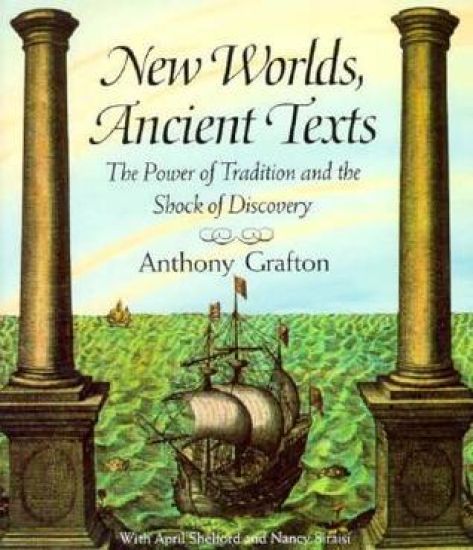
Describing an era of exploration during the Renaissance that went far beyond geographic bounds, this book shows how the evidence of the New World shook the foundations of the old, upsetting the authority of the ancient texts that had guided Europeans so far afield. What Anthony Grafton recounts is a war of ideas fought by mariners, scientists, publishers, and rulers over a period of 150 years. In colorful vignettes, published debates, and copious illustrations, we see these men and their contemporaries trying to make sense of their discoveries as they sometimes confirm, sometimes contest, and finally displace traditional notions of the world beyond Europe.
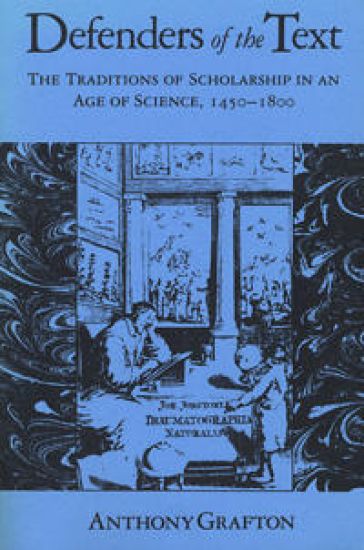
Anthony Grafton is erudite and elegant in the style of the best historical writers who make the past come alive for the reader. In a full-scale presentation of the world of scholarship, from the Renaissance to the modern period, Grafton sets before us in three-dimensional detail such seminal figures as Poliziano, Scaliger, Kepler, and Wolf. He calls attention to continuities, moments of crisis, and changes in direction.The central issue in Defenders of the Text is the relation between humanism and science from the mid-fifteenth century to the beginning of the modern period. Treatments of Renaissance humanism in English have emphasized the humanists’ commitment to rhetoric, ethics, and politics and have accused the humanists of concentrating on literary matters in preference to investigating the real world via new developments in science, philosophy, and other technical disciplines. This revisionist book demonstrates that humanism was neither a simple nor an impractical enterprise, but worked hand-in-hand with science in developing modern learning.Grafton makes clear that humanism remained an integral and vital part of European culture until the eighteenth century, maintaining a technical component of its own—classical philology—which developed in as rich, varied, and unexpected a way as any other field of European thought. Attention to the text led the humanists to develop a whole range of cools and methods that lent power to science and learning for centuries to come. Grafton shows the continued capacity of classical texts to provoke innovative work in both philology and philosophy, and traces a number of close and important connections between humanism and natural science. His book will be important to intellectual historians, students of the classics and the classical tradition, and historians of early modern science.
During the fifteenth and sixteenth centuries technical chronology, the study of calendars and of dates in ancient and medieval history, was both a fashionable and a controversial discipline. Theologians debated the dates of the Creation, the Flood, and the Crucifixion. Astronomers and historians argued about the identity of the eclipses that could supply absolute dates for events long past. Classical scholars reconstructed the religious beliefs and political practices that had governed the Greek and Roman calendars. Clerics and consultant experts, finally, debated what was to be done to mend the obviously faulty calendar of the western Church. Poliziano and Pico, Luther and Melanchthon, Copernicus and Kepler all studied and wrote about chronology. Late in the 1570s Joseph Scaliger (1540-1609) turned his attention to this field. He had already established himself as an innovative and ingenious editor of Latin texts, as the first volume of this study showed. But he now became one of the most celebrated scholars in Europe. He synthesized the work of dozens of other scholars, many of them now forgotten. He started or took part in many technical debates. And on such central problems as the date and nature of the Last Supper, the reliability of the various Old Testament texts, and the worth of the fragmentary historians of the ancient Near East, he showed remarkable erudition and insight. This book tells the stories of chronology and of Scaliger himself. It describes the scholarly circles in which he moved - above all the University of Leiden, the most innovative in Europe, where he spent the last decade and a half of his life. And it reconstructs his relations with contemporary scholars and scientists - notably Tycho Brahe and Johannes Kepler - and his remarkable, if wholly unofficial, career as a teacher. It is a sequel to volume I: Textual Criticism and Exegesis, published in 1983.
Anthony Grafton nous invite a un parcours aussi original qu'attrayant a travers l'histoire des grands faussaires et de leurs oeuvres . d'Erasme a Macpherson, de Thomas Chatterton a Giovanni Nanni, il nous fait decouvrir des individus exceptionnels qui, de la Grece antique a l'epoque moderne, ont souvent fait preuve de genie. Quelles que soient les motivations des faussaires - vanite, rivalite intellectuelle ou politique, cupidite, pur plaisir de la supercherie - leur activite, montre Anthony Grafton, est indissolublement liee a celles des critiques. Et si les faussaires sont systematiquement en avance d'une tete sur ces derniers, c'est parce qu'ils sont toujours les premiers a se poser les questions fondamentales concernant les criteres d'authentification de leurs textes, criteres qu'ils devront ensuite s'appliquer a dejouer pour parvenir a leurs fins. Enfin, en presentant les travaux de Porphyre (IIIe siecle), d'Isaac Casaubon (1559-1614) et de Richard Reitzenstein (1861-1931), Anthony Grafton nous fait comprendre les principales etapes de la methode d'investigation critique des textes historiques. Anthony Grafton est professeur a l'Universite de Princeton (E. U.).
This volume is the first half of an intellectual biography of Joseph Scaliger (1540-1609), the greatest classical scholar of his time. Anthony Grafton describes Scaliger's early work as an editor of and commentator on classical texts, setting this into the wider context of classical scholarship in the Renaissance. At the same time he interprets the major changes that Scaliger's work underwent, as responses to pressures exerted by his social situation and emotional life.