Kirjailija
Anthony Payne
Kirjat ja teokset yhdessä paikassa: 21 kirjaa, julkaisuja vuosilta 1996-2024, suosituimpien joukossa Health Benefits of Vitamin Mk7. Vertaile teosten hintoja ja tarkista saatavuus suomalaisista kirjakaupoista.
21 kirjaa
Kirjojen julkaisuhaarukka 1996-2024.
Samuel Herbert Dougal had a successful military career lasting over 20 years in the Royal Engineers, where he rose to the rank of Quartermaster-Sergeant. But he was also a forger, embezzler, thief, arsonist, serial womaniser and murderer. After leaving the army he preyed on well-off older women and one of them – Camille Cecile Holland – would become the central figure and victim of the Moat Farm Murder. In 1899, Dougal persuaded her to purchase Coldhams Farm, an isolated property at Clavering, Essex, which they renamed “The Moat Farm” and which she supposed was to be their love-nest. Instead, she disappeared shortly after they moved in, with Dougal reporting that she had gone travelling on a sudden whim. He also installed his real wife Sarah at the Moat Farm; she was his third wife and it is likely that he poisoned both the others whilst serving in Canada. He then began to systematically ransack Miss Holland’s bank account using forged cheques, as well as selling off her substantial investments with forged letters to brokers and putting the farm into his own name. The womanising continued unabated and became the stuff of local legend. Four years later, when Miss Holland’s funds were used up, Dougal tried to flee the country but was arrested at the Bank of England trying to change high value banknotes. After an unsuccessful attempt at escape on the way to the police station, he remained in custody for several months while an unsatisfactory trial for fraud dragged on before the Magistrates Bench. At last the police decided to look for a body, spending weeks to no avail dragging the moats which surrounded the farmhouse. At the very moment when the trial for fraud hung on a thread, Miss Holland was discovered in a filled-in drainage ditch with a bullet in her skull. Public hysteria was at fever-pitch and sightseers came in thousands from all over England. An inquest and trial for murder followed swiftly; Dougal was convicted and executed in July 1903\. His last word was “Guilty”.
This bibliography concerns the ten works written by or produced with the involvement of Richard Hakluyt (1552-1616) between 1580 and 1588, describing each book and its history with as much primary and secondary documentation as possible. The introduction gives a brief notice of Hakluyt's life and career, followed by an outline of the bibliography's scope and conventions. The detailed bibliography enables us to trace not only the composition and material form of these writings and their reception, but also Hakluyt's developing interests, his intellectual debts and milieu, the books and other sources available to him, and his patrons and career from his time at Oxford until the imminent publication of the original edition of the Principall Navigations, his celebrated collection of voyages and travels, in 1589. While partly an exercise in documentation, identifying sources and references as a guide to research, it goes further in attempting a study of Hakluyt's books drawing on the various approaches to bibliography, taking these into the allied field of 'the history of the book'.
This book, first published in 1984, analyses the background to the revolution in Grenada and details the course of its progress, examining the reasons why it faltered and failed. International factors played no small part in these events, setting the agenda for the internal processes of the revolution and bringing it to an end. The book also examines closely the US-led invasion of this tiny island and its aftermath.
This book, first published in 1984, presents a comprehensive survey of the forces of change that operate in the Caribbean, an area of political instability at the time. It examines the internal politics of the different countries and considers the roles of the United States, Cuba, the European and new Latin American powers in the political conflicts, coups and revolutions.
This book, first published in 1984, analyses the background to the revolution in Grenada and details the course of its progress, examining the reasons why it faltered and failed. International factors played no small part in these events, setting the agenda for the internal processes of the revolution and bringing it to an end. The book also examines closely the US-led invasion of this tiny island and its aftermath.
This book, first published in 1984, presents a comprehensive survey of the forces of change that operate in the Caribbean, an area of political instability at the time. It examines the internal politics of the different countries and considers the roles of the United States, Cuba, the European and new Latin American powers in the political conflicts, coups and revolutions.
The Long Battle for Global Governance charts the manner in which largely excluded countries, variously described as ‘ex-colonial’, ‘underdeveloped’, ‘developing’, ‘Third World’ and lately ‘emerging’, have challenged their relationship with the dominant centres of power and major institutions of global governance across each decade from the 1940s to the present. The book offers a fresh perspective on global governance by focusing in particular on the ways in which these countries have organised themselves politically, the demands they have articulated and the responses that have been offered to them through all the key periods in the history of modern global governance. It re-tells this story in a different way and, in so doing, describes and analyses the current rise to a new prominence within several key global institutions, notably the G20, of countries such as Brazil, China, India and South Africa. It sets this important political shift against the wider history of longstanding tensions in global politics and political economy between so-called ‘Northern’ and ‘Southern’ countries.Providing a comprehensive account of the key moments of change and contestation within leading international organisations and in global governance generally since the end of the Second World War, this book will be of great interest to scholars, students and policymakers interested in politics and international relations, international political economy, development and international organisations.
As we struggle with the legacy of the crisis and with the prospect of accelerating environmental degradation, it is time to ask not what we can do for capitalism but what capitalism can do for us, as citizens of a democratic society. In Civic Capitalism, Colin Hay and Anthony Payne build on their influential analysis of the crisis of the Anglo-liberal growth model to set out a coherent account of the steps required to build an alternative that is more sustainable socially, economically and environmentally.They argue that it is time to move on from the Anglo-liberal model of capitalism whose failings were so cruelly exposed by the crisis. They outline a new model that will work better in advanced capitalist societies, showing how this might be acheived in Britain today. They call this civic capitalism the governance of the market, by the state, in the name of the people, to deliver collective public goods, equity and social justice. This reverses the long ascendant logic of Anglo-liberalism in which citizens have been made to answer to the perceived logics of the capitalism they have been made to serve.The crisis shows us that we can no longer be driven by the perceived imperatives of the old model and by those who have claimed for far too long and, as it turns out, falsely to be able to discern for us the imperatives of the market. It is now time to ask what capitalism can do for us and not what we can do for capitalism.
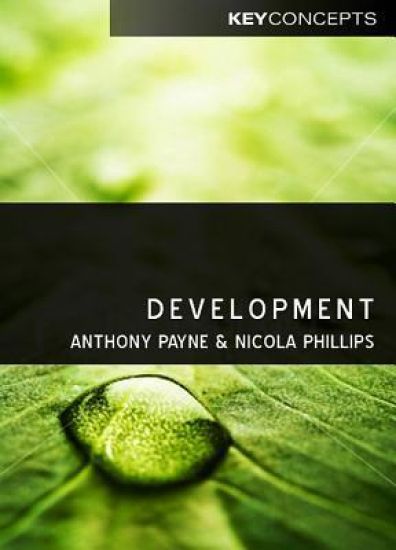
Just about everyone is 'for' development as an assumed 'good', yet few seem to have a concrete idea of what the term actually entails. Development offers a comprehensive and wide-ranging analysis of the various ways in which this important concept has been used in social and political analysis over the past 200 years.
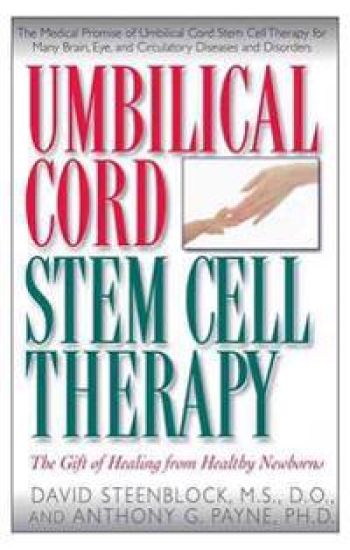
Umbilical Cord Stem Cell Therapy
Anthony Payne; Steenblock David
Basic Health Publications
2006
nidottu
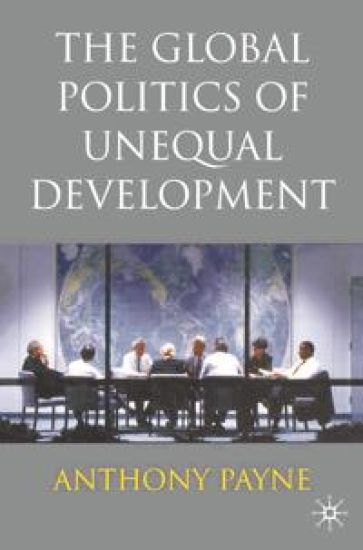
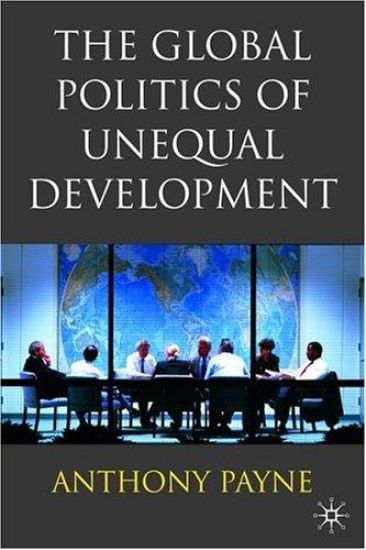
Although the phrase 'North-South' divide is not heard so much these days, what separates rich countries from poor countries is a question that is still very much with us. Anthony Payne offers a new way of thinking about these issues, grounded in the insights of global political economy and interpreting contemporary global politics as a contest between the development strategies of competing countries.
The New Regional Politics of Development assesses the various development strategies being pursued in each of the major regions of the world. While huge inequalities in wealth and capacity remain a hallmark of the twenty-first century world order, the contributors argue that hard and fast distinctions between developed and developing states are outdated and inhibit our understanding of the real relationships and dynamics at work.
Regionalism and World Order assesses the origins, significance and likely evolution of the trend towards regionalism within the world order. It analyses how states have been responding to the end of US hegemony and assesses the extent to which new regional blocs are emerging and their nature. These questions are analysed through detailed case studies of the three most advanced regions of the world economy - the Americas, the European Union, and East Asia - firstly from the standpoint of the 'core' state or states, and secondly from that of the 'peripheral' states.