Kirjojen hintavertailu. Mukana 12 595 353 kirjaa ja 12 kauppaa.

Kirjailija

Antoine Arjakovsky

Kirjat ja teokset yhdessä paikassa: 10 kirjaa, julkaisuja vuosilta 2013-2026, suosituimpien joukossa Églises orthodoxes. Vertaile teosten hintoja ja tarkista saatavuus suomalaisista kirjakaupoista.

10 kirjaa

Kirjojen julkaisuhaarukka 2013-2026.

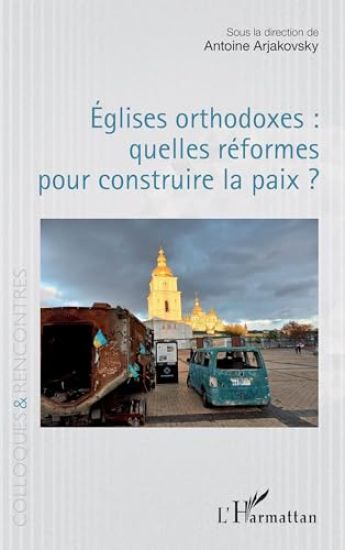
Églises orthodoxes

Églises orthodoxes

Antoine Arjakovsky

Editions L'Harmattan
2026
pokkari
Ce livre, r dig par un groupe de dix-sept experts, est un v nement. Des chr tiens orthodoxes reconnaissent publiquement que les glises orthodoxes traversent une crise profonde et se joignent des chr tiens de diff rentes confessions pour proposer des voies de gu rison. Leur constat est que la crise du monde orthodoxe concerne toute l' glise et a des cons quences g opolitiques et civilisationnelles d bordant largement le cadre eccl sial, g ographique et politique de l'Europe orientale. Aussi tablissent-ils un diagnostic pr cis des maladies qui affectent l' glise orthodoxe, r alit la fois divine et humaine, tout en indiquant des perspectives r alistes de r forme et de construction de la paix. Le dialogue oecum nique sur ce sujet des r formes au sein de l' glise orthodoxe est indispensable. Dans le pass , d'autres glises chr tiennes ont connu des crises profondes, dont elles ont pu sortir, par un travail de repentir et de r forme, gr ce au soutien d'autres glises soeurs.
Towards an Ecumenical Metaphysics, Volume 3

Towards an Ecumenical Metaphysics, Volume 3

Antoine Arjakovsky

Angelico Press
2023
pokkari
The World Council of Churches does not limit its conception of ecumenism to what unites or divides Christians. In a famous 1997 text entitled "Common Understanding and Vision," ecumenism is more broadly defined as "everything that relates to the whole task of the whole church to bring the gospel to the whole world." Moreover, further steps have since been taken toward integrating other religions and faith traditions, leading to a new discipline offering a fully realistic and fully spiritual ecumenical perspective on the world, founded on ecumenical metaphysics and epistemology. This perspective applies to all realities of this world-from the mysteries of faith and spiritual practice to questions of international relations and ecology. It does not deny the originality of the classical, modern, or post-modern paradigms as found in all spiritual collectivities past and present upon our earth. Rather, it integrates them into a deeper, more personal, more sapiential, more transdisciplinary, and more eschatological logic. From this new perspective, the ecumenical movement is no longer aimed at constructing a vast worldview in which each individual might lose conviction in their personal orientations. Instead, we seek now a "loving gaze" focused on the actual, living faith of individuals. The power of this gaze knows no bounds: may it help make visible and joyously ring in the coming of the Kingdom of God on earth.
Towards an Ecumenical Metaphysics, Volume 3

Towards an Ecumenical Metaphysics, Volume 3

Antoine Arjakovsky

Angelico Press
2023
sidottu
The World Council of Churches does not limit its conception of ecumenism to what unites or divides Christians. In a famous 1997 text entitled "Common Understanding and Vision," ecumenism is more broadly defined as "everything that relates to the whole task of the whole church to bring the gospel to the whole world." Moreover, further steps have since been taken toward integrating other religions and faith traditions, leading to a new discipline offering a fully realistic and fully spiritual ecumenical perspective on the world, founded on ecumenical metaphysics and epistemology. This perspective applies to all realities of this world-from the mysteries of faith and spiritual practice to questions of international relations and ecology. It does not deny the originality of the classical, modern, or post-modern paradigms as found in all spiritual collectivities past and present upon our earth. Rather, it integrates them into a deeper, more personal, more sapiential, more transdisciplinary, and more eschatological logic. From this new perspective, the ecumenical movement is no longer aimed at constructing a vast worldview in which each individual might lose conviction in their personal orientations. Instead, we seek now a "loving gaze" focused on the actual, living faith of individuals. The power of this gaze knows no bounds: may it help make visible and joyously ring in the coming of the Kingdom of God on earth.
Towards an Ecumenical Metaphysics, Volume 1

Towards an Ecumenical Metaphysics, Volume 1

Antoine Arjakovsky; Rowan Williams

Angelico Press
2022
pokkari
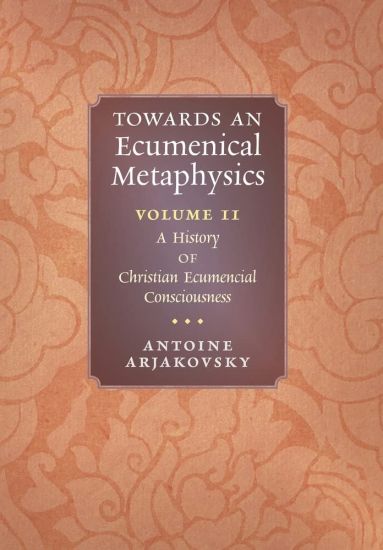
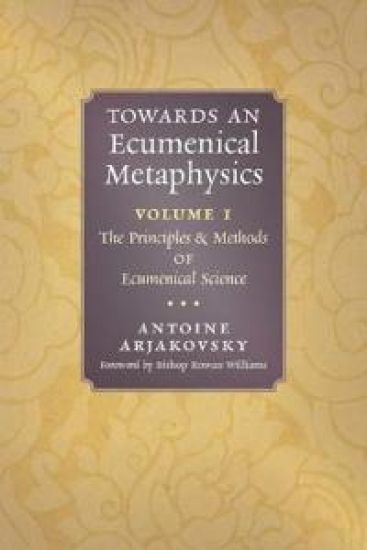
For at least a century the ecumenical movement has fostered momentum at a global level towards rapprochement among Christians of all confessions. But neither ecclesiology nor religious studies is capable of taking the full measure of its depth and originality. The first aim of this work, then, is to illustrate the imperative need that this movement-which has explicitly defined itself as "ecumenical" rather than as "universal" or "catholic"-be given objective form through a science dedicated to it, which has not previously been the case. But the purpose to be served by ecumenical science will be broader than that of the ecumenical movement as usually understood. For instance, to speak of confessional reconciliation in Ireland is also to tackle the political, economic, and social roots of division and harm. Or again, to reflect on relations between Buddhists and Christians is also to study the convergences and divergences between them on topics as different as safeguarding the environment and genetic modification. That is why this three-volume work presents metaphysics as the discipline best fitted to inquiries into the notion of ecumenical consciousness in its full breadth, which has the further effect of rehabilitating metaphysics as a true science, while redefining metaphysics itself as an ecumenical discipline. In short, since the intrinsically universal character of metaphysics is the very essence of ecumenism, the principles governing metaphysics offer us a methodology for promoting interdenominational and interreligious dialogue.
Towards an Ecumenical Metaphysics, Volume 1

Towards an Ecumenical Metaphysics, Volume 1

Antoine Arjakovsky; Rowan Williams

Angelico Press
2022
sidottu
For at least a century the ecumenical movement has fostered momentum at a global level towards rapprochement among Christians of all confessions. But neither ecclesiology nor religious studies is capable of taking the full measure of its depth and originality. The first aim of this work, then, is to illustrate the imperative need that this movement-which has explicitly defined itself as "ecumenical" rather than as "universal" or "catholic"-be given objective form through a science dedicated to it, which has not previously been the case. But the purpose to be served by ecumenical science will be broader than that of the ecumenical movement as usually understood. For instance, to speak of confessional reconciliation in Ireland is also to tackle the political, economic, and social roots of division and harm. Or again, to reflect on relations between Buddhists and Christians is also to study the convergences and divergences between them on topics as different as safeguarding the environment and genetic modification. That is why this three-volume work presents metaphysics as the discipline best fitted to inquiries into the notion of ecumenical consciousness in its full breadth, which has the further effect of rehabilitating metaphysics as a true science, while redefining metaphysics itself as an ecumenical discipline. In short, since the intrinsically universal character of metaphysics is the very essence of ecumenism, the principles governing metaphysics offer us a methodology for promoting interdenominational and interreligious dialogue.
The Way

The Way

Antoine Arjakovsky

University of Notre Dame Press
2013
nidottu
The journal Put', or The Way, was one of the major vehicles for philosophical and religious discussion among Russian émigrés in Paris from 1925 until the beginning of World War II. This Russian language journal, edited by Nicholas Berdyaev among others, has been called one of the most erudite in all Russian intellectual history; however, it remained little known in France and the USSR until the early 1990s. This is the first sustained study of the Russian émigré theologians and other intellectuals in Paris who were associated with The Way and of their writings, as published in The Way. Although there have been studies of individual members of that group, this book places the entire generation in a broad historical and intellectual context. Antoine Arjakovsky provides assessments of leading religious figures such as Berdyaev, Bulgakov, Florovsky, Nicholas and Vladimir Lossky, Mother Maria Skobtsova, and Afanasiev, and compares and contrasts their philosophical agreements and conflicts in the pages of The Way. He examines their intense commitment to freedom, their often contentious struggles to bring the Christian tradition as experienced in the Eastern Church into conversation with Christians of the West, and their distinctive contributions to Western theology and ecumenism from the perspective of their Russian Orthodox experience. He also traces the influence of these extraordinary intellectuals in present-day Russia, Western Europe, and the United States. Throughout this comprehensive study, Arjakovsky presents a wealth of arguments, from debates over "Russian exceptionalism" to the possibilities of a Christian and Orthodox version of socialist politics, the degree to which the church could allow its agenda to be shaped by both local and global political realities, and controversies about the distinctively Russian theology of Divine Wisdom, Sophia. Arjakovsky also maps out the relationships these émigré thinkers established with significant Western theologians such as Jacques Maritain, Yves-Marie Congar, Henri de Lubac, and Jean Daniélou, who provided the intellectual underpinnings of Vatican II.